Bonheur du jour Empire stamped by Antoine-Nicolas Lesage
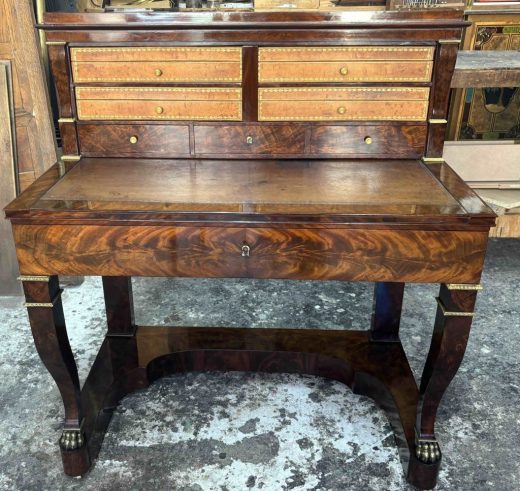
Restoration of an Empire bonheur du jour in mahogany veneer, stamped Antoine-Nicolas Lesage: top reattached, veneer missing, gilt bronzes cleaned and shellac finish redone.
Restoration. Conservation. Creation

Restoration of an Empire bonheur du jour in mahogany veneer, stamped Antoine-Nicolas Lesage: top reattached, veneer missing, gilt bronzes cleaned and shellac finish redone.
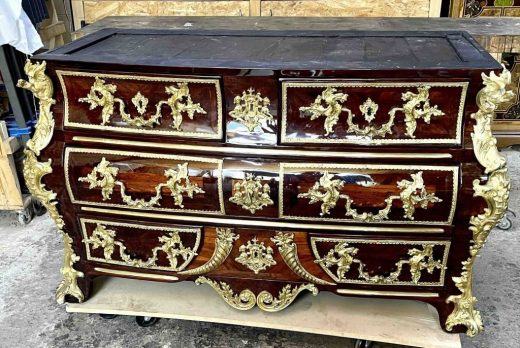
Restoration of a Regency period commode, topped with a 30 mm thick Rance marble slab, molded with a corbelled edge. Curved in plan and elevation, both on the front and sides, it is veneered with snakewood and satinwood. It has four drawers (giving the appearance of six), in three rows. Its voluminous feet evoke the clawed paws of a dragon. It is adorned with brass fluting and chased and gilded bronze mounts: chased waterleaf frames framing the drawers, thick drop handles with shell motifs, wide plates with […]
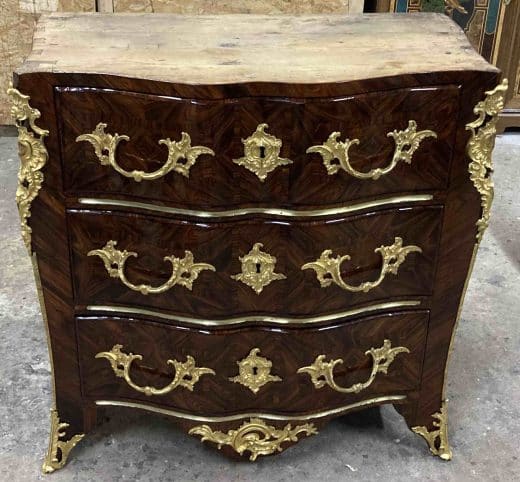
Restoration of a commode stamped Michel Mallerot. With its serpentine front, it is entirely veneered in kingwood. Its frame is made of fir. As for the drawers, their sides are beech and their bottoms are walnut. You don't know Michel Mallerot? That's understandable! Indeed, Michel Mallerot (1675-1753) remains little known, like many Parisian cabinetmakers of the early 18th century. He was identified thanks to a pencil inscription, "M. Mallerot," on a Regency commode bearing this abbreviated stamp (formerly in the Philippe Glédel collection). The […]
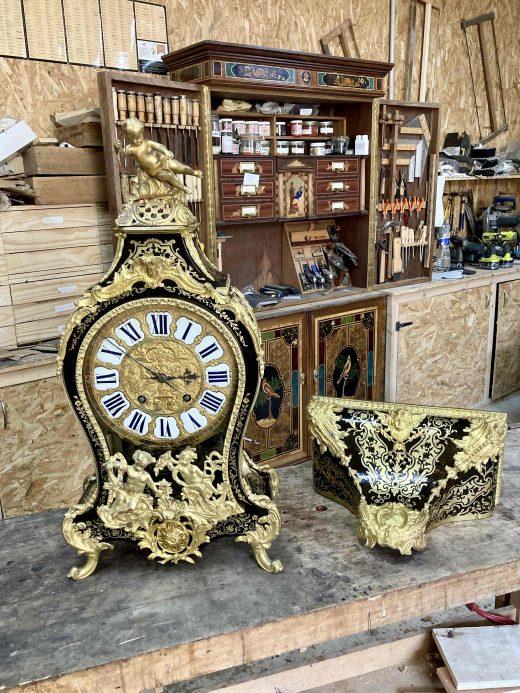
Here are some images of the restoration of a clock case that some may have glimpsed during the work at the Mans'Art fair this year. Dating from the Louis XV period, it is inlaid with tortoiseshell and brass on an oak frame. The bronze pieces bear the hallmark of the Crowned C. The Crowned C is a reference to an edict of 1745 that required bronze workers to mark their pieces with a small distinctive letter, a C surmounted by a crown, thus subjecting them to a tax. This tax applied to both objects and furniture that […]
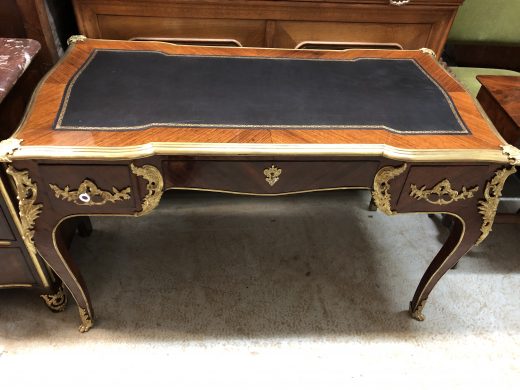
A major restoration was undertaken for this small Louis XV style desk, richly adorned with bronze mounts and veneered in rosewood. The restoration involved replacing the missing veneer while preserving as much of the remaining material as possible. This was achieved by using veneer that was sliced, scraped, sanded, oxidized, and varnished before being re-glued, thus avoiding the need to sand the piece before finishing. Rosewood is a very dark wood that lightens with age, developing a beautiful reddish patina that cannot be removed by any means.
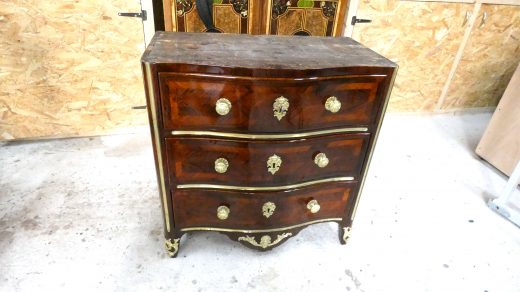
This small chest of drawers has a classic form typical of the Regency period. It still retains the rigor of the Louis XIV style: the front is curved, the front uprights are rounded, and the sides remain straight. It opens with three drawers. Its uprights and intermediate rails are decorated with brass fluting. The frame is entirely made of fir. The intermediate panels are dovetailed into the sides. The back is made of horizontal planks, nailed with rebates. The drawers are walnut, except for their wooden fronts […]
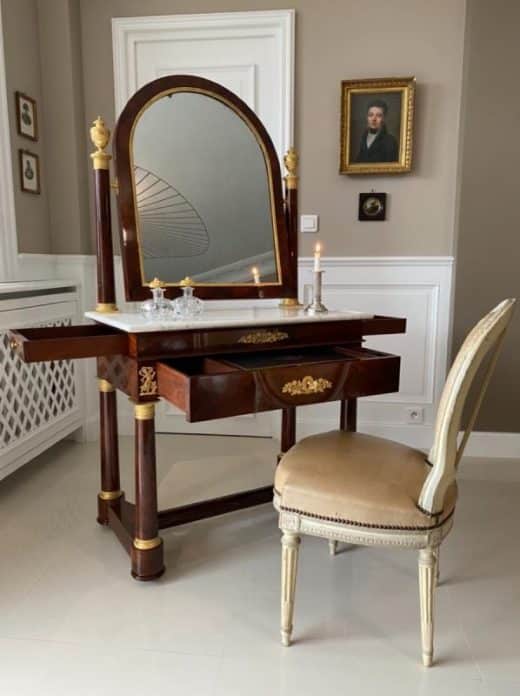
A beautiful restoration and, above all, conservation effort has been undertaken on this lovely Empire-period dressing table. Its frame is made of oak and poplar, veneered with mahogany burl. The drawer sides and bottoms are solid mahogany. It rests on four column legs ending in casters and joined by an H-shaped stretcher. The frieze opens with a central drawer, revealing a writing surface lined with blue morocco leather, a pen case, and two compartments for inkwells. Two large drawers on either side hold toiletries. […]
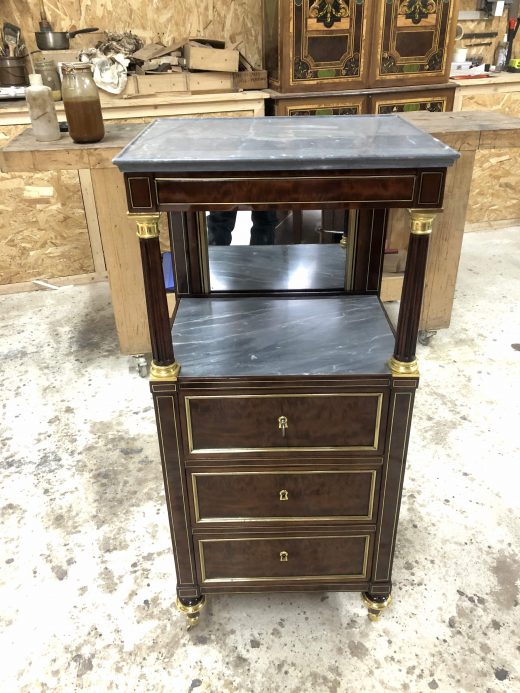
This elegant barber's cabinet in solid and veneered mahogany dates from the late 18th century. It rests on four tapered legs with casters and opens with three drawers in the front. Above, a niche with a blue Turquin marble top is framed by fluted columns. Next come two side drawers and a sliding marble top with a recessed base. Finally, this reveals a mirror that pivots on a rack and pinion mechanism, framed with ebony and brass stringing. Appearing during the reign of Louis XVI, the barber's cabinet is a piece of men's grooming furniture. Indeed, it holds the pitcher and […]
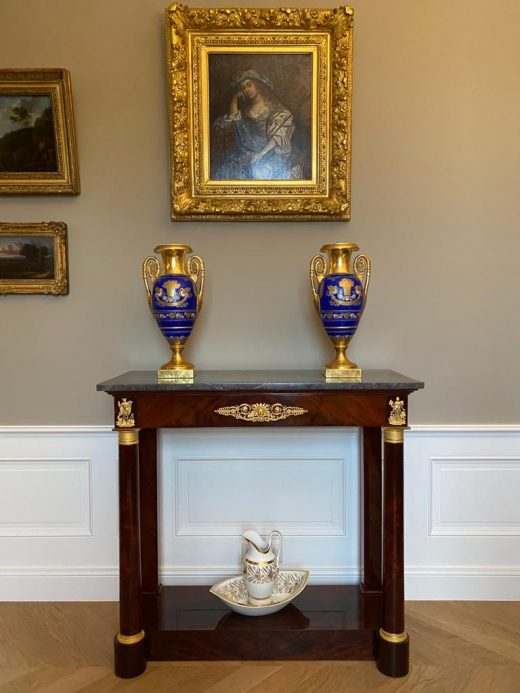
Here are some images of the restoration of this Empire-style console table. But first, a little history: do you know what a console table is and what its use was? Primarily a decorative piece of furniture, the console table was placed in the entrance hall of apartments or between two windows. The "console table," as it was called during the reign of Louis XV, was placed against the wall. Its marble top rested on two scrolled legs. During the reign of Louis XV, console tables were often elaborately crafted and adorned with highly elaborate motifs. Sculptures and reliefs, arched legs and curved fronts… Louis XV console tables […]
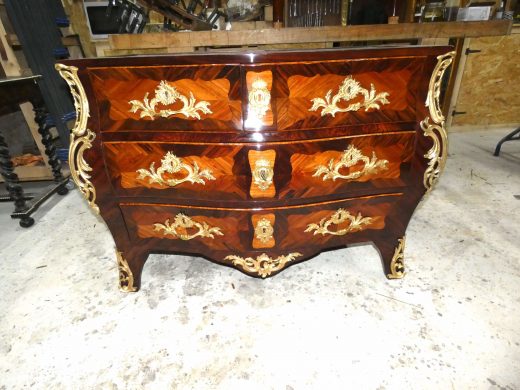
This is a significant restoration project for this Louis XV commode, originally veneered in rosewood and violet wood. It took me some time to confirm that it was indeed violet wood. This commode has undergone so many restorations that it now contains almost as much rosewood as violet wood. Fortunately, the drawers are still in fairly good condition, and they are definitely violet wood. I therefore conclude that the commode was originally veneered with these two woods. [… ]
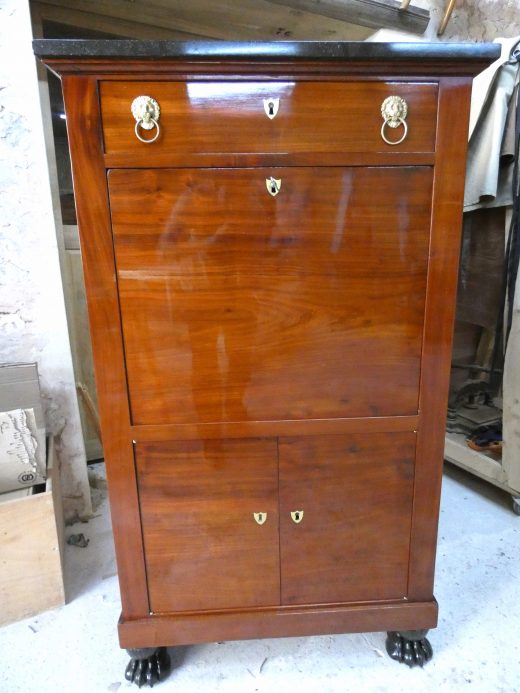
Here is a secretary desk in the most understated style of the Directoire period. Its frame is made of solid beech and conifer, and it is veneered with mahogany and mottled mahogany. It is very simply adorned with bronze handles in the form of a lion's head holding a ring in its mouth. The keyhole escutcheons are in the form of a shield. The interior has seven drawers, the middle one of which locks. The drop-front closes with a period three-point lock. The lower section has three drawers, onto which Louis XV style pull rings have been added.
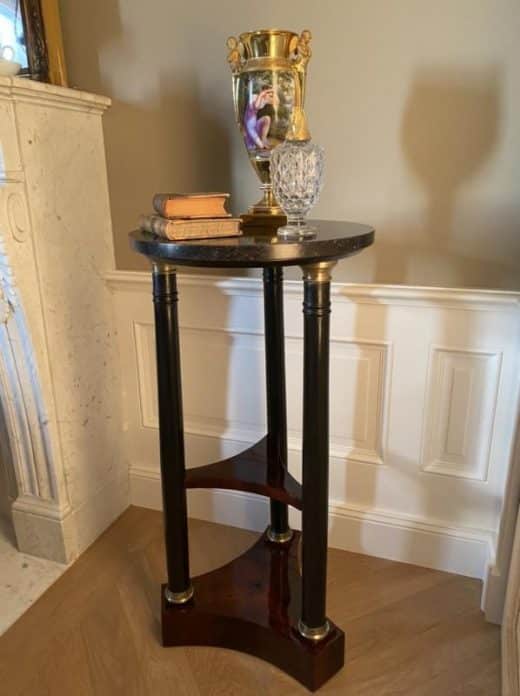
Restoration of a side table with walnut legs and frame, veneered in flame mahogany. It rests on three slender columns, adorned with bronze rings and surmounted by a circular top of veined black marble. The restoration consisted of tightening the cracked base, re-gluing the edge veneers, and applying some grafts. I stripped the columns, which were heavily infested with wood-boring insects, and then treated them with static anoxia. Static anoxia is an insecticidal treatment that works by depriving the wood of oxygen and also has an effect on […]
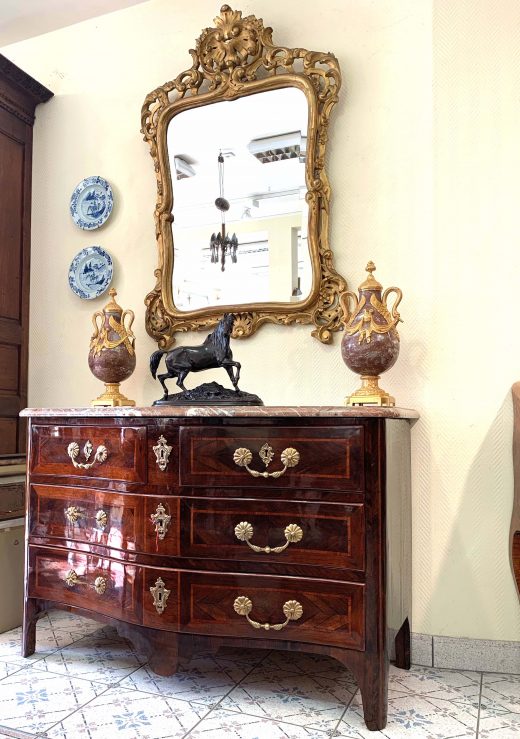
Restoration of a chest of drawers veneered in Rio rosewood, with satinwood stringing. It opens with two large drawers and, in the upper section, two smaller ones. Its frame is made of oak and fir. It also bears the stamp J.BIRCKLE and the JME hallmark on the left upright. Finally, there are some traces of restoration and an ink mark on one side of a drawer. Jacques Bircklé (1734-1803) – Cabinetmaker – master craftsman obtained on July 30, 1764. One of the suppliers to the Royal Furniture Repository under Louis XVI. Free craftsman […]
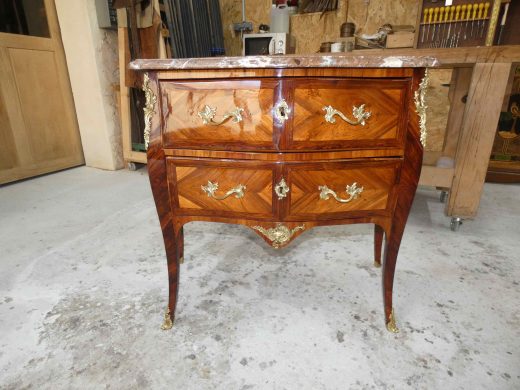
The commode with a jumping top appears to have been invented during the Regency period, between 1705 and 1730, by the cabinetmaker Charles Cressent. It then became widespread under Louis XV. It has only two drawers, or two rows of drawers. Its body is raised on cabriole legs of medium height: the body occupies half the height of the piece, the legs the other half. The observer thus has the impression that the piece has legs allowing it to jump like a frog. The width offers straight, curved, or crossbow-shaped forms. The marble top follows the […]
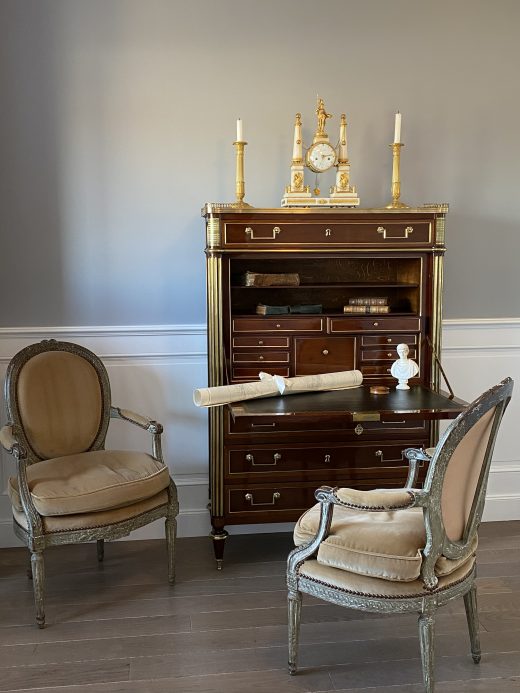
Restoration of a drop-front secretary desk with an oak frame, veneered in mottled mahogany and Santo Domingo mahogany. It likely dates from the late 18th century. Its white Carrara marble top is surrounded by a partially openwork brass gallery. It opens with a drawer at the top, a drop-front in the middle, and three drawers at the bottom. All the original locks are secured with a cloverleaf key. Furthermore, brass quarter-round moldings frame all the panels, both on the front and sides. The drop-front is veneered in mottled mahogany […]
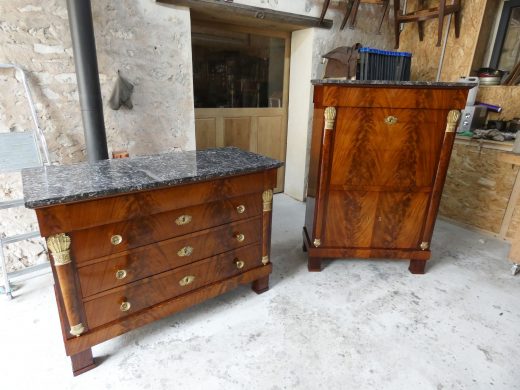
Do you remember the Empire chest of drawers with the quivers? Well, here is the secretary desk with the quivers. It is built in exactly the same way as the chest: same construction, same solid woods used, and same mahogany veneers. The restoration is identical to that of the chest of drawers. The goal: to preserve as much as possible and restore the piece to its function without altering its history. So I re-glued the structure and the few detached veneers, then added some mahogany burl grafts. Finally, the hinges of the drop-front had to be reinforced […]
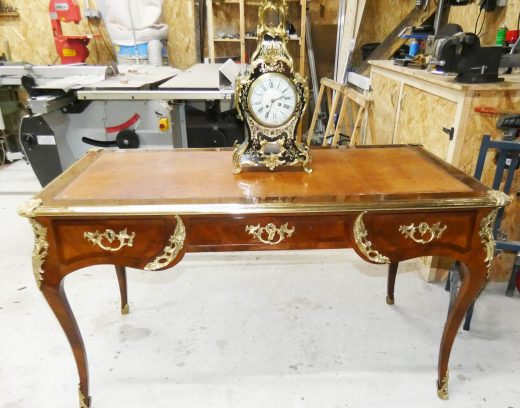
The restorer's trade holds many surprises. There are over 60,000 species of trees in the world. Suffice it to say that even though the same types of wood are often found in French furniture, sometimes you stumble upon something unfamiliar. I found this wood odd. Violet wood? No. Rosewood? Perhaps, but a variety I don't recognize. Okay, I'll strip a section to see the wood's true color. Hey, the varnish was very red: this veneer is made of […]
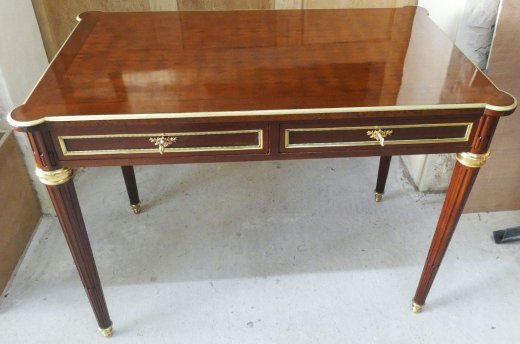
This desk is exquisitely crafted, with its oak frame veneered in mahogany and its solid mahogany legs. It is, in fact, a perfect example of high-quality 19th-century furniture. Indeed, the cabinetmaking is flawlessly executed, and the bronze mounts are in perfect condition. In short, everything is there; nothing is missing. The Krieger firm began its cabinetmaking business in the mid-19th century with Antoine Krieger (1804-1869). It then added a significant decorative department, which ensured its prestige until around 1945. Thus, it produced all […]
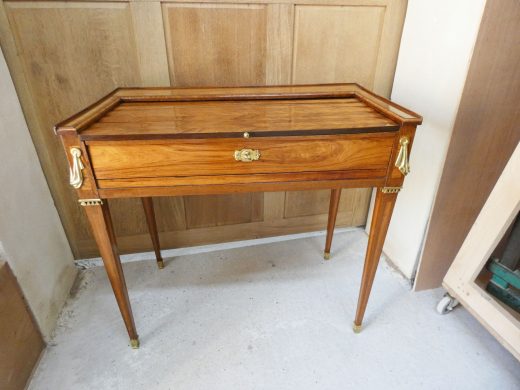
Restoration and conservation work on this rare Louis XVI period roll-top desk stamped by Jean-Chrysostôme Stumpff (1731 – January 17, 1806), who became a master craftsman on August 27, 1766. Originally from Schweigern, Swabia (Germany), he married in 1760 in Paris, at the Swedish embassy, like most of his compatriots of the Reformed faith. His witness was his fellow cabinetmaker Ferdinand Schwerdfeger. In his workshop on Rue Saint-Nicolas, he produced some Louis XV furniture, but primarily a large number of Transition and Louis XVI pieces. Stumpff's production […]
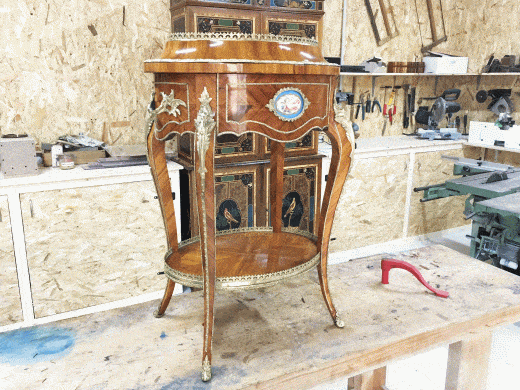
This week, two pieces of furniture left the workshop: a Napoleon III jardinière in rosewood veneer and a Louis XVI chiffonier in rosewood and violet wood veneer. If this piece had seven drawers, it would have been called a "semainier" (weekly chest of drawers). Here are some photos of their restoration.