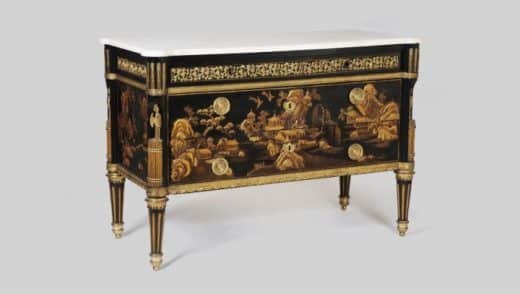
Louis XVI secretary stamped Schlichtig

Ebénisterie Mathieu Vath

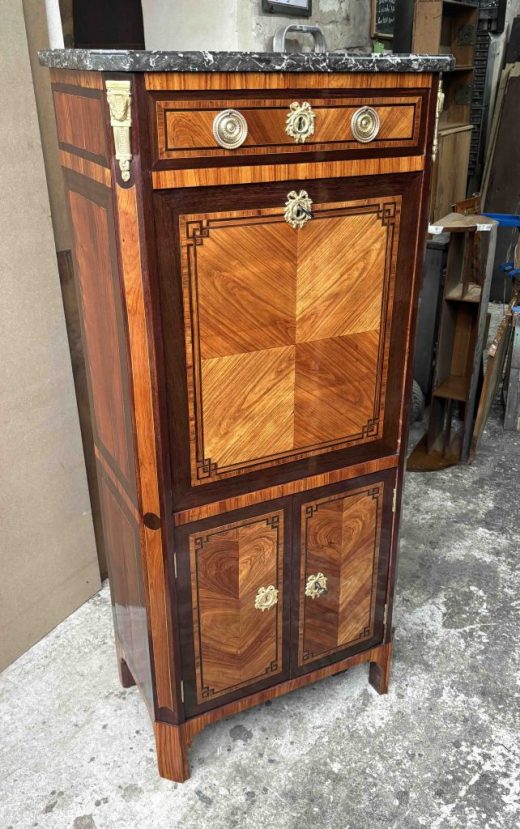
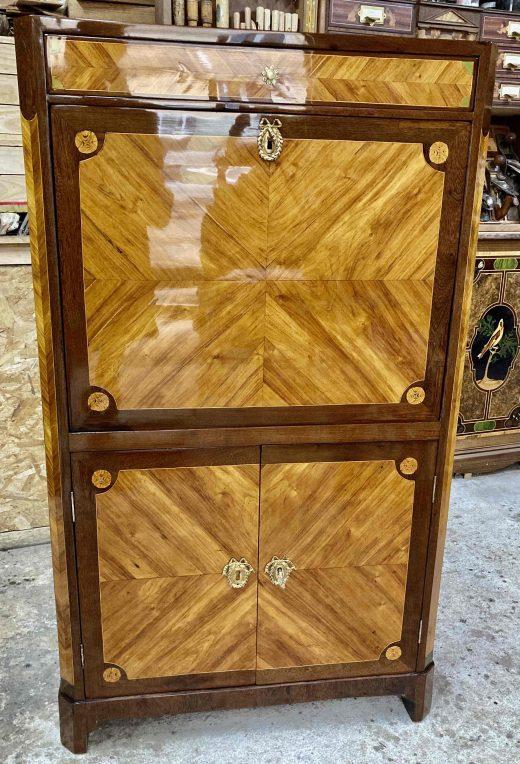
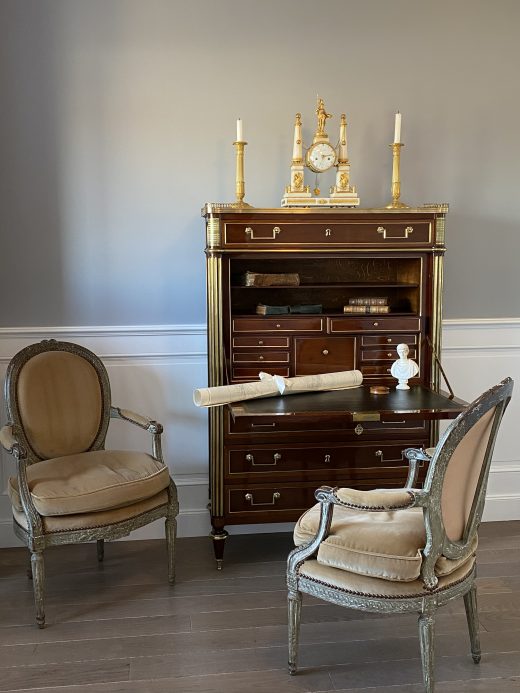
This Louis XVI style secretary desk bears the stamp of JG Schlichtig. It combines rosewood, satinwood (on the sides), and amaranth veneers on an oak and softwood frame. It opens with two lower doors, a central drop-front, and a top drawer. The interior includes six drawers and three niches. At 1.20 meters long, it is a lady's secretary desk. Jean-Georges Schlichtig († February 1782) was a Parisian cabinetmaker of German origin, admitted as a master on October 2, 1765. He initially established himself […]
Louis XVI psyche mirror Weisweiler

Ebénisterie Mathieu Vath

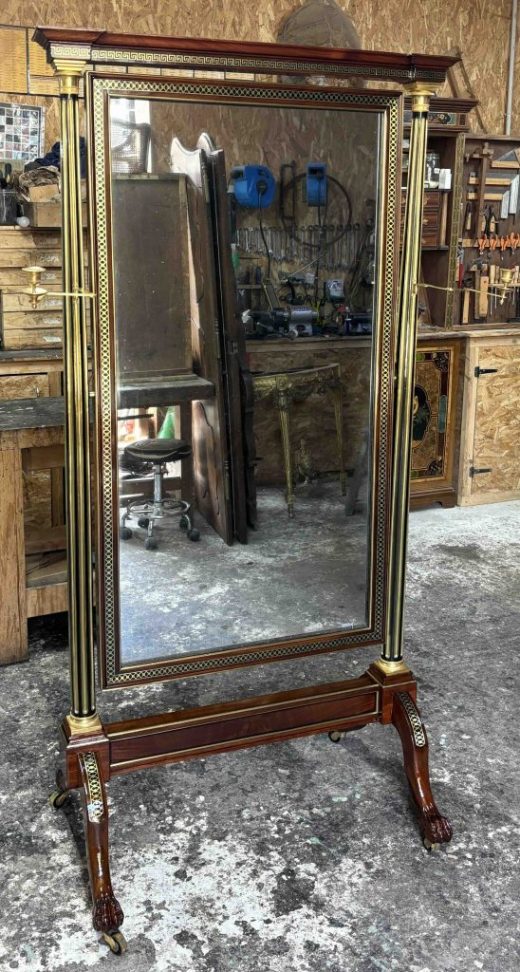
Restoration of a Louis XVI/Directoire period cheval glass stamped by Adam Weisweiler. This piece of furniture represents one of the innovations in late 18th-century furniture design. Far more than a simple dressing table accessory, it represents a significant evolution in the design of furniture intended for private use. Its appearance coincided with changing lifestyles, the development of new domestic spaces, and evolving practices related to self-presentation. For both the furniture historian and the restorer, the cheval glass is a particularly interesting object. It bears witness to both […]

Louis XVI commode stamped JL Cosson

Ebénisterie Mathieu Vath

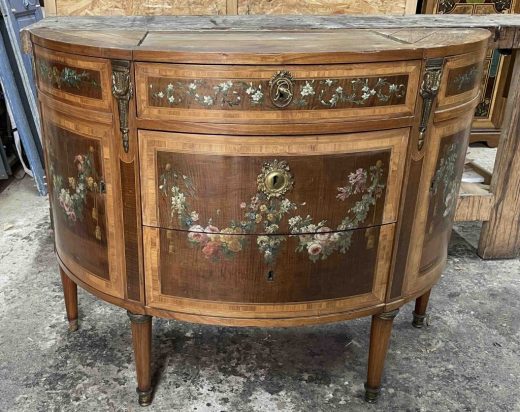
This Louis XVI period half-moon commode is stamped by the cabinetmaker Jacques Laurent Cosson. It belongs to a production probably dating from 1780 to 1790. It is an exceptional example of painted furniture from the end of the Ancien Régime. It belongs to a very small group, of which only seven examples are currently known. Highly sought-after 18th-century French painted furniture represents one of the most inventive areas of Parisian cabinetmaking on the eve of the Revolution. This commode, with its curved, half-moon shape, rests on four tapered legs […]

Louis XVI chest of drawers by Jean-Francois Leleu

Ebénisterie Mathieu Vath

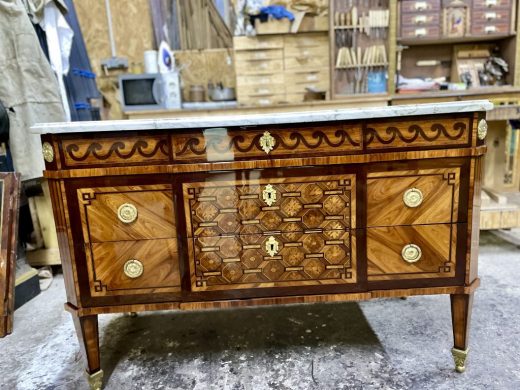
Restoration of a Louis XVI period commode with a central projection, stamped JF LELEU. Entirely constructed of oak, it is veneered with amaranth, rosewood, boxwood, stained maple burl, and tobacco-grey maple. A frieze of posts adorns the top drawer. On the projection, Greek key patterns and fleurons are set within a mosaic of hexagons, known as "marquetry à la reine." It has three drawers, two of which conceal drawers with crossbars. Furthermore, its front uprights have canted corners and simulated fluting. Finally, its feet are made of […]

Louis XVI powder compact stamped Jacob

Ebénisterie Mathieu Vath

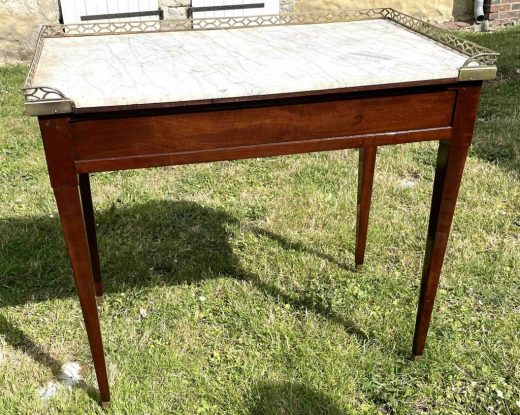
Restoration of a powder table, or dressing table, from the last quarter of the 18th century, stamped G.JACOB and JME. It opens with two drawers in the frieze. On the top, a white Carrara marble slab is surrounded by an openwork brass gallery. It rests on four tapered legs of solid mahogany, ending in casters. Finally, the solid oak stretchers are veneered with mahogany. Georges Jacob (1739-1814) Georges Jacob was born on July 6, 1739, in Cheny, Yonne, into a family of farmers. At a very young age, he left for Paris. There he […]

Louis XVI secretary stamped Ohneberg

Ebénisterie Mathieu Vath

This Louis XVI period secretary bears the stamp of Martin Ohneberg. A masterpiece of sobriety and refinement, it combines a solid wood frame with rosewood and a sumptuous satinwood veneer. Its sinuous, golden veins lend brilliance and depth. Furthermore, the ornamentation remains understated yet exquisite. Indeed, delicately floral, chased bronze frames accentuate the clean lines of the piece, typical of the Neoclassical style. Martin Ohneberg, of German origin, was active in Paris during the last decades of the […]

Louis XVI Weekly Planner

Ebénisterie Mathieu Vath

Restoration of a Louis XVI chest of drawers veneered in rosewood, satinwood, and amaranth. It opens with a series of seven drawers framed by rounded uprights with simulated fluting made of boxwood and blackened pearwood. A chest of drawers? The chest of drawers appeared in the mid-18th century. It was primarily intended for women. It is a chiffonier (which appeared during the Regency period, between 1715 and 1723) with seven drawers, one for each day of the week, for storing the day's undergarments. The restoration: This piece of furniture showed little […]

Louis XVI commode stamped J. LAPIE

Ebénisterie Mathieu Vath

Lise restored this Louis XVI commode, stamped by Jean Lapie, during her internship at the workshop. The piece is constructed of oak, fir, and beech, veneered with rosewood with hornbeam and amaranth stringing, and adorned with gilt bronze mounts. And since Lise submitted an excellent internship report, I'm publishing it almost in its entirety. Jean Lapie (known as "The Younger"), son of the potter Nicolas Lapie, was born around 1734. Brother of the cabinetmaker Nicolas-Alexandre Lapie (known as "The Elder") and cousin of Jean-François Lapie, […]

VASSOU stamped chest of drawers

Ebénisterie Mathieu Vath

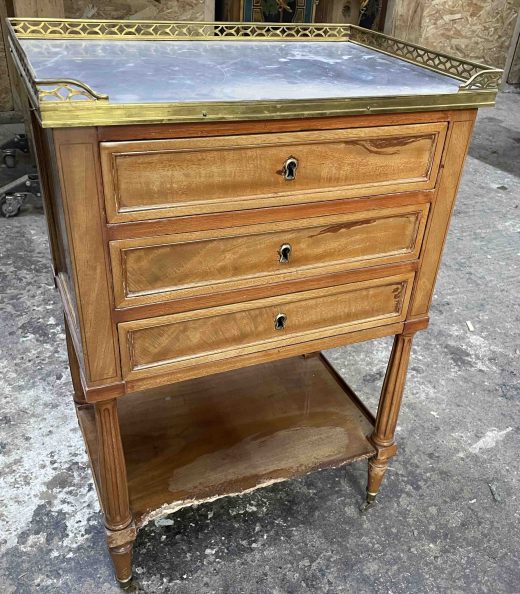
Restoration of a Louis XVI period chiffonier table, stamped by Jean-Baptiste VASSOU (1739-1807). It is made of solid mahogany and mahogany veneer, on oak and softwood frames. It is, moreover, a very finely crafted piece of furniture, with beautiful veneer and a lovely blue Turquin marble top. What exactly is a chiffonier table? The first mention of a "chiffonniere table" appears in 1755 in the journal of the haberdasher Lazare Duvaux (1703-1758). In 1763, the post-mortem inventory of Jean-François Oeben mentions a "frame of a chiffonier table […]

Small chest of drawers from La Rochelle

Ebénisterie Mathieu Vath

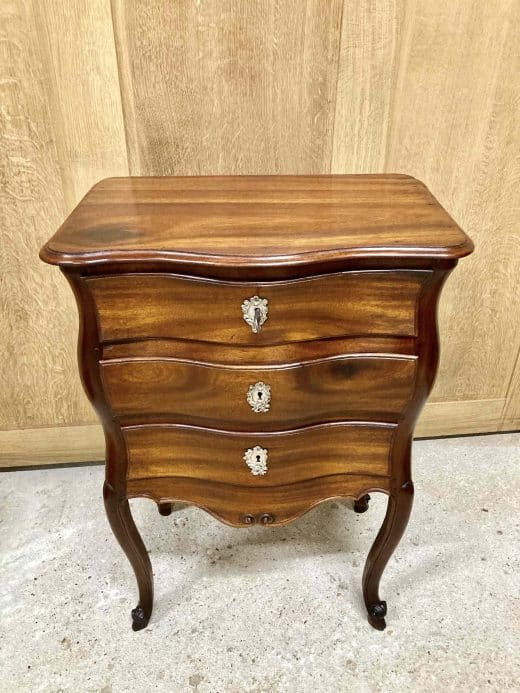
Here is the restoration of a small Louis XV commode, made of solid satinwood and ribboned satinwood. Curved on all sides, including the back, it opens with three drawers. In addition, a pull-out candle holder opens at the back. It comes from La Rochelle and dates from the 18th century. Its top, molded with a corbel-shaped edge highlighted by a cavetto molding, is made of ribboned satinwood. This wood is also used on the front and sides. In contrast, the base is made of straight-grain satinwood, with "snail" feet ending in split goat's hoof feet. [… ]

Louis XVI writing table

Ebénisterie Mathieu Vath

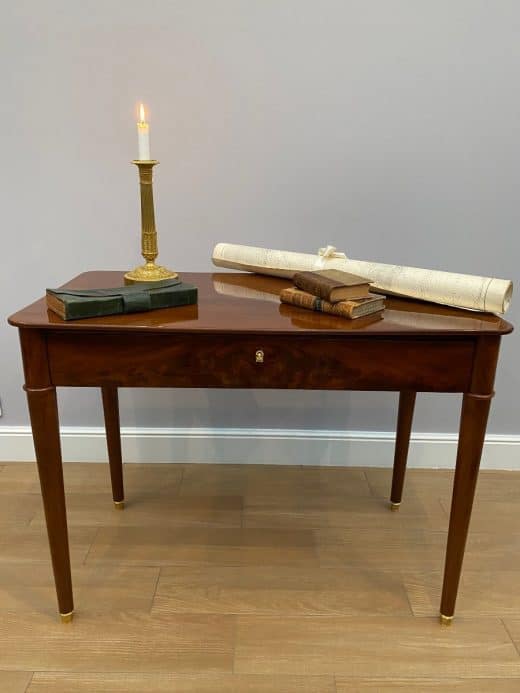
Restoration of a writing table built in oak, with a solid mahogany top and mahogany burl veneer. It features a large drawer in the frieze and rests on four tapered legs ending in gilt bronze sabots. Typical work of the late 18th century. To see previous restorations: https://ebenisterie-mathieuvath.fr/en-ce-moment-a-latelier/ This piece can be found at Antiquités Stéphane Guin.

Louis XVI secretary stamped Montigny

Ebénisterie Mathieu Vath

A little restoration for this Louis XV period secretary desk stamped by Philippe-Claude Montigny. It is constructed of oak and softwood, and veneered with rosewood, amaranth, and boxwood. It consists of a top drawer, a drop-front, and two doors. The interior compartments contain six drawers. Philippe Claude Montigny (1734-1800) became a master craftsman on January 29, 1766. Son of Louis Montigny, a privileged craftsman of the King, he owned a workshop in the Contrescarpe district of Paris. He was also the brother-in-law of Fidelis Schey, a cabinetmaker […]

Louis XVI commode stamped JB.Tuart

Ebénisterie Mathieu Vath

Here is a very pretty Louis XVI period commode, veneered in rosewood and amaranth, with marquetry of boxwood, pearwood, maple, hornbeam, walnut, blackened pearwood, lemonwood… It is built of oak and softwood. It is stamped twice with the mark of Jean-Baptiste II TUART. But its maker is probably Jean LAPIE. Jean-Baptiste II Tuart came from a dynasty of Parisian cabinetmakers and merchants. His father, Jean-Baptiste I, obtained his master craftsman's certificate in 1741 and remained active until around 1760. Born around 1720, Jean-Baptiste II was not a master cabinetmaker, but a master woodworker […]

Louis XVI planter

Ebénisterie Mathieu Vath

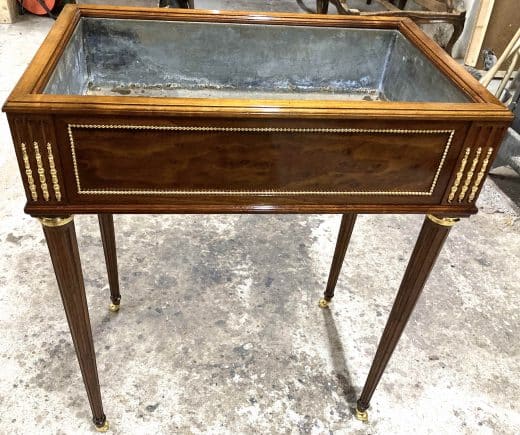
A little restoration for this Louis XVI jardinière in mottled mahogany veneer and solid mahogany for the feet. Simply regluing the joints, which had become slightly loose, restoring the varnish yellowed with age using a French polish, and re-gilding the bronze mounts were enough to give it a new lease on life. To see previous restorations: https://ebenisterie-mathieuvath.fr/en-ce-moment-a-latelier/

Louis XVI Molitor Console

Ebénisterie Mathieu Vath

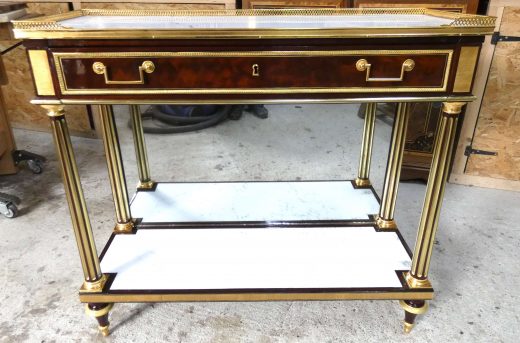
Restoration of a Louis XVI console table (1790-1795) stamped by Bernard Molitor. The frame is oak, and the legs are solid mahogany. The panels of the lower shelf are beech. It is veneered with mahogany burl and ebony and brass stringing. Originally from Luxembourg, Bernard Molitor (1755 – November 17, 1833) obtained his master craftsman's certificate in Paris on October 26, 1787. Arriving in Paris in 1776, he initially worked in a small workshop in the Arsenal district. After completing his master's degree, he established himself on the rue de Bourbon-Saint-Germain. The austerity of his work, […]

Barber shop Louis XVI/Directory

Ebénisterie Mathieu Vath

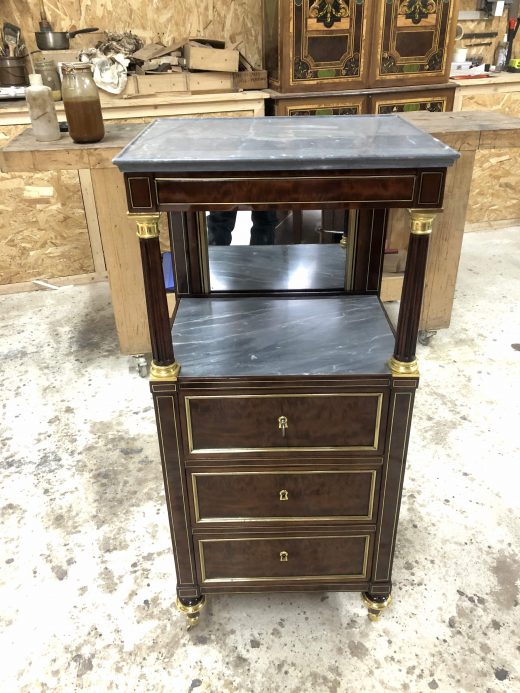
This elegant barber's cabinet in solid and veneered mahogany dates from the late 18th century. It rests on four tapered legs with casters and opens with three drawers in the front. Above, a niche with a blue Turquin marble top is framed by fluted columns. Next come two side drawers and a sliding marble top with a recessed base. Finally, this reveals a mirror that pivots on a rack and pinion mechanism, framed with ebony and brass stringing. Appearing during the reign of Louis XVI, the barber's cabinet is a piece of men's grooming furniture. Indeed, it holds the pitcher and […]

Louis XVI commode

Ebénisterie Mathieu Vath

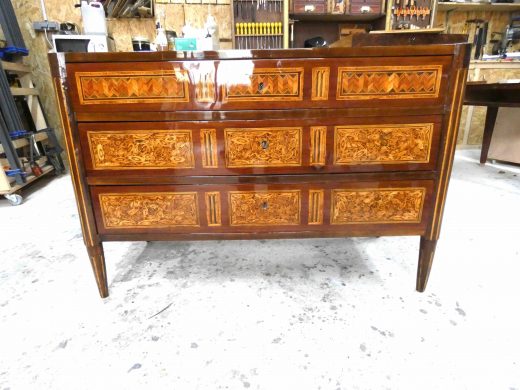
Restoration of a Louis XVI period commode from eastern France. It is made of solid oak and fir, veneered with end-grain laburnum, walnut, plum, amaranth, rosewood, palisander, boxwood, and green-stained hornbeam. The handles and keyhole escutcheons were added later. Indeed, the original fittings have disappeared: only the handle holes remain. This is a piece of furniture that has never been restored. Moreover, the veneer is almost 4 mm thick in places. Furthermore, one can see […]

Louis XVI/Directory Secretary

Antiquités Guin

Restoration of a drop-front secretary desk with an oak frame, veneered in mottled mahogany and Santo Domingo mahogany. It likely dates from the late 18th century. Its white Carrara marble top is surrounded by a partially openwork brass gallery. It opens with a drawer at the top, a drop-front in the middle, and three drawers at the bottom. All the original locks are secured with a cloverleaf key. Furthermore, brass quarter-round moldings frame all the panels, both on the front and sides. The drop-front is veneered in mottled mahogany […]

Louis XVI half-moon table

Ebénisterie Mathieu VATH

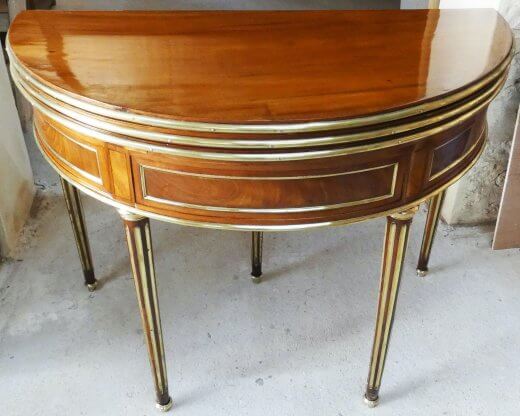
Here is a three-tiered half-moon table. This style of table, originating in England, is a classic of the Louis XVI style. It opens to reveal two circular tiers, one lined with felt, the other veneered in mahogany. Its apron, veneered in mahogany burl, is adorned with brass frames. It rests on five tapered legs, fluted and trimmed in brass, ending in sabots. The fifth leg is attached to a drawer: it is pulled out to support the drop leaf when unfolded. A very attractive piece, probably dating from the late 18th century. […]

N. PETIT Roll-Top Desk

Ebénisterie Mathieu VATH

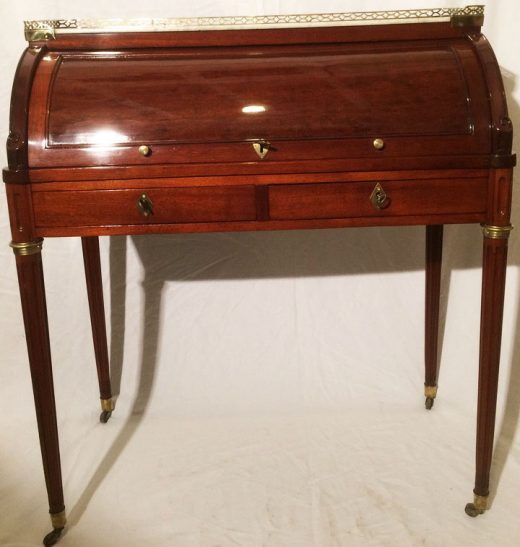
DIMENSIONS: H.71 W.104 D.52 This roll-top desk perfectly matches those produced by Nicolas Petit's workshop between 1770 and 1791, the year of his death. Indeed, with a few exceptions, Nicolas Petit primarily crafted this type of furniture in molded mahogany, on fluted legs and with white marble tops. Their understated elegance reflected the taste of the period. It features two drawers in the frieze, two pull-out side shelves, and a central shelf that locks when the drop-top is closed. Furthermore, the interior contains two drawers, the one on the right […]

Louis XVI style table

Ebénisterie Mathieu VATH

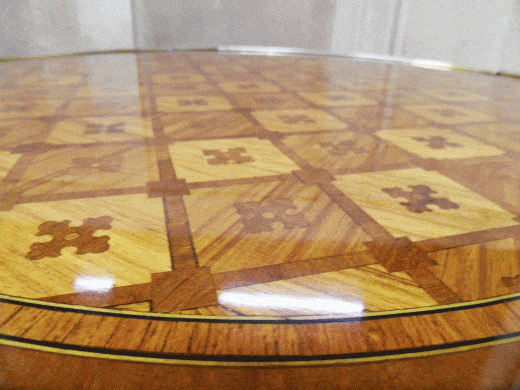
Here is a Louis XVI style table, which is probably an early 20th-century piece. It was likely made in the Faubourg Saint-Antoine, or perhaps at the École Boulle. I have seen apprentice furniture of this quality made by students during their training. Its frame is oak, while the veneer is rosewood and mahogany with a black inlay. The restoration was straightforward, apart from a lack of rosewood in the marquetry […]

The chest of drawers of ingratitude

Ebénisterie Mathieu VATH

Cette année, pour la deuxième année consécutive, les Journées du patrimoine permettaient de visiter une partie des réserves et les ateliers de restauration du mobilier national. Ainsi, l’édition 2019 exposait la commode de « l’ingratitude ». Cette commode a d’ailleurs une histoire bien particulière. La Couronne la commande, et elle est livrée le 13 juillet 1789, veille de la prise de la Bastille. Son créateur est l’ébéniste Pierre-François Guignard, reçu maître le 21 janvier 1767. Or, payé par le Garde-Meuble le 13 juillet, il prend dès le lendemain une part […]