Boulle Dubois Cartel

Restoration of a Louis XV period brown tortoiseshell Boulle Dubois cartel clock, the dial of which bears an engraving with the monogram of Louis XV.
Restoration. Conservation. Creation

Restoration of a Louis XV period brown tortoiseshell Boulle Dubois cartel clock, the dial of which bears an engraving with the monogram of Louis XV.

This is the first cartel clock restoration undertaken by Raphael, focusing on this Louis XV cartel clock in Boulle marquetry of brown tortoiseshell and brass. Restoring a cartel clock is a complex task requiring considerable time and meticulous attention to detail. The curved shapes make gluing delicate. Large sections of the brass elements generally need to be reattached. Condition report: This cartel clock presented widespread soiling, an oxidized and tarnished varnish, as well as several lifting and missing pieces in the brass and tortoiseshell marquetry. In addition, there were signs of detachment […]

The restoration of five Boulle marquetry clocks, begun a few months ago, is now complete. Here is a Regency clock and its console, inlaid with tortoiseshell and brass on an oak frame. Measuring Time: Since time immemorial, humankind has sought to measure time. First came the gnomon, a simple stick planted in the ground, the ancestor of the sundial. Then came the clepsydra, where water flows, and later the hourglass, based on the same principle. Through these methods, people organized their social, religious, and […]
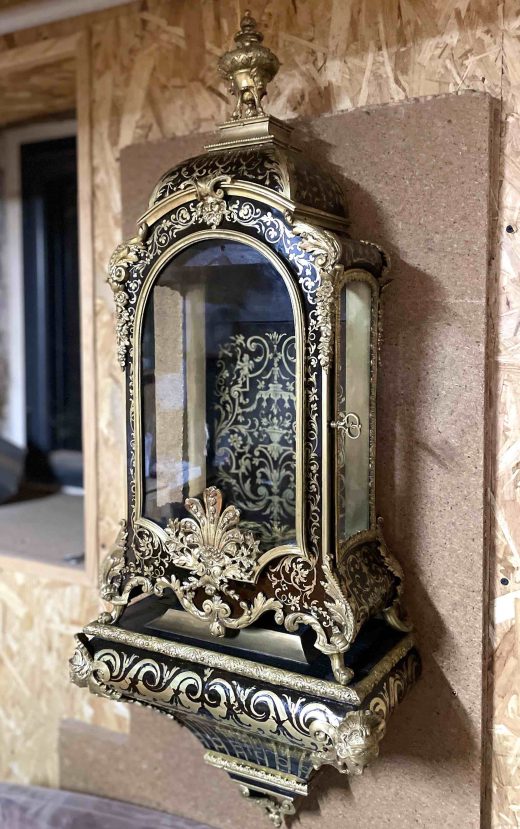
Restoration of a Regency clock case in Boulle marquetry on a brown tortoiseshell background. Since Antiquity, humankind has sought to master time and create a "timekeeper." Egyptian obelisks, water clocks, sundials, hourglasses. But it was in the 15th century that the first mechanical weight-driven clocks were made, with a single hand, but generally equipped with striking mechanisms. In the 16th century, the two-hour day, instead of 24, was adopted almost everywhere. Each city, however, retained its own meridian time until the advent of railways and […]
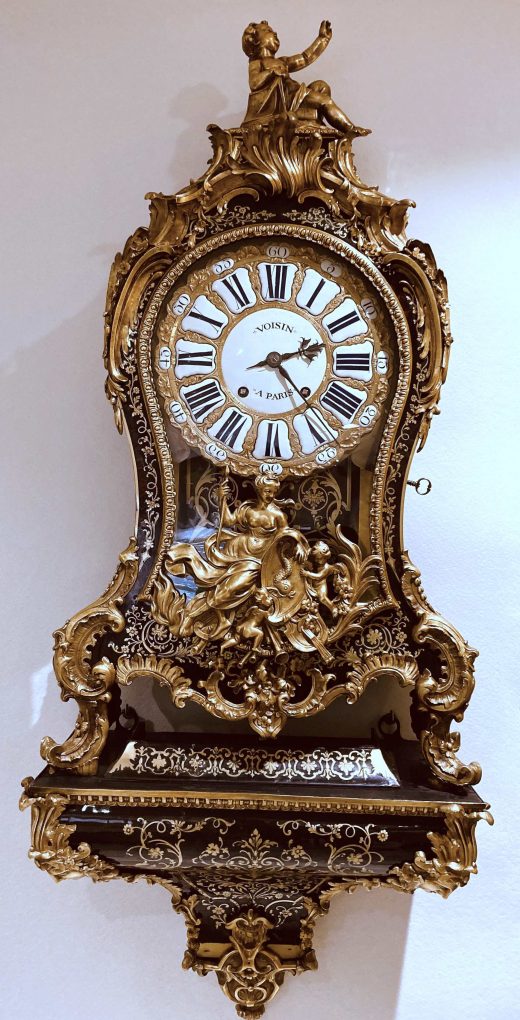
Restoration of a Louis XV cartel clock in tortoiseshell and brass marquetry. Its movement is signed Charles Voisin (1686-1760), master clockmaker in 1710. A distinctive feature of this clock is that its bronze mounts bear the mark of a crowned C. The crowned C: An edict of 1745 required bronze workers to mark their pieces with a small, distinctive letter: a C surmounted by a crown. They were thus required to pay a tax. This tax applied to both objects and furniture adorned with bronze. This mark therefore proves the payment of a tax on bronzes and […]
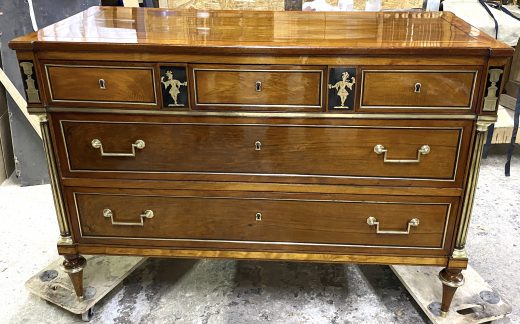
Restoration of a curious Directoire commode in solid walnut and walnut, mahogany, and maple veneer, featuring marquetry of a Medici vase and a Louis XIV-inspired ballet dancer, in brass on an ebony ground. The drawers have walnut bottoms with an ebony stringing surmounted by a quarter-round brass and wood molding, surrounded by a mahogany molding. The uprights are three-quarter-fluted columns terminating in toupie feet. The locks are in the shape of trefoils. A conservation project for this […]
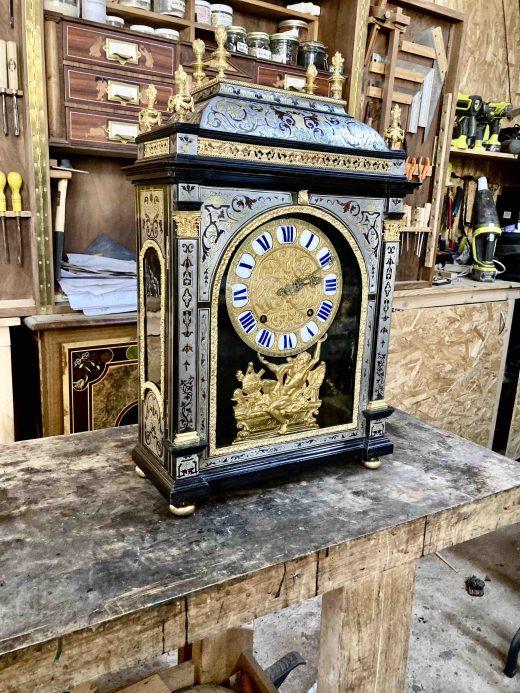
Restoration of a "religious" clock from the third quarter of the 17th century, which chimes on the hours and half-hours. The dial and movement are signed "Sarrabat à Paris." Religious clocks were among the first clocks produced during the reign of the Sun King. Indeed, their use developed from 1660 onwards, thanks to the regulator pendulum developed by Huygens. This particular clock features Boulle marquetry of red tortoiseshell, brass, and pewter, set on a walnut frame. It is further adorned with gilt bronze mounts and ebony moldings. Thus, […]
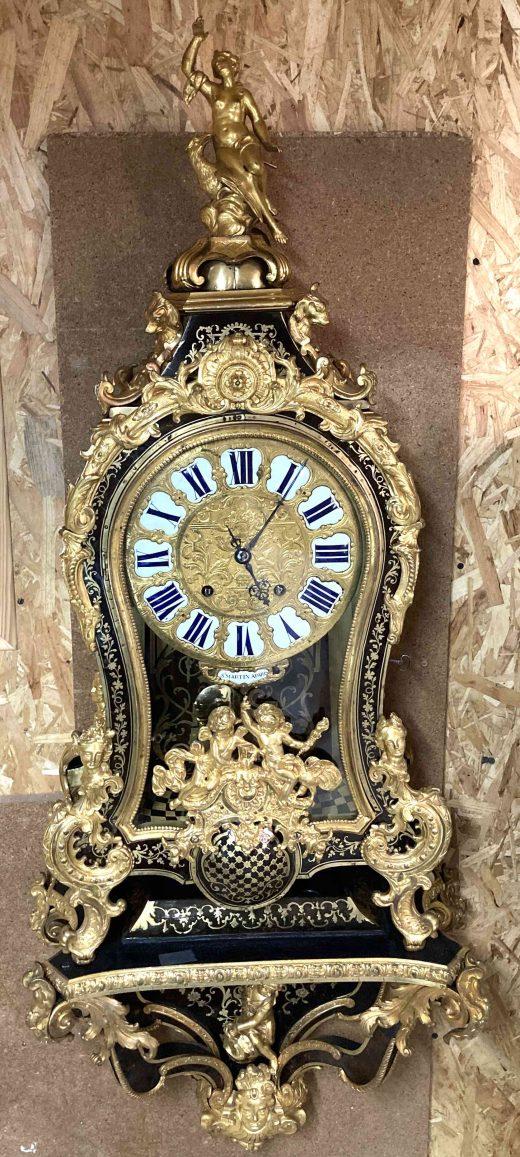
Restoration of a large cartel clock (137 cm high) and its bracketed base, from the Regency period. Made of solid oak, it is veneered with Boulle marquetry of brown tortoiseshell and brass. It is further adorned with floral garlands, crosshatching, and foliage. Its chased and gilded bronze dial features interlacing patterns and birds. The Roman numerals are enameled, and a reserve bears the signature St Martin à Paris. The clock plate also bears the same name. Finally, on the capital, chased and gilded bronzes depict […]
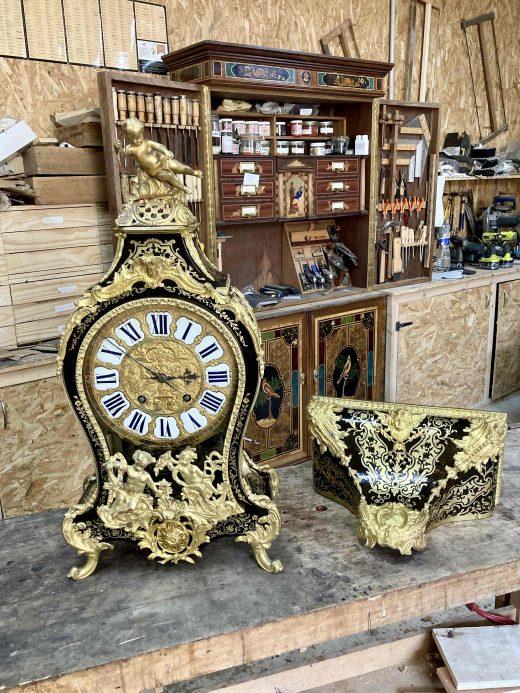
Here are some images of the restoration of a clock case that some may have glimpsed during the work at the Mans'Art fair this year. Dating from the Louis XV period, it is inlaid with tortoiseshell and brass on an oak frame. The bronze pieces bear the hallmark of the Crowned C. The Crowned C is a reference to an edict of 1745 that required bronze workers to mark their pieces with a small distinctive letter, a C surmounted by a crown, thus subjecting them to a tax. This tax applied to both objects and furniture that […]
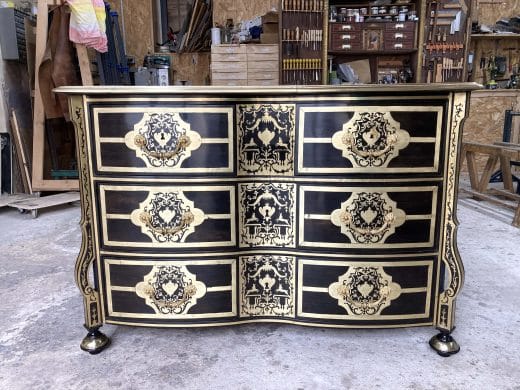
Restoration of a Louis XIV period commode, known as a Mazarine commode, veneered in brass and ebony on a softwood frame. Its drawers are serpentine: two full-length drawers surmounted by two half-drawers separated by an intermediate stile. Their fronts are made of softwood, their sides and bottoms of walnut. The brass decoration supporting the pendant handles features fine marquetry of scrolls, foliage, foliage, and arabesques. A geometric brass cartouche frames it and simulates keyhole escutcheons. The commode rests on four supports with […]
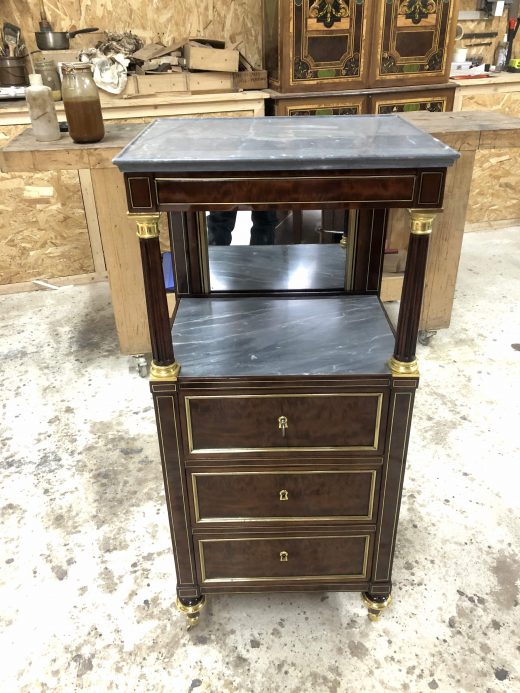
This elegant barber's cabinet in solid and veneered mahogany dates from the late 18th century. It rests on four tapered legs with casters and opens with three drawers in the front. Above, a niche with a blue Turquin marble top is framed by fluted columns. Next come two side drawers and a sliding marble top with a recessed base. Finally, this reveals a mirror that pivots on a rack and pinion mechanism, framed with ebony and brass stringing. Appearing during the reign of Louis XVI, the barber's cabinet is a piece of men's grooming furniture. Indeed, it holds the pitcher and […]
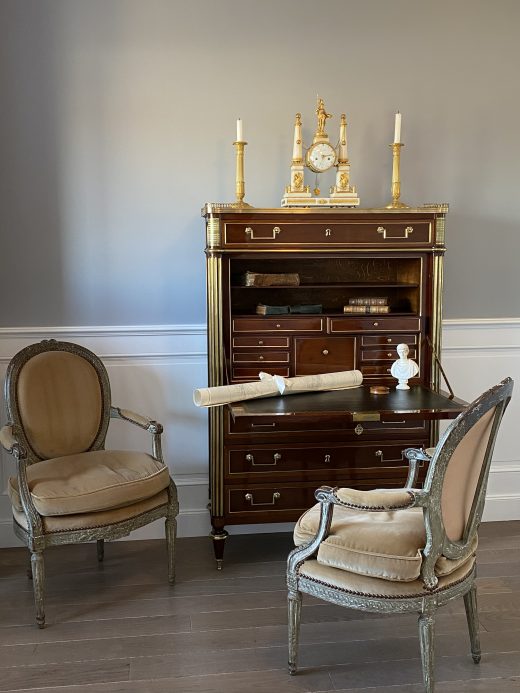
Restoration of a drop-front secretary desk with an oak frame, veneered in mottled mahogany and Santo Domingo mahogany. It likely dates from the late 18th century. Its white Carrara marble top is surrounded by a partially openwork brass gallery. It opens with a drawer at the top, a drop-front in the middle, and three drawers at the bottom. All the original locks are secured with a cloverleaf key. Furthermore, brass quarter-round moldings frame all the panels, both on the front and sides. The drop-front is veneered in mottled mahogany […]
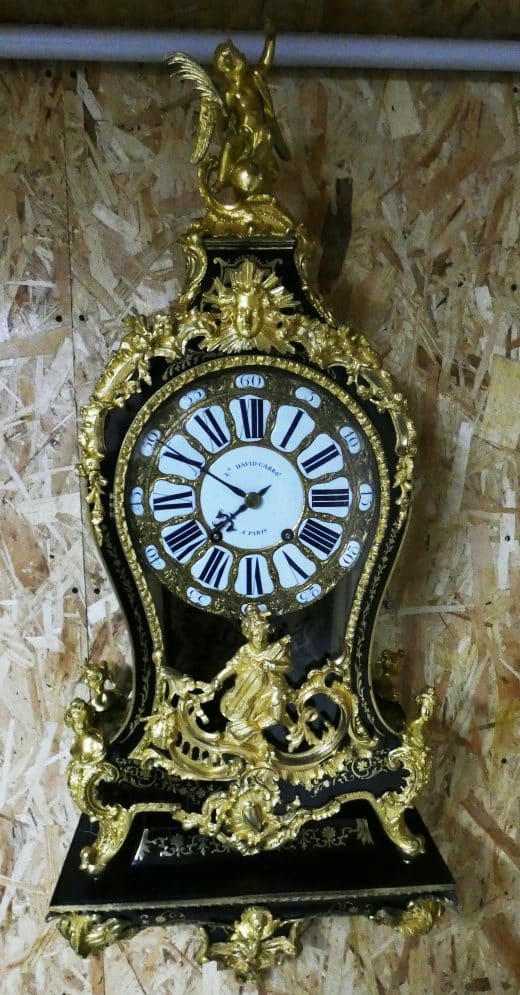
After several weeks of work, the restoration of this clock is finally complete. It is a Louis XV period clock in brown tortoiseshell and brass marquetry, with rosewood restorations. The dial is by Louis David Carré, nephew of Julien Le Roy, who became a master craftsman on December 31, 1748. Lodged at the Louvre from 1744, he was elected a juror in 1775. The greatest treasure of this clock lies in its bronze mounts. They are truly magnificent, and above all, they are in very good condition. There is only […]
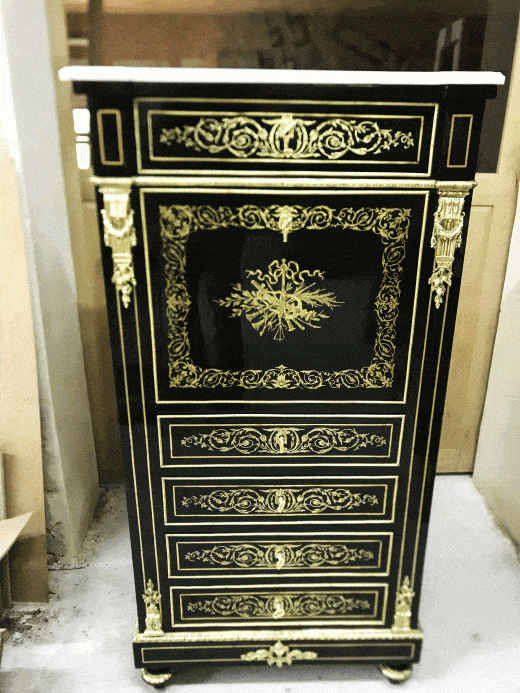
On the restoration side, there wasn't much to do: the brass fittings were reattached with fish glue and by infiltration, then stripped and varnished. The most difficult part of this type of furniture is the black stain. Over time, pear wood darkens, loses its color, and turns gray. It then needs to be stained, without, of course, obscuring the brass. To do this, I fill and polish the piece until the brass becomes a true mirror. Then, I apply a hot logwood stain, and then […]
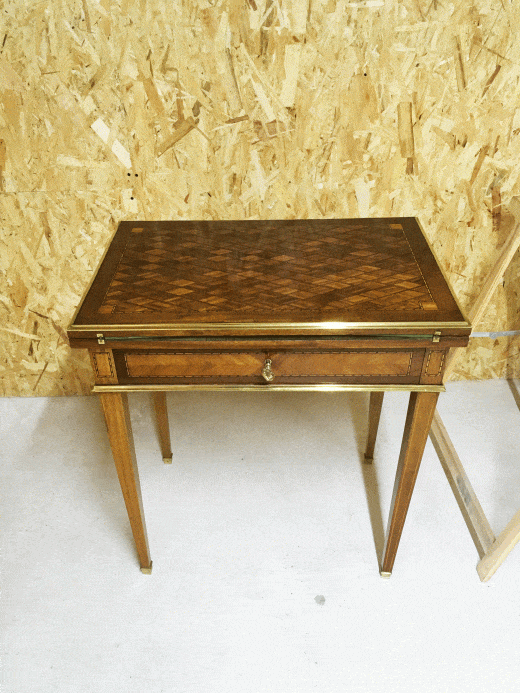
This week, a small Louis XVI style games table left the workshop. As you'll see, there wasn't much work to be done. It just goes to show that a simple cleaning, revarnishing, and a fresh coat of leather can breathe new life into a rather dull piece of furniture.
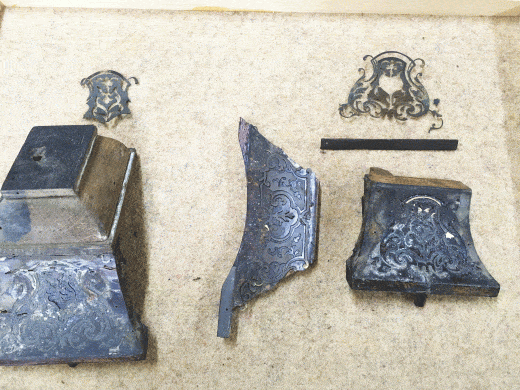
Once the various structural elements were glued back together, I tackled the tortoiseshell and brass marquetry. As you'll see, on this clock it's in very, very bad condition; practically nothing is holding. So, all the brass has to be removed. The tortoiseshell, however, is holding well; it's only partially detached. The first step in restoring this marquetry is therefore to remove and set aside each brass element. The second is to clean off the old glue, […]
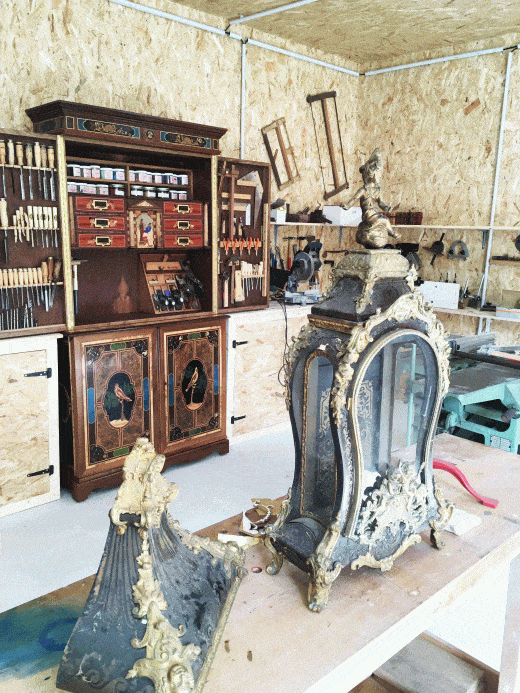
Here is my first client, or patient… whichever you prefer. It's a Boulle marquetry cartel clock in brown tortoiseshell, ebony, and brass. As the photos show, it's not in very good condition. A lot of the brass is missing, and what remains is peeling off everywhere. At first glance, it's always difficult to precisely date a Boulle cartel clock. Moreover, this one doesn't bear a maker's mark. On the other hand, it has corkscrew screws, typical of the 18th century, and few visible tool marks. Yet, I had a hunch it was a copy […]