Restaurant Secretary

Ebénisterie Mathieu Vath

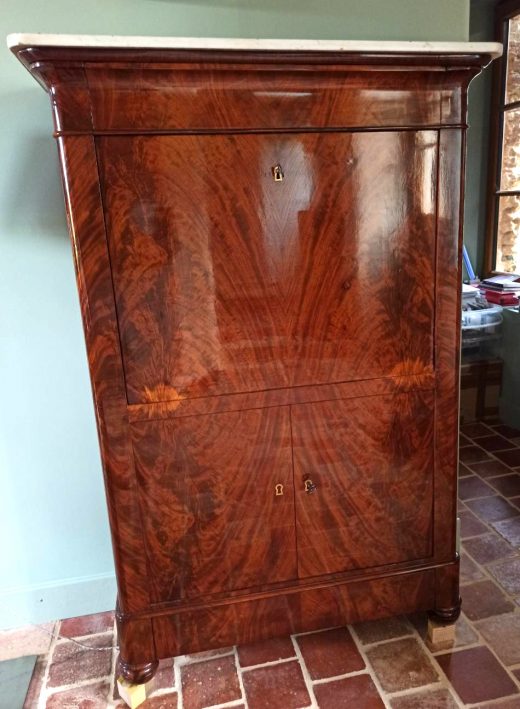
Restoration of a Restoration period (1815–1830) drop-front secretary veneered in burr mahogany and topped with Carrara white marble. The front legs are rounded and the rear legs are square. The frame is made of oak and softwood. An inventory mark (I91) is found inside the lower drawer on the right side. The Restoration style? After Napoleon's defeat at Waterloo on June 18, 1815, power in France was taken over by the two brothers of Louis XVI: the Count of Provence, who would reign under the […]
Empire Console

Ebénisterie Mathieu Vath

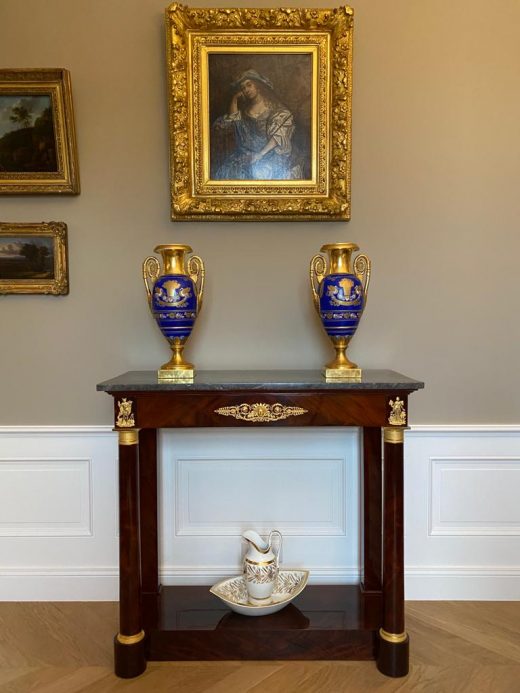
Here are some images of the restoration of this Empire-era console table. But first, a little history: do you know what a console table is and what its use was? Primarily a decorative piece of furniture placed in the entrance hall of apartments or between two windows, the "console table"—as it was called during the reign of Louis XV—consists of a marble top supported by two scrolled legs and placed against the wall. During the reign of Louis XV, console tables were often elaborately crafted and adorned with highly detailed motifs. Sculptures and reliefs, arched legs […]

Mahogany games table, late 18th - early 19th century

Ebénisterie Mathieu Vath

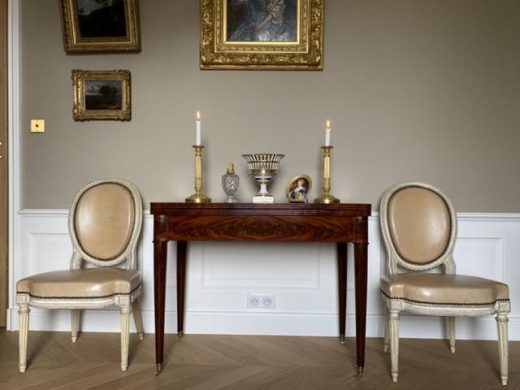
96 x W 47.5 x H 74 cm. Open: 96 x 95.5 cm. Restoration of a games table with a folding top veneered in burr mahogany, commonly known as Cuban mahogany. In fact, according to the recent book "L'essence du bois" (The Essence of Wood) by Patrick George, Emmanuel Maurin, and Marie-Christine Troujy-Jaquemet, it seems more accurate to call this type of mahogany Saint-Domingue mahogany. The base is veneered in solid oak, and the top in poplar. The moldings are solid mahogany. The table rests on legs […]

Secretary of the Board of Directors

Ebénisterie Mathieu VATH

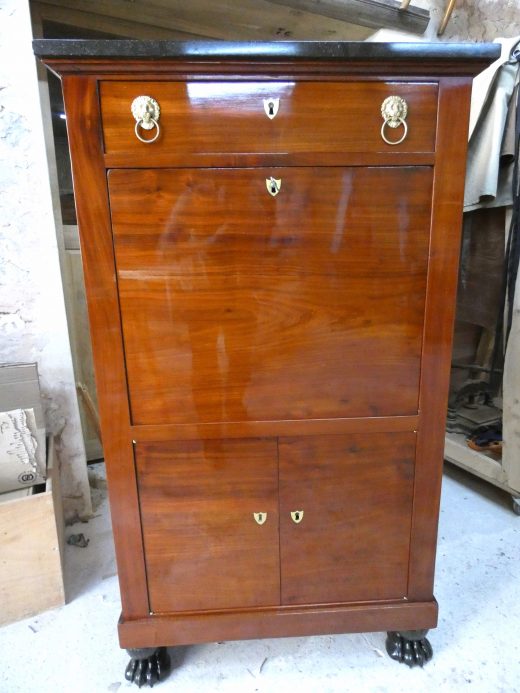
Here is a secretary desk in the most understated style of the Directoire period. Its frame is made of solid beech and conifer, and it is veneered with mahogany and mottled mahogany. It is very simply adorned with bronze handles in the form of a lion's head holding a ring in its mouth. The keyhole escutcheons are in the shape of a shield. The interior comprises seven drawers, the middle one of which opens with a key. The drop-front opens with a period three-point lock. The lower section consists of three drawers, or has been transferred […]

Jacob Frères bench and armchairs on rue Meslée

Ebénisterie Mathieu VATH

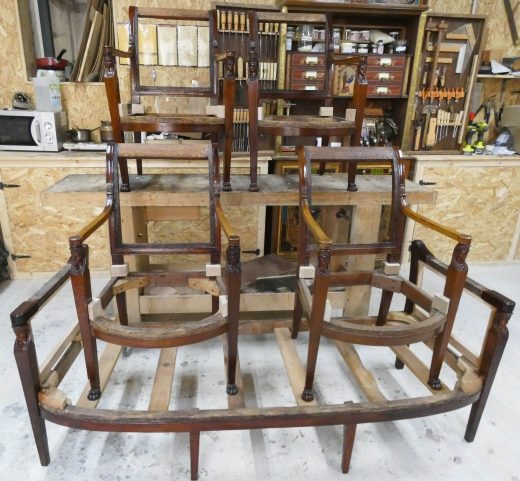
Extensive restoration and conservation work has been undertaken on this bench and its four armchairs from the Consulate period, stamped Jacob Frères, rue Meslée. The front and back legs are made of solid Cuban mahogany, while the crossbars are veneered. The armrests, supported by Egyptian heads, are made of light Saint-Domingue mahogany to create a contrast with the uprights. They are adorned with carved palmettes and rosettes in Cuban mahogany. They rest on tapered front legs ending in claw feet, and the rear legs are arched. […]

Empire Chest of Drawers with Quivers

Ebénisterie Mathieu VATH

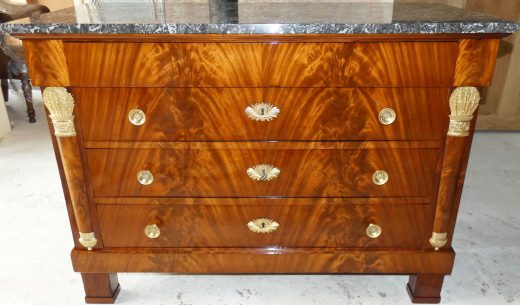
This week, here are some photos of the restoration of this Empire-style chest of drawers veneered in mahogany burl. This chest is truly unique due to the quality and originality of its bronze mounts. Indeed, they form quivers along with the side columns. The keyhole escutcheons are composed of two crossed laurel branches held together by a ribbon. Originally, they were mercury-gilded, as can be seen from the gilding stains on the back. Unfortunately, only a few partial traces remain on the front […]

Louis XVI style desk stamped KRIEGER

Ebénisterie Mathieu VATH

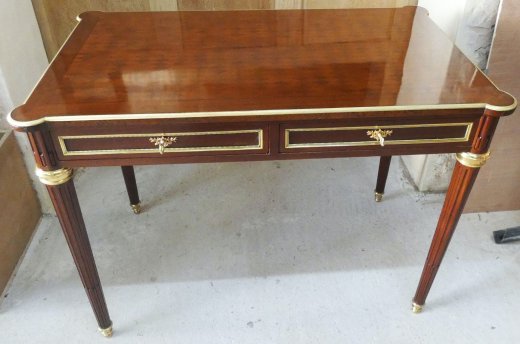
Exquisitely crafted with its mahogany-veneered oak frame and solid mahogany legs, this desk is a perfect example of high-quality 19th-century furniture. The cabinetmaking is flawlessly executed, and the bronze mounts are in pristine condition. Everything is there; nothing is missing. The Krieger firm began its cabinetmaking business in the mid-19th century with Antoine Krieger (1804-1869) before adding a significant decorative department, which ensured the prestige of its business until around 1945. The Krieger firm produced all the […]

Napoleon III style Louis XVI work table

Ebénisterie Mathieu VATH

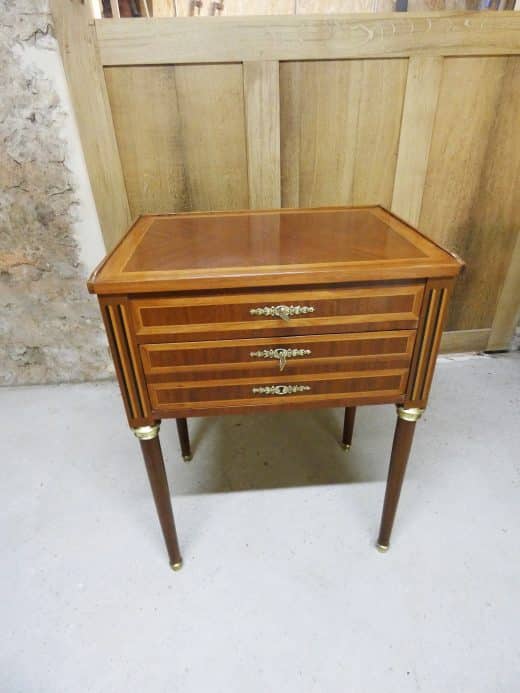
A few photos of the restoration of a small Louis XVI style work table from the late 19th century. The legs are solid mahogany, and it is veneered with rosewood, sapele, blackened pearwood, and boxwood for the fluting and stringing. Nothing too serious for this pretty little piece of furniture, which only had a few missing veneers and a small chip on the side of the oak drawer. A simple restoration: a few veneer grafts glued with hot glue, a light cleaning of […]

Boulle box

Ebénisterie Mathieu VATH

To kick off the new year, I'm excited to present my latest project. I'm embarking on a replica of this box attributed to André Charles Boulle. You'll be able to follow its progress and even come see it in person, as it will be my main subject for marquetry work at various exhibitions and events over the next few years. And yes, I'm talking about several years, as it's an extremely time-consuming project. But first, I had to find and select the different types of wood that make up the […]

Empire bed

Ebénisterie Mathieu VATH

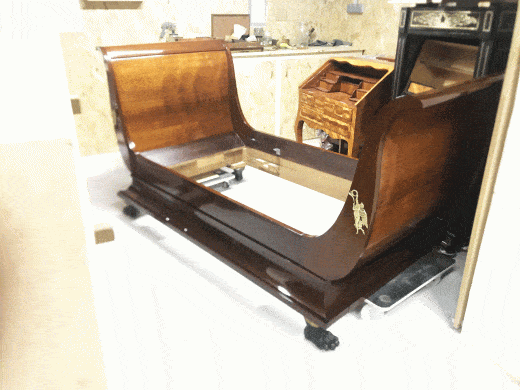
The "boat" bed, with its characteristic curve, is a French invention that appeared during the Directory and was very fashionable during the Empire and the Restoration. It is easily recognizable here by its lion's paw feet. The varnish on this bed had worn away, making it impossible to distinguish between the two mahogany pieces. The mahogany is known as Cuban mahogany (Swietenia mahogani), from Cuba, a Spanish colony. Evidence of its importation into Spain, specifically Seville, dates back to 1519-1520. It was used by Philip II between 1563 and 1584 during the construction of the Palace […]

Majorelle Table

Ebénisterie Mathieu VATH

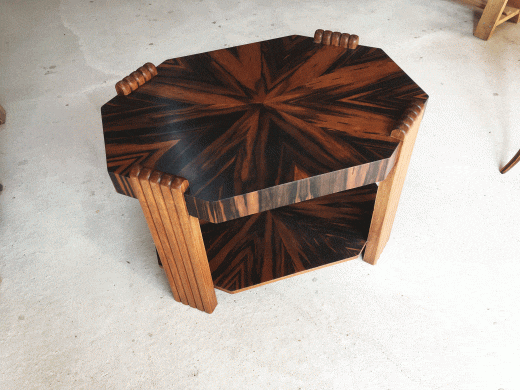
Here is a table in pure Art Deco style. It is veneered with Macassar ebony and the legs are mahogany. This table was probably created around the 1920s. Indeed, Louis Majorelle is best known as one of the great cabinetmakers of the Art Nouveau style, but it is too often forgotten that he was one of the forerunners of the Art Deco style, this table being a perfect example. In terms of restoration, as always, the veneer requires the most work; there […]

Louis XV commode stamped JC Ellaume

restauration de mobilier

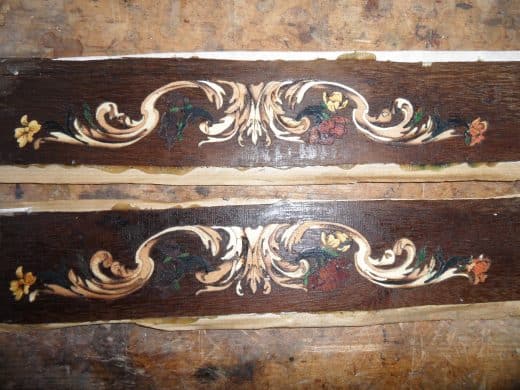
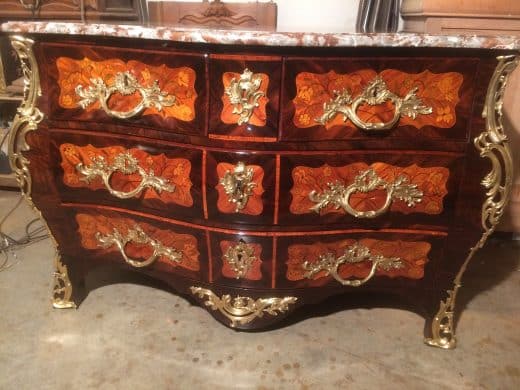
Restoration of a Louis XV period commode stamped JC Ellaume. This commode is veneered in rosewood and palisander with floral marquetry on the drawer fronts. The frame is made of oak and softwood. Jean-Charles Ellaume, also sometimes written as Allaume, received his master craftsmanship in Paris on November 6, 1754. Many pieces of furniture bearing his stamp are known. These are mostly Louis XV commodes. It was in his workshop on Rue Traversière that he produced numerous high-quality pieces of furniture for over thirty years, […]

Tool cabinet – Michelangelo's The Creation of Adam

Ebénisterie Mathieu Vath

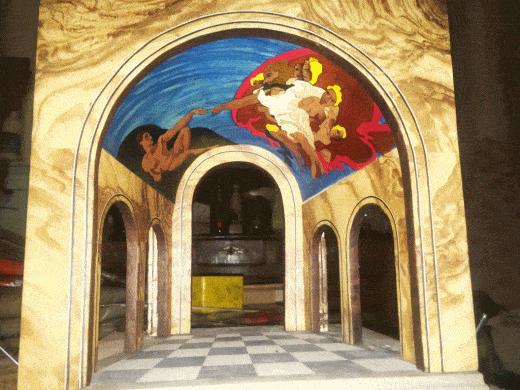
I indulged myself with this marquetry project; I had always wanted to recreate this famous marquetry fresco. This allowed me to revisit David Roentgen's "mosaic marquetry" technique. I created a pack with a hornbeam leaf, a sycamore maple leaf, and a pear leaf to make the figures, as pear wood is the best for reproducing skin tones. To tint the background, I dipped it in different baths to produce this effect of […]

Tool cabinet – The sculptor

Mathieu Vath

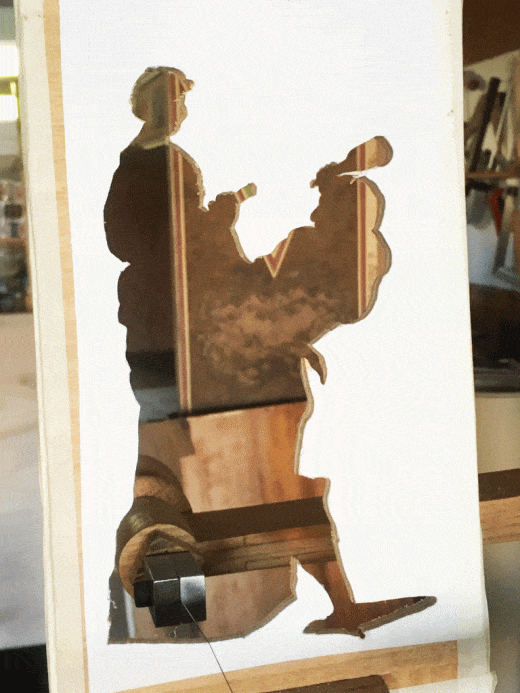
The idea behind this tool cabinet was to explore and implement the various projects I was researching. One of these ideas was to tackle the marquetry technique of a famous 18th-century cabinetmaker, David Roentgen. This technique, known as "mosaic marquetry," involves cutting a single sheet of veneer using a conical saw and then coloring it by dipping each piece in a pre-defined dye. However, there were two problems to overcome: Conical sawing, which is difficult to […]