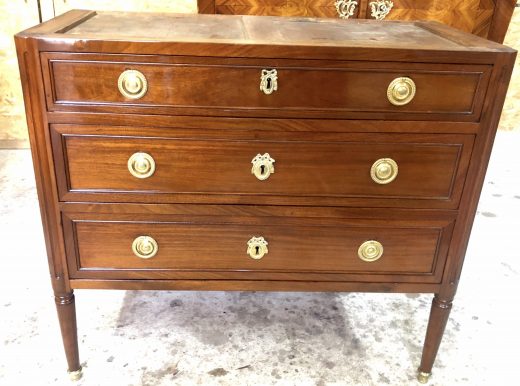
Louis XVI commode stamped JA LECLERE

Ebénisterie Mathieu Vath

Jacques-Antoine Leclere (1744 – January 30, 1792) obtained his master craftsman's certificate in Paris on September 29, 1779. He worked on the rue du Faubourg-Saint-Antoine, then on the rue des Barres, and finally in the courtyard of the Jewish Quarter, a stone's throw from the Bastille. This cabinetmaker produced well-made Louis XV and Louis XVI pieces. He used rosewood, satinwood, mahogany, and also lacquer panels. His stamp can be found on secretaries, chests of drawers, and various small pieces of furniture. For example, a pair of Louis XVI half-moon commodes veneered […]
Louis XV/Transition Commode by Nicolas Abraham Couleru

Ebénisterie Mathieu Vath

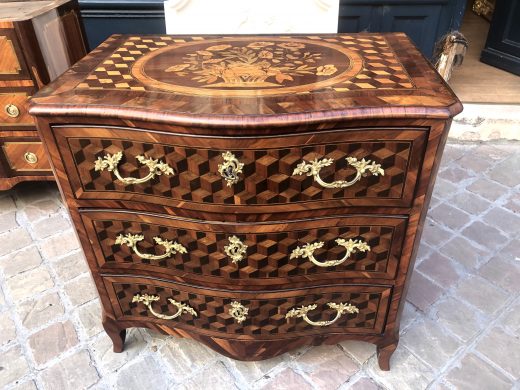
This slightly curved commode opens with three drawers. It is veneered with bottomless cubes of walnut, plum, and cherry wood. Its top is inlaid with a bouquet of flowers on an amaranth ground. Plum, or damson, is easily recognizable by its sapwood demarcations: these create a lighter pattern and give the decoration an irregular appearance. The frame is made of fir and walnut. It is difficult to assign this commode to a specific style. It is Louis XV, but the simplicity of its stringing and the marquetry framing clearly suggests […]

Empire X-Leg Desk

Ebénisterie Mathieu Vath

Here are some images of the restoration of this desk, with a solid mahogany base and mahogany burl veneer for the rest. Note that the recessed top is made from a single 12mm thick plank of solid mahogany burl. Here is the desk before restoration. The bulk of the work is on the legs. They are broken at the middle joint. They have already been repaired and are held together only by additional screws. Two cracks can be seen at the […]

Louis XV writing table

Ebénisterie Mathieu Vath

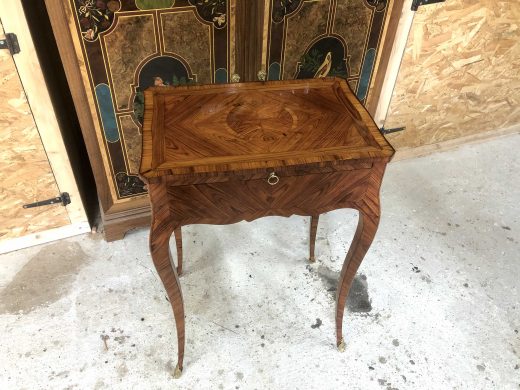
Before/after the restoration of a Louis XV writing table veneered in kingwood on solid oak. It has two side drawers and a central pull-out shelf beneath the leather-covered top. Besides the significant discoloration of the varnish, there were some small areas of peeling and missing veneer. The missing pieces were replaced with new veneer, which was sawn, scraped, and sanded, then cut to the correct thickness before gluing in order to avoid disturbing the patina beneath the bleached varnish. The […]

Louis XV slant-front secretary

Ebénisterie Mathieu Vath

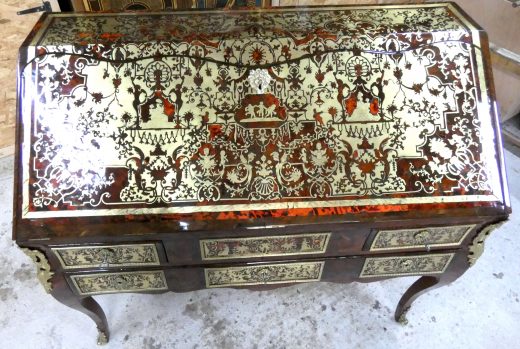
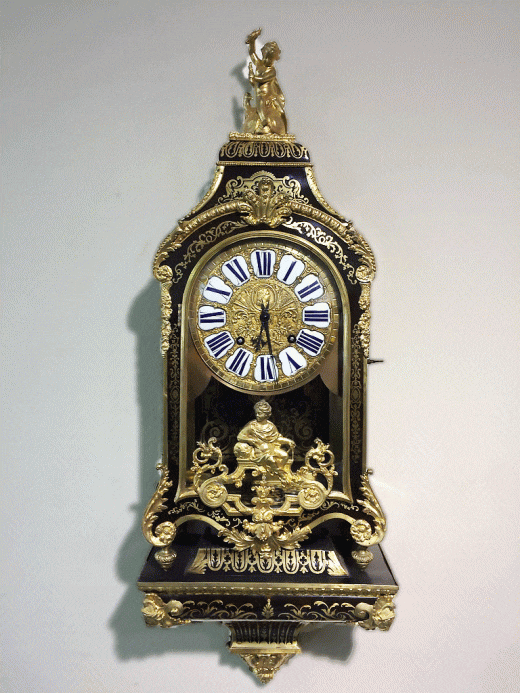
This week, a curious and very pretty Louis XV period secretary/desk with a slanted front in Boulle marquetry and rosewood. Yes, the reuse of Boulle marquetry wasn't only fashionable under Napoleon III! In fact, Boulle marquetry never ceased to have admirers in the 18th century. The renewed interest was particularly noticeable from the 1750s onwards. Prominent furniture merchants, such as Lazare Duvaux, resold them at exorbitant prices to prestigious clients. Madame de Pompadour herself bought a commode as a gift for her […]

Regency chest of drawers

Ebénisterie Mathieu Vath

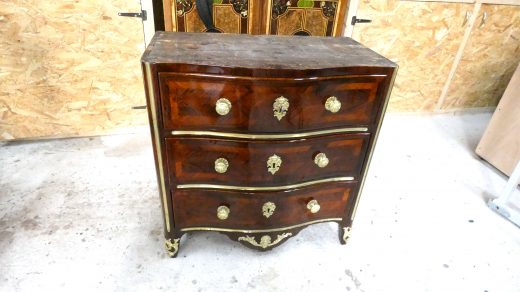
This small chest of drawers has a classic form typical of the Regency period. It still retains the rigor of the Louis XIV style: the front is curved, the front uprights are rounded, and the sides remain straight. It opens with three drawers. Its uprights and intermediate rails are decorated with brass fluting. The frame is entirely made of fir. The intermediate panels are dovetailed into the sides. The back is made of horizontal planks, nailed with rebates. The drawers are walnut, except for their wooden fronts […]

Transition cylinder desk

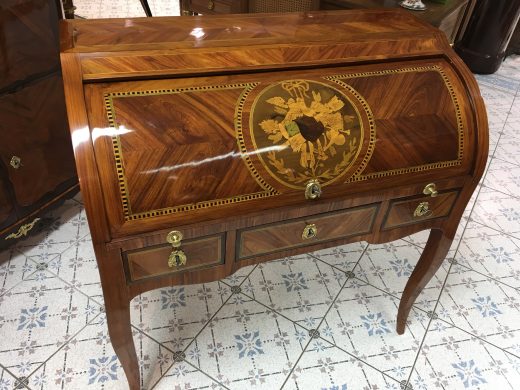
A few years ago, I had the pleasure of restoring this magnificent Transition period (1780) roll-top desk. Its frame is made of oak and fir. Most notably, it is veneered with rosewood, arranged in a butterfly pattern on the fall front. Around this, a delicate border of boxwood and green-stained hornbeam stringing is edged with a narrow band of amaranth. The back is veneered in satinwood. Finally, the central marquetry, on a tobacco-stained sycamore background, depicts musical instruments. Two doves are flying above, a musical score within […]

Napoleon III side table

Ebénisterie Mathieu Vath

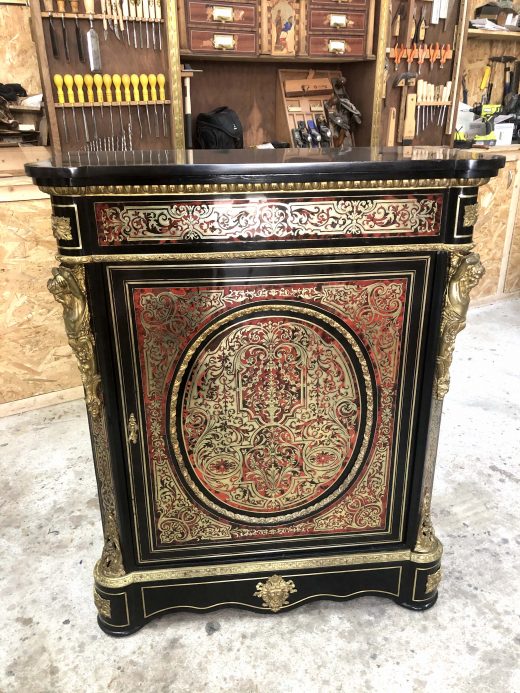
This Napoleon III period sideboard, quadrangular in shape, is veneered in ebonized pearwood. It is further enlivened by rich Boulle marquetry in brass and red tortoiseshell, forming a decoration of arabesques, foliate scrolls, rocaille motifs, and small flowers. In addition, beautiful gilt-bronze mounts add rhythm to the piece: atlantes with clasped hands on the uprights, acanthus leaves, and an apron. A gadrooned molding also highlights the top, which is slabbed with a black marble top with a rounded edge. Finally, the piece opens with a door, […]

Napoleon III Boulle marquetry side table

Ebénisterie Mathieu Vath

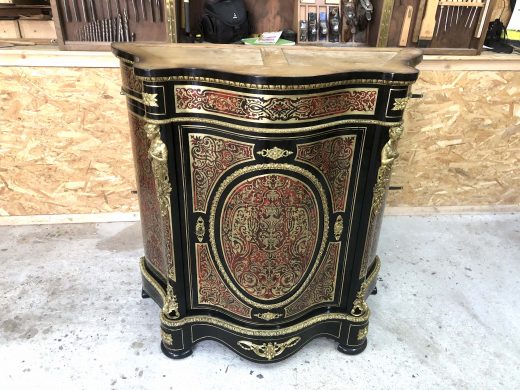
A console table veneered in ebonized pearwood, with Boulle marquetry of brass on tortoiseshell depicting arabesques. It opens with a door adorned with an oval medallion. This reveals shelves in mahogany and mahogany veneer. Finally, it is richly ornamented with chased and gilded bronze: egg-and-dart friezes, caryatids in corner drops, interlaced friezes, acanthus leaf friezes, fruit, and florets. This Boulle cabinet required extensive restoration! Indeed, some pieces of brass, fillets, and especially a great deal of tortoiseshell were missing.

Transitional chest of drawers stamped LARDIN

Ebénisterie Mathieu Vath

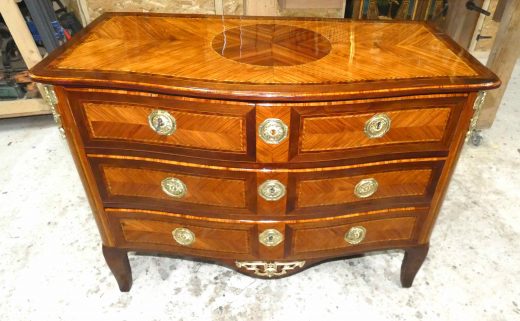
Restoration of a Transition period commode, constructed of fir and oak and veneered with rosewood. It is framed by hornbeam stringing, white and green-stained, with a satinwood band edged in amaranth. The central medallion is made of satinwood veneer assembled in a herringbone pattern. The maker's mark and the JME (Journée des Métiers d'Art) are located at the base of the left rear leg. André-Antoine Lardin (1724 – August 10, 1790) obtained his master craftsman's certificate on July 1, 1750. He established himself on the rue de Charenton, at the sign "Au Bois de Boulogne," and worked there until 1770. He then moved […]

Empire Dressing Table

Ebénisterie Mathieu Vath

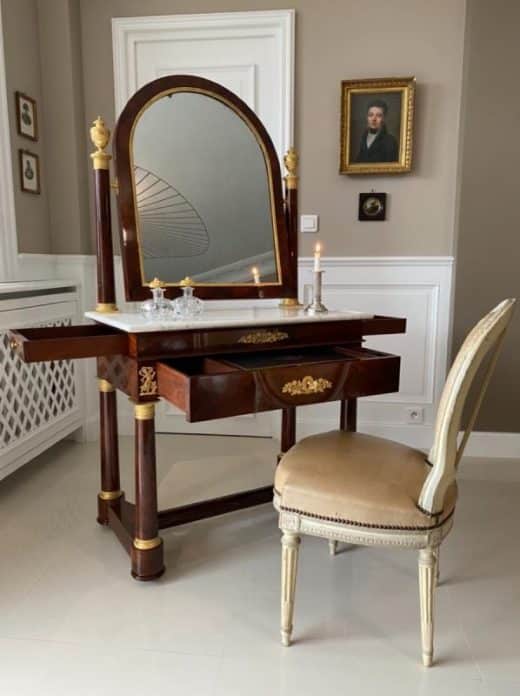
A beautiful restoration and, above all, conservation effort has been undertaken on this lovely Empire-period dressing table. Its frame is made of oak and poplar, veneered with mahogany burl. The drawer sides and bottoms are solid mahogany. It rests on four column legs ending in casters and joined by an H-shaped stretcher. The frieze opens with a central drawer, revealing a writing surface lined with blue morocco leather, a pen case, and two compartments for inkwells. Two large drawers on either side hold toiletries. […]

Louis XV commode stamped JC Ellaume

restauration de mobilier

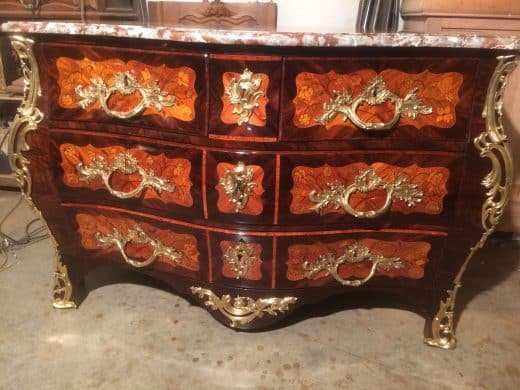
Restoration of a Louis XV period commode stamped JC Ellaume. This commode is veneered in rosewood and palisander with floral marquetry on the drawer fronts. The frame is made of oak and softwood. Jean-Charles Ellaume, whose name is also spelled Allaume, became a master craftsman in Paris on November 6, 1754. Many pieces of furniture bearing his stamp are known, mostly Louis XV commodes. For over thirty years, in his workshop on Rue Traversière, he produced numerous high-quality pieces. These are primarily […]