Empire Desk

Ebénisterie Mathieu Vath

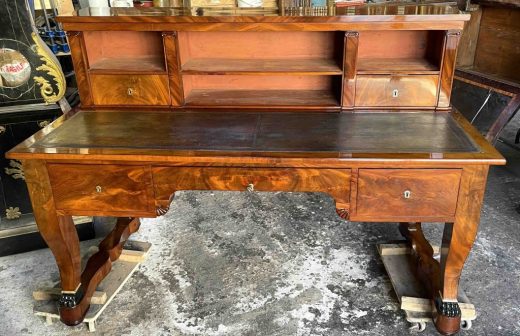
Restoration of an Empire period desk, veneered in mahogany burl on an oak frame. Its four "chimera thigh" legs are connected by stretchers. They terminate in lion's paw feet. The Empire style emerged at the beginning of the 19th century, under Napoleon I. Indeed, the Emperor desired a new, grandiose aesthetic, befitting his power. Heir to Neoclassicism, this style drew inspiration from Greek, Roman, and Egyptian antiquity. The excavations of Pompeii and Herculaneum inspired it, as did the Egyptian campaign. This […]

8-foot Boulle desk

Ebénisterie Mathieu Vath

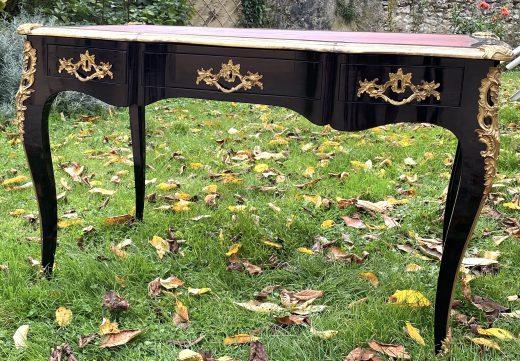
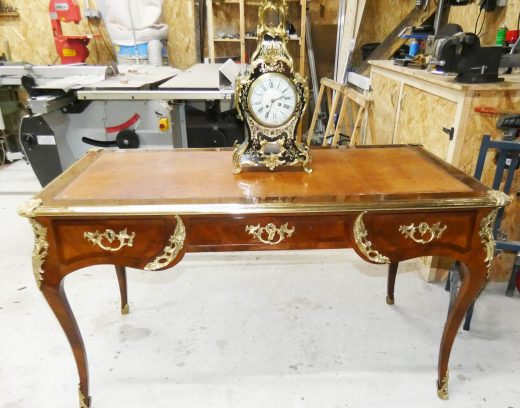
Here is a restoration carried out earlier this year by Raphaël. It was a long but successful undertaking. In fact, I recently revisited this desk: it has perfectly withstood significant variations in temperature and humidity. The rest of this report is in Raphaël's own handwriting. A "Mazarin" Desk This desk dates from the Louis XIV period. It is covered with Boulle marquetry of brass on a red tortoiseshell ground. Eight console legs support the case; they are connected in groups of four by an X-shaped stretcher. On the front, […]

Flat Greek-style desk stamped DUBOIS

Ebénisterie Mathieu Vath

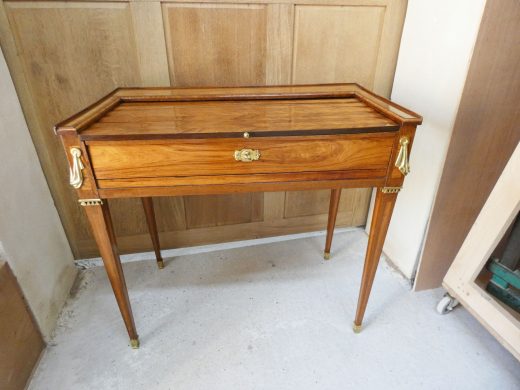
One desk, one stamp, three cabinetmakers? This desk is a masterpiece of French cabinetmaking. It alone embodies the culmination of 18th-century Neoclassical taste. Yet, a question immediately arises: why three cabinetmakers for a single desk? In fact, the answer lies in a mixture of succession, talent, collaboration, and opportunism, typical of the craftsmanship of the period. This flat desk, known as a "Greek-style" desk, is a perfect example of the Louis XVI style. It combines marquetry of amaranth, satinwood, and other woods.

Regency style pedestal desk

Ebénisterie Mathieu Vath

Restoration of a desk veneered on all sides with yew burl and amaranth, decorated with geometric boxwood stringing. It opens with five drawers in the front and five simulated drawers in the back. Furthermore, the two lower drawers follow the contour of the edge and slide at a 45-degree angle. In addition, a bronze molding encircles the amaranth-veneered top. The desk rests on four cabriole legs, terminating in curious acanthus leaf bronzes. Finally, the frame is entirely oak, except for the drawers, which are walnut, with […]

Louis XV slant-front desk

Ebénisterie Mathieu Vath

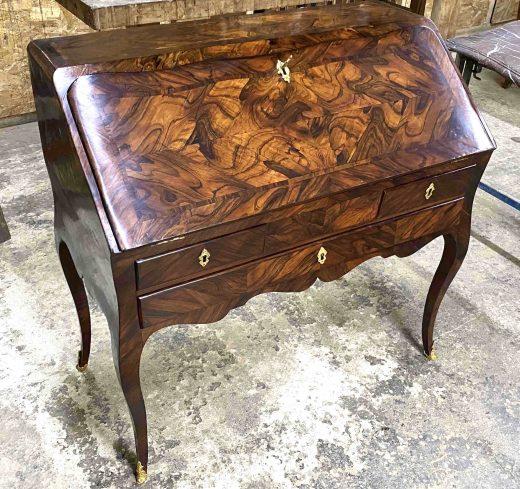
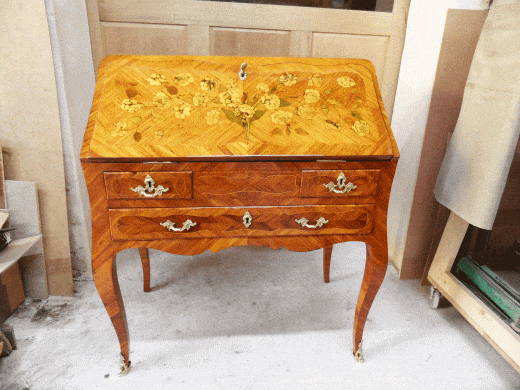
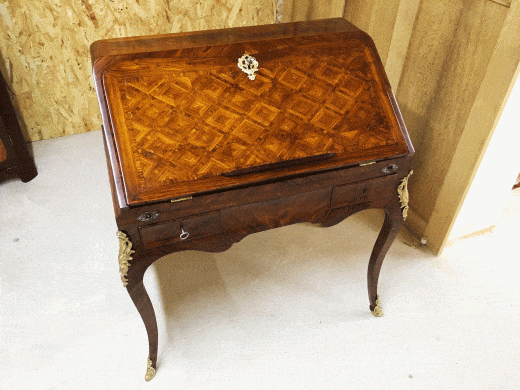
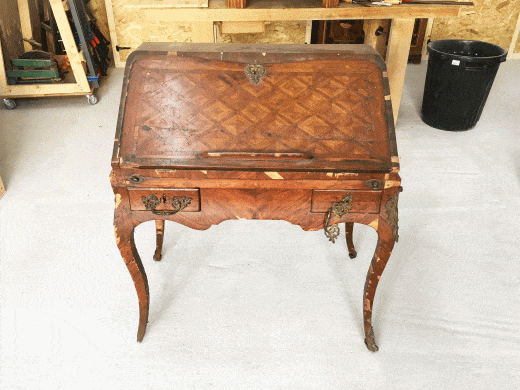
Raphaël's first restoration project was this Louis XV period rosewood veneer slant-front secretary. It was a complete restoration involving numerous veneer grafts and a waxed, filled finish. A delicate job, as rosewood is unforgiving. The slightest misstep with the chisel, or excessive sanding, and its beautiful blond patina disappears, revealing the original dark color and causing unsightly stains. Therefore, there was no choice but to scrape and sand the newly sawn veneer and cut it to the correct thickness before gluing it […]

Louis XV desk stamped SAR

Ebénisterie Mathieu Vath

Restoration of a Louis XV desk stamped by Jean-Girard-Théodore SAR. It is a magnificent desk, of very high quality craftsmanship. Its legs, apron, and drawers are made of walnut. The top, however, is made of softwood. Finally, a beautiful Indian ebony covers the entire piece. Jean-Girard-Théodore SAR was born in 1724 and became a master craftsman on October 1, 1766. Established on Rue de Lappe, in the Faubourg Saint-Antoine, he worked primarily for fellow craftsmen. Among them were Migeon from 1755, Coulon in 1774, and Dubuisson. In addition, he supplied […]

Louis XV desk

Ebénisterie Mathieu Vath

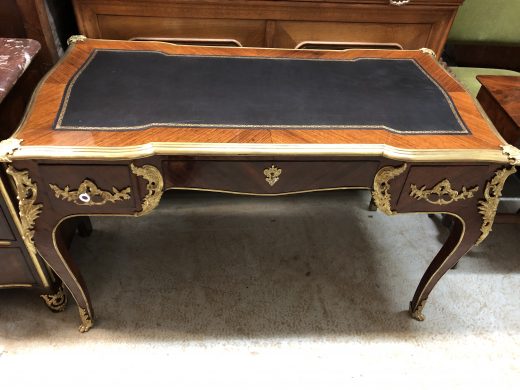
Restoration of a Louis XV desk veneered in rosewood and violet wood on an oak and softwood frame. Replacement of missing veneer, cleaning, and refinishing with a French polish. Cleaning and conservation of the leather. Removal and steam cleaning of the gilt bronze mounts. To see previous restorations: https://ebenisterie-mathieuvath.fr/en-ce-moment-a-latelier/

Louis XV style desk

Ebénisterie Mathieu Vath

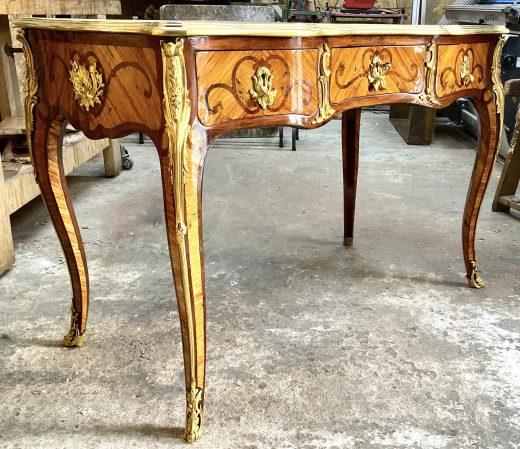
A major restoration was undertaken for this small Louis XV style desk, richly adorned with bronze mounts and veneered in rosewood. The restoration involved replacing the missing veneer while preserving as much of the remaining material as possible. This was achieved by using veneer that was sliced, scraped, sanded, oxidized, and varnished before being re-glued, thus avoiding the need to sand the piece before finishing. Rosewood is a very dark wood that lightens with age, developing a beautiful reddish patina that cannot be removed by any means.

Louis XV style desk in yellow Saint-Martin veneer

Ebénisterie Mathieu VATH

The restorer's trade holds many surprises. There are over 60,000 species of trees in the world. Suffice it to say that even though the same types of wood are often found in French furniture, sometimes you stumble upon something unfamiliar. I found this wood odd. Violet wood? No. Rosewood? Perhaps, but a variety I don't recognize. Okay, I'll strip a section to see the wood's true color. Hey, the varnish was very red: this veneer is made of […]

N. PETIT Roll-Top Desk

Ebénisterie Mathieu VATH

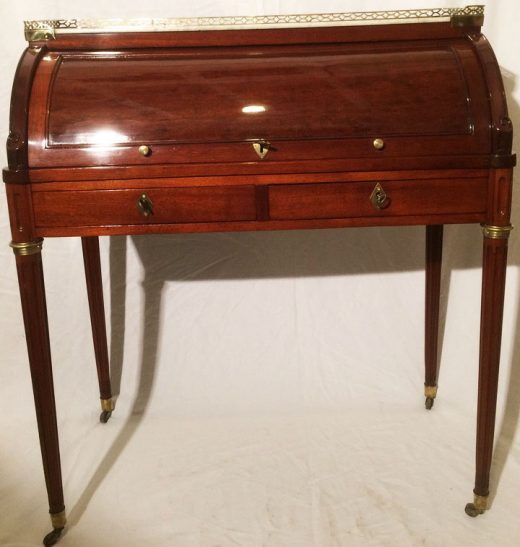
DIMENSIONS: H.71 W.104 D.52 This roll-top desk perfectly matches those produced by Nicolas Petit's workshop between 1770 and 1791, the year of his death. Indeed, with a few exceptions, Nicolas Petit primarily crafted this type of furniture in molded mahogany, on fluted legs and with white marble tops. Their understated elegance reflected the taste of the period. It features two drawers in the frieze, two pull-out side shelves, and a central shelf that locks when the drop-top is closed. Furthermore, the interior contains two drawers, the one on the right […]

J.STUMPFF Roll-Top Desk

Ebénisterie Mathieu VATH

Restoration and conservation work on this rare Louis XVI period roll-top desk stamped by Jean-Chrysostôme Stumpff (1731 – January 17, 1806), who became a master craftsman on August 27, 1766. Originally from Schweigern, Swabia (Germany), he married in 1760 in Paris, at the Swedish embassy, like most of his compatriots of the Reformed faith. His witness was his fellow cabinetmaker Ferdinand Schwerdfeger. In his workshop on Rue Saint-Nicolas, he produced some Louis XV furniture, but primarily a large number of Transition and Louis XVI pieces. Stumpff's production […]

Louis XV slant-front desk (After restoration)

Ebénisterie Mathieu VATH

Some time ago, I told you about this desk that was being restored. Well, here it is finished. The varnishing took three weeks, allowing enough time for the varnish to dry properly and achieve the best possible result. To review the restoration process: Louis XV slant-front desk. Here are some before and after photos.

Louis XV slant-front desk stamped HEDOUIN (Restoration complete)

Ebénisterie Mathieu VATH

Remember that slant-front desk? Well, it's finished. It wasn't easy, but it's regained its former glory. All that's left is to install the drawer locks and the leather before it goes back to its owner. I remade a large part of the legs using sawn kingwood. I cut it to the correct thickness, scraped, sanded, and oxidized it before gluing. That way, there was no need to sand the entire piece of furniture, which would have damaged it even more.

Louis XV slant-front desk stamped HEDOUIN

Ebénisterie Mathieu VATH

Thanks to its stamp, this slant-front desk can be dated between 1738 and 1783. Jean-Baptiste Hédouin's life remains relatively unknown. After completing his master craftsmanship, he set up his workshop on Rue Traversière-Saint-Antoine. All his furniture is of high quality. Primarily in the Regency and Louis XV styles, almost all veneered in sheets or with grid patterns, they are also quite varied: wardrobes, flat and slant-front desks, bookcases… But chests of drawers make up the largest part of his production. Most of them adopt the […]