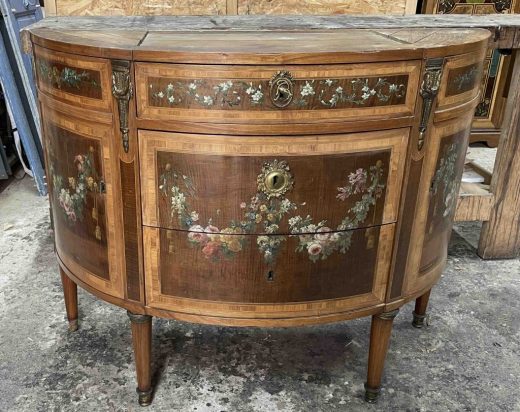
Louis XVI commode stamped JL Cosson

Ebénisterie Mathieu Vath

This Louis XVI period half-moon commode, stamped by the cabinetmaker Jacques Laurent Cosson, likely dates from a production between 1780 and 1790. It is an exceptional example of painted furniture from the end of the Ancien Régime, belonging to a very small group of which only seven examples are currently known. This small and highly sought-after group of 18th-century French painted furniture is now recognized as one of the most inventive areas of Parisian cabinetmaking on the eve of the Revolution. This commode, with its curved, half-moon shape, rests […]
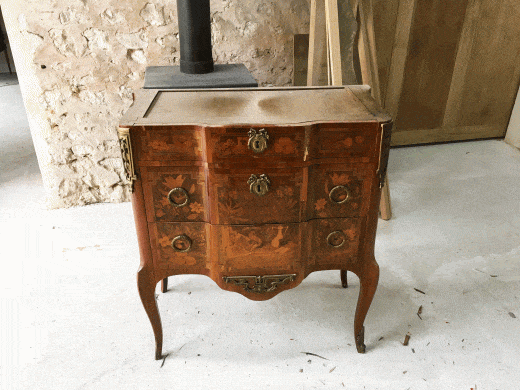
Transitional dresser in the style of Topino

Ebénisterie Mathieu VATH

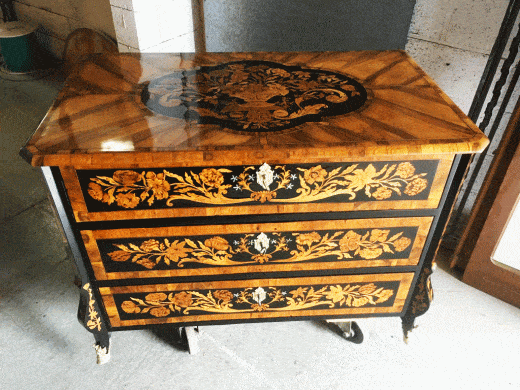
A month ago, a lovely transitional commode arrived, which reminds me of the work of the cabinetmaker Charles Topino (circa 1742-1803) – he received his master craftsman's certificate on July 4, 1773. However, this commode does not bear his stamp, nor any stamp for that matter. This confirms that a stamp is not necessary to possess a piece of high-quality furniture. Furthermore, the marquetry could very well have come from Topino's workshop, as he sold panels of his marquetry to the haberdashers and his colleagues […]

Mazarine Chest of Drawers

Ebénisterie Mathieu VATH

This week, we're revisiting the restoration of a Louis XIV period commode, a commode known as a Mazarine commode. But where does the name "Mazarine" come from? Well, it seems that the first example was made for the famous Mazarine Library, quite simply. Moreover, the illustrious creator of the commode was none other than André Charles Boulle himself. For Louis XIV's bedroom at Trianon, he revolutionized a type of furniture in 1708: the commode, which takes its name from its "practical" aspect compared to the chests that were widely used at the time. Today, we're presenting […]

Tool cabinet – The sculptor

Mathieu Vath

The idea behind this tool cabinet was to explore and implement the various projects I was researching. One of these ideas was to tackle the marquetry technique of a famous 18th-century cabinetmaker, David Roentgen. This technique, known as "mosaic marquetry," involves cutting a single sheet of veneer using a conical saw and then coloring it by dipping each piece in a pre-defined dye. However, there were two problems to overcome: Conical sawing, which is difficult to […]