Bonheur du jour Empire stamped by Antoine-Nicolas Lesage
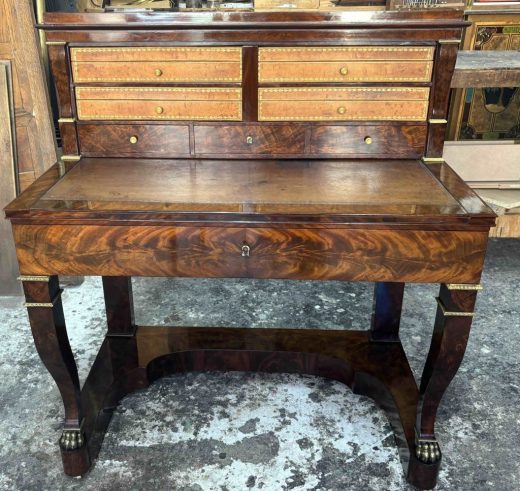
Restoration of an Empire bonheur du jour in mahogany veneer, stamped Antoine-Nicolas Lesage: top reattached, veneer missing, gilt bronzes cleaned and shellac finish redone.
Restoration. Conservation. Creation

Restoration of an Empire bonheur du jour in mahogany veneer, stamped Antoine-Nicolas Lesage: top reattached, veneer missing, gilt bronzes cleaned and shellac finish redone.
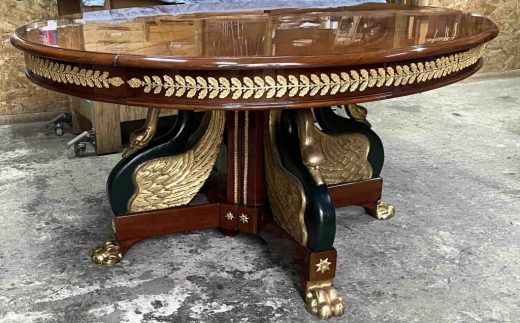
The restoration of this Empire dining table is now complete. The work focused primarily on the finishing touches. We removed the previously applied polyurethane varnish and applied a French polish to the solid mahogany top and its four-legged base decorated with swan neck motifs and lion's paw feet. The apron features an oak frieze. Length x Width = 162 x 140 cm. Length x Width with extensions = 252 cm.
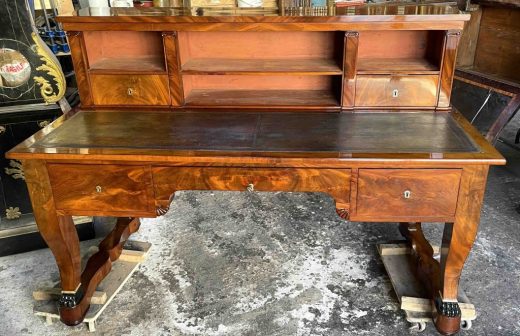
Restoration of an Empire period desk, veneered in mahogany burl on an oak frame. Its four "chimera thigh" legs are connected by stretchers. They terminate in lion's paw feet. The Empire style emerged at the beginning of the 19th century, under Napoleon I. Indeed, the Emperor desired a new, grandiose aesthetic, befitting his power. Heir to Neoclassicism, this style drew inspiration from Greek, Roman, and Egyptian antiquity. The excavations of Pompeii and Herculaneum inspired it, as did the Egyptian campaign. This […]

Restoration of a rectangular inkwell from the late Empire period. It is surmounted by a central dish with a lid pierced by palmettes and handles in the form of flowering tassels. Two winged putti, with quivers on their backs and volute tails, support this dish. On either side, two inkwells with trellis motifs have pierced lids topped with acorn finials. The body contains a niche for the quill. In the center of the frieze, a mask of Apollo from which stylized foliate scrolls emerge. The whole rests on a molded plinth and feet in […]
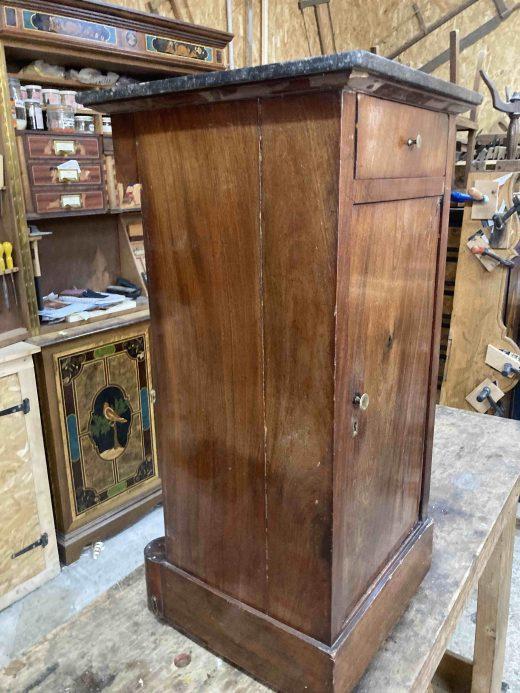
Restoration of an Empire-period somno, veneered in mahogany burl. You might be wondering what a somno is? The somno, or somneau, appeared during the Consulate, at the beginning of the Napoleonic era. It is a small, table-shaped piece of furniture, cylindrical or square. Its closed section serves as storage. It is therefore placed in the bedroom, often near the bed, as a nightstand. Finally, it was during the Empire that it acquired the name "somno," from the Latin somnus, meaning sleep. The somno under the Empire. Under the First Empire, the somno […]
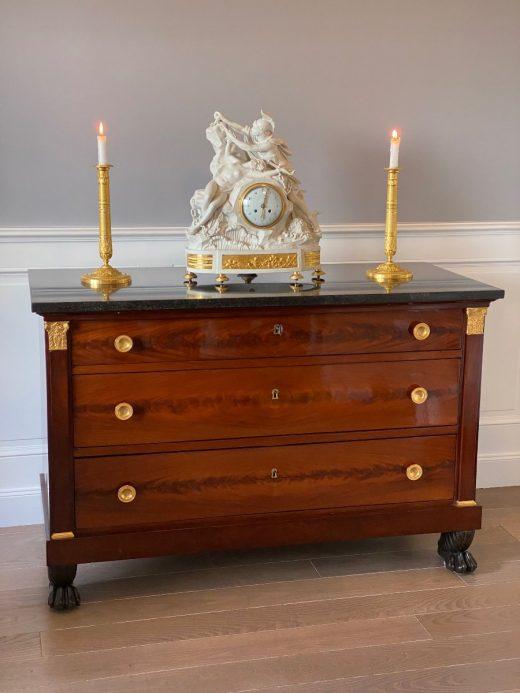
Restoration of a mahogany burl veneer commode with three drawers. Its straight uprights form Corinthian pilasters. The front feet are claw feet, while the rear feet feature three decreasing balls, known as a rosary. It is topped with a black Belgian granite slab. Finally, it has retained all its original gilt bronze mounts, as well as its trefoil locks and key. The gilt bronze mounts feature Corinthian capitals with projecting bird heads, palmettes, acanthus leaves, flowers, and scrolls. They also play on […]
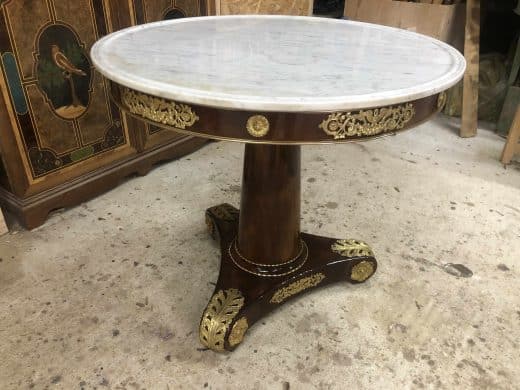
Restoration of an Empire period pedestal table, veneered in mahogany burl. It arrived at the workshop in rather poor condition. The bronze mounts were heavily soiled. There were also many structural separations and missing veneers. The restoration therefore consisted of re-gluing the structure and veneers under vacuum, with the injection of a penetrating adhesive for the upper apron and the central column. I removed the few old grafts that had been applied against the grain and replaced them with a better-matching veneer. I then reapplied the old varnish using a French polish and […]
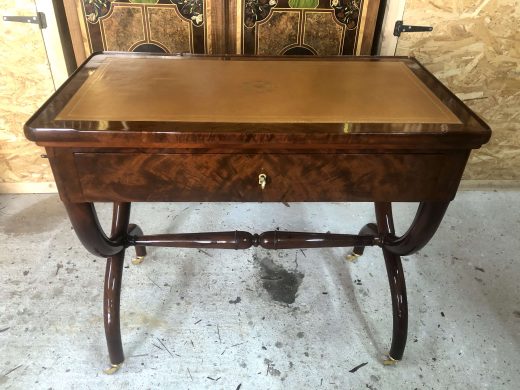
Here are some images of the restoration of this desk, with a solid mahogany base and mahogany burl veneer for the rest. Note that the recessed top is made from a single 12mm thick plank of solid mahogany burl. Here is the desk before restoration. The bulk of the work is on the legs. They are broken at the middle joint. They have already been repaired and are held together only by additional screws. Two cracks can be seen at the […]
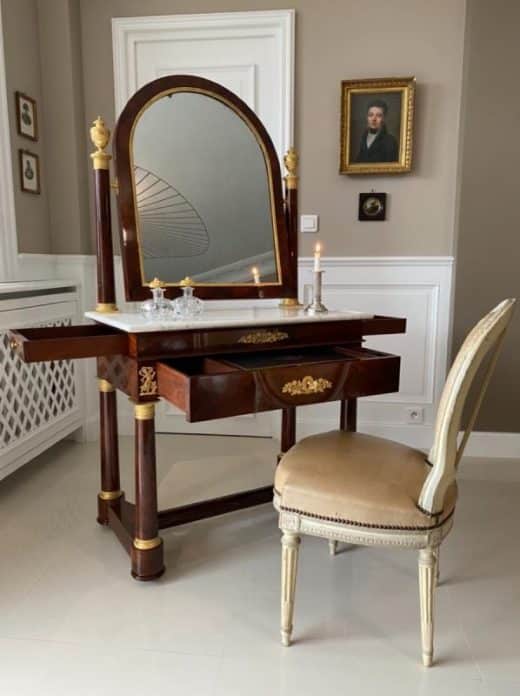
A beautiful restoration and, above all, conservation effort has been undertaken on this lovely Empire-period dressing table. Its frame is made of oak and poplar, veneered with mahogany burl. The drawer sides and bottoms are solid mahogany. It rests on four column legs ending in casters and joined by an H-shaped stretcher. The frieze opens with a central drawer, revealing a writing surface lined with blue morocco leather, a pen case, and two compartments for inkwells. Two large drawers on either side hold toiletries. […]
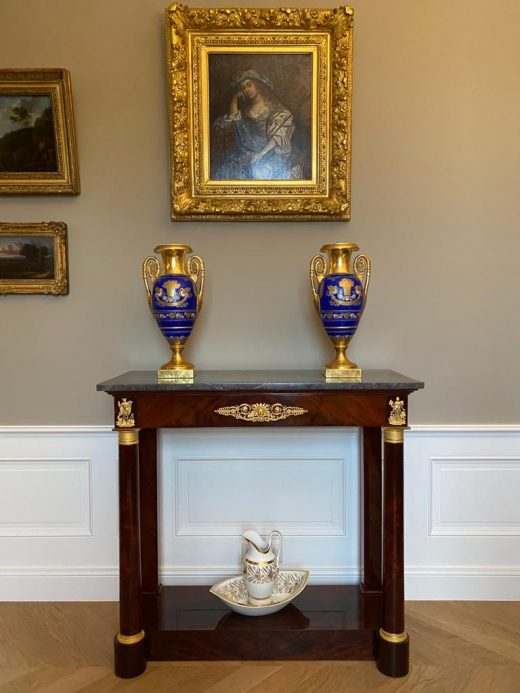
Here are some images of the restoration of this Empire-style console table. But first, a little history: do you know what a console table is and what its use was? Primarily a decorative piece of furniture, the console table was placed in the entrance hall of apartments or between two windows. The "console table," as it was called during the reign of Louis XV, was placed against the wall. Its marble top rested on two scrolled legs. During the reign of Louis XV, console tables were often elaborately crafted and adorned with highly elaborate motifs. Sculptures and reliefs, arched legs and curved fronts… Louis XV console tables […]
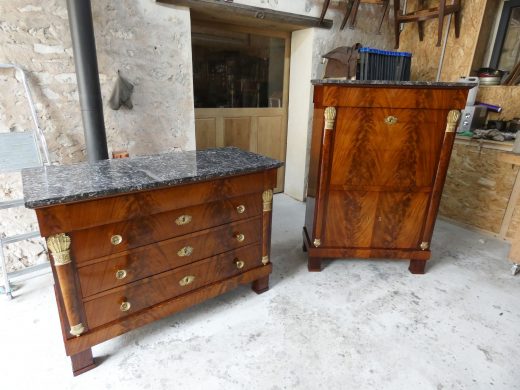
Do you remember the Empire chest of drawers with the quivers? Well, here is the secretary desk with the quivers. It is built in exactly the same way as the chest: same construction, same solid woods used, and same mahogany veneers. The restoration is identical to that of the chest of drawers. The goal: to preserve as much as possible and restore the piece to its function without altering its history. So I re-glued the structure and the few detached veneers, then added some mahogany burl grafts. Finally, the hinges of the drop-front had to be reinforced […]
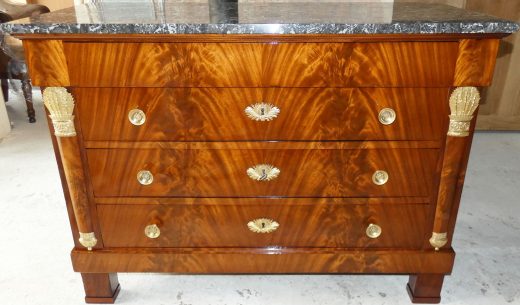
This week, here are some photos of the restoration of this Empire-style chest of drawers veneered in mahogany burl. Its originality lies primarily in the quality of its bronze mounts. Indeed, together with the side columns, they form quivers. Furthermore, the keyhole escutcheons feature two crossed laurel branches tied with a ribbon. Originally, the bronze mounts were mercury-gilded, as evidenced by the gilding stains on the back. Unfortunately, only a few traces remain on the visible surface. Moreover, it is all the more unique because I must […]