Boulle Dubois Cartel

Restoration of a Louis XV period brown tortoiseshell Boulle Dubois cartel clock, the dial of which bears an engraving with the monogram of Louis XV.
Restoration. Conservation. Creation

Restoration of a Louis XV period brown tortoiseshell Boulle Dubois cartel clock, the dial of which bears an engraving with the monogram of Louis XV.
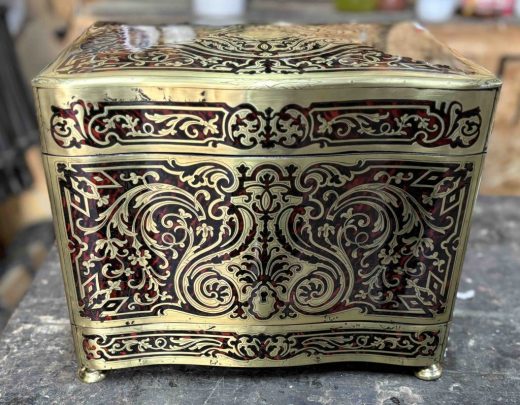
Restoration of a Napoleon III liquor cabinet in tortoiseshell and brass marquetry. The liquor cabinet, an elegant and ingenious piece of furniture, appeared at the end of the 18th century. Initially designed to accompany long carriage journeys, it allowed for the easy transport and consumption of liqueurs. Its true rise in popularity, however, occurred in the 19th century, a period during which it became a symbol of refinement and the French art of living. This piece of furniture takes the form of a box, called a "caisson," […]

This is the first cartel clock restoration undertaken by Raphael, focusing on this Louis XV cartel clock in Boulle marquetry of brown tortoiseshell and brass. Restoring a cartel clock is a complex task requiring considerable time and meticulous attention to detail. The curved shapes make gluing delicate operations, and it is generally necessary to reattach large sections of the brass elements. Condition report: This cartel clock presented widespread soiling, an oxidized and tarnished varnish, as well as several lifting and missing pieces in the brass and tortoiseshell marquetry. […]

The restoration of five Boulle marquetry clocks, begun a few months ago, is now complete. Here is a Regency clock and its console, inlaid with tortoiseshell and brass on an oak frame. Measuring Time: Since the dawn of time, humankind has strived to measure time. From the gnomon, a simple stick planted in the ground—a precursor to the sundial—to the flow of water in the clepsydra, and then to the hourglass using the same principle, all these methods have allowed people to organize their social lives, […]

We are continuing our series on cartel clocks, which began a few months ago. Here are some images of the restoration of this Louis XV cartel clock in brown tortoiseshell and brass marquetry on an oak frame. Condition report: The structure is in a state of significant deterioration, and re-gluing the joints appears necessary. All the marquetry is detached or shows signs of glue dehydration. Furthermore, the clock has been heavily sanded, which has resulted in the disappearance of all traces of engraving on the brass elements. […]

Restoration of a cabinet opening with nine drawers arranged in five rows (six small drawers in the top row, one small central drawer, and two wide drawers in the lower section, each simulating two drawers) with turned ivory knobs. It is set into a base, itself opening with a wide drawer in the frieze, with four faceted legs connected by a flat, frame-like stretcher and punctuated by ball feet. This octagonal base, characteristic of Antwerp furniture, allows us to date this cabinet to around 1660, at the very end of the Louis XIII period […]

Restoration of a Regency mantel clock in brown tortoiseshell and brass marquetry on an oak frame. Without its bronze mounts, this type of furniture loses its splendor. But when it regains its bronze fittings, knowing that the function of this type of furniture is to tell the time, the symbols that compose them take on their full meaning. Fame on the escapement and the eagle on the door are perfect examples. Fame is originally an allegorical Greek deity personifying public recognition […]
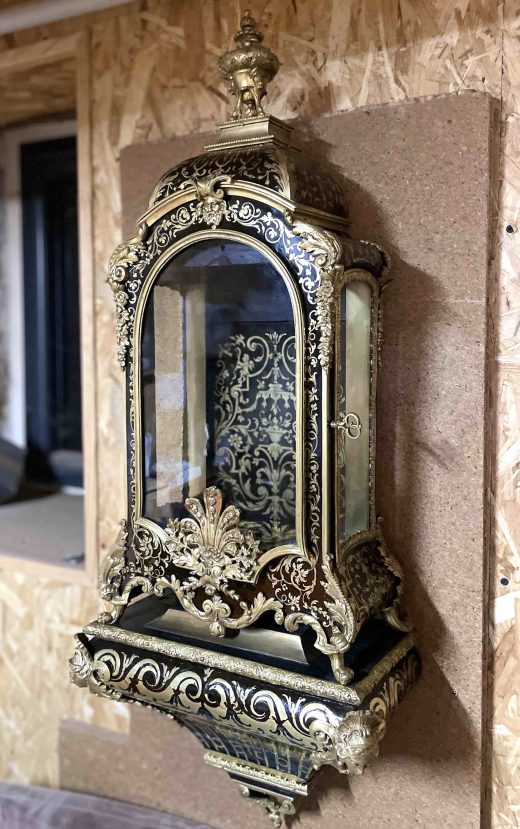
Restoration of a Regency clock case in Boulle marquetry on a brown tortoiseshell background. Since Antiquity, humankind has sought to master and create a "timekeeper." Egyptian obelisks, water clocks, sundials, hourglasses. But it was in the 15th century that the first mechanical weight-driven clocks were made, with a single hand, but generally equipped with chimes. Then, in the 16th century, the counting of the day in two parts, 12 hours instead of 24, was adopted almost everywhere, even though each city kept its own meridian time until the advent of railways and […]
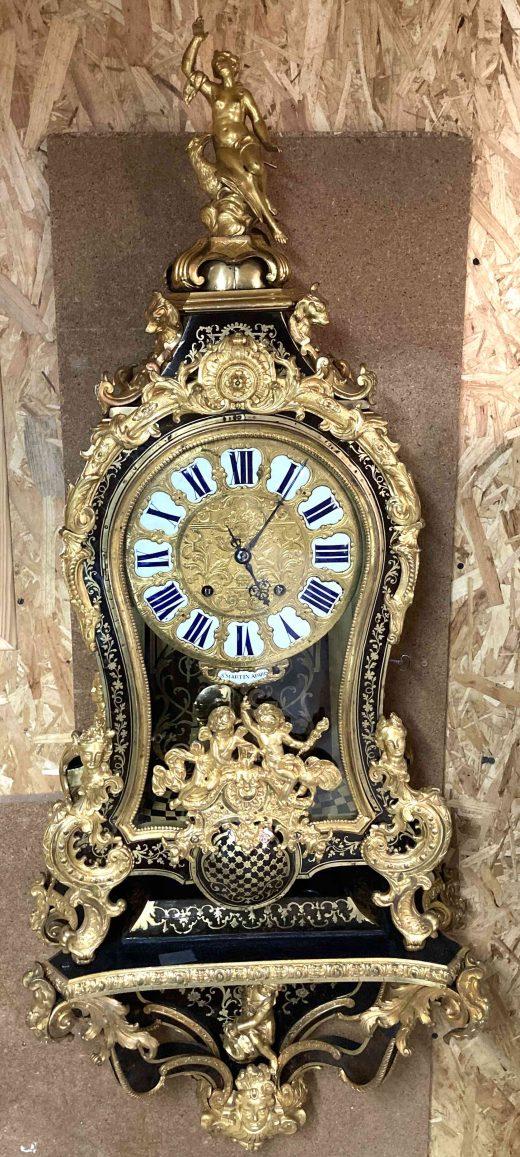
Restoration of a large cartel clock (137cm high) and its console-style bracket from the Regency period. It is made of solid oak veneered with Boulle marquetry of brown tortoiseshell and brass. It is decorated with floral garlands, crosshatching, and foliage. The dial is made of chased and gilded bronze with an interlacing design and birds; the Roman numerals are enameled, and the signature St Martin à Paris is inset. The plate is signed with the same name. It is adorned with chased and gilded bronze mounts depicting on its capital […]
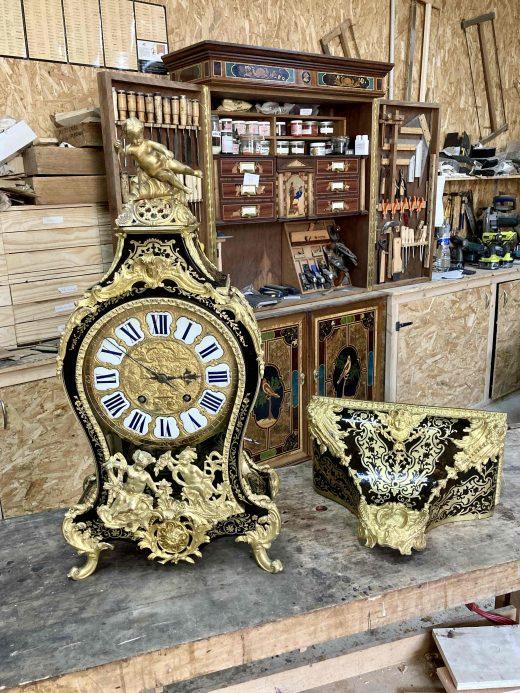
Here are some images of the restoration of a clock case that some of you may have seen during the work at the Mans'Art fair this year. This Louis XV period clock case is inlaid with tortoiseshell and brass, and the frame is oak. The bronze mounts bear the hallmark of the Crowned C. The Crowned C was established by an edict of 1745, which required bronze workers to mark their pieces with a small distinctive letter, a C surmounted by a crown, thus subjecting them to a tax. This tax applied to […]
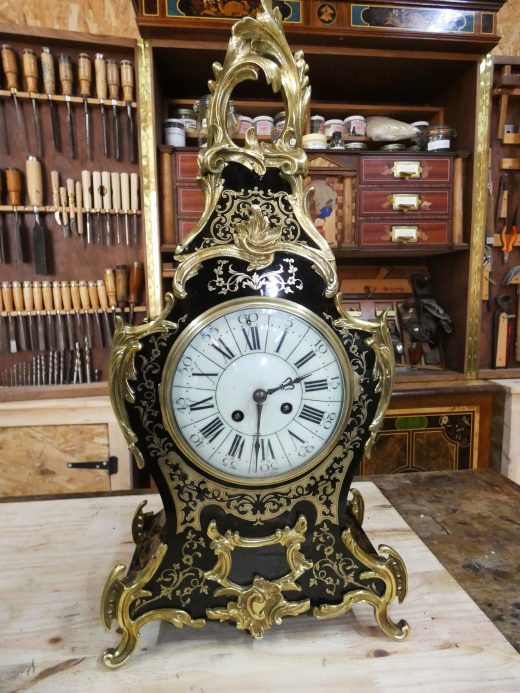
Restoration of a Napoleon III period marquetry clock in brown tortoiseshell on a black ground and brass. Despite dust, oxidation, and years spent in the depths of an attic, this small clock is in very good condition. Except for a missing piece of brass on the right side of the capital, it is complete. The gilding is still clearly visible beneath the layer of grime, and the structure is in perfect condition. The restoration was therefore straightforward: re-gluing all the marquetry under vacuum, then a light cleaning, and a varnishing with […]
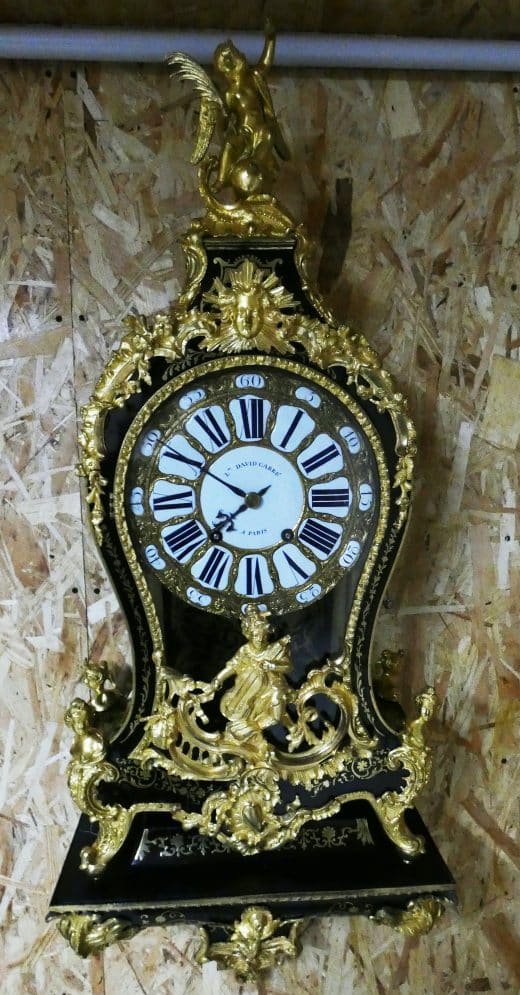
After several weeks of work, the restoration of this clock is finally complete. It is a Louis XV period clock in brown tortoiseshell and brass marquetry, with rosewood restorations. The dial is by Louis David Carré, nephew of Jullien le Roy, who became a master craftsman on December 31, 1748. Lodged at the Louvre from 1744, he was elected a juror in 1775. The greatest treasure of this clock lies in its bronze mounts. They are truly magnificent, and above all, they are in very good condition. There is only […]
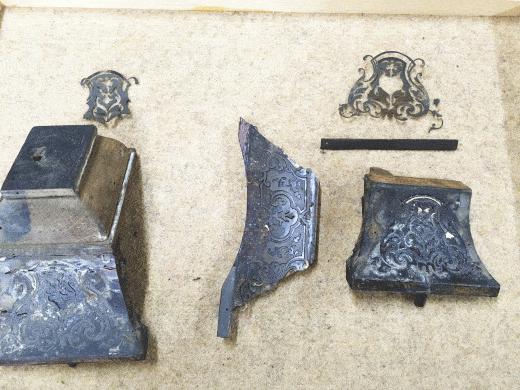
Once the various structural elements were glued back together, I tackled the tortoiseshell and brass marquetry. As you'll see, on this clock it's in very, very bad condition; practically nothing is holding. So, all the brass has to be removed. The tortoiseshell, however, is holding well; it's only partially detached. The first step in restoring this marquetry is therefore to remove and set aside each brass element. The second is to clean off the old glue, […]
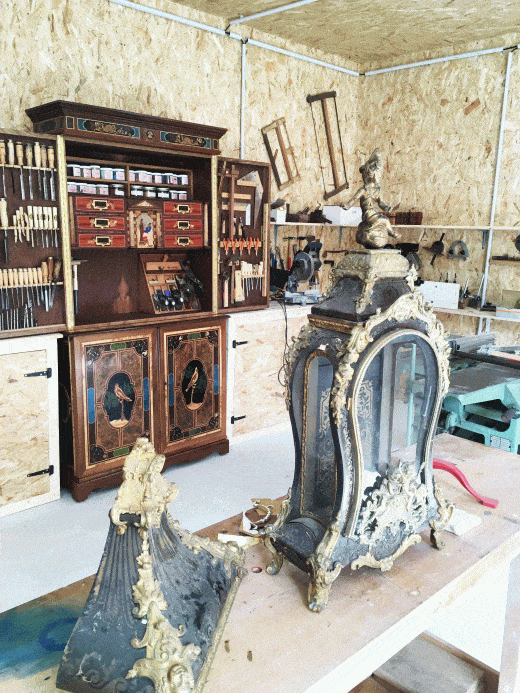
Here is my first client, patient… well, whatever you want to call him. It's a Boulle marquetry cartel clock in brown tortoiseshell, ebony, and brass. As you can see in the following photos, it's not in very good condition. There are many missing brass pieces, and the remaining brass is peeling off everywhere. At first glance, it's always difficult to precisely date a Boulle cartel clock: this one doesn't have a maker's mark. However, it does have corkscrew screws (typical of the 18th century […]