Barber shop Louis XVI/Directory

Ebénisterie Mathieu Vath

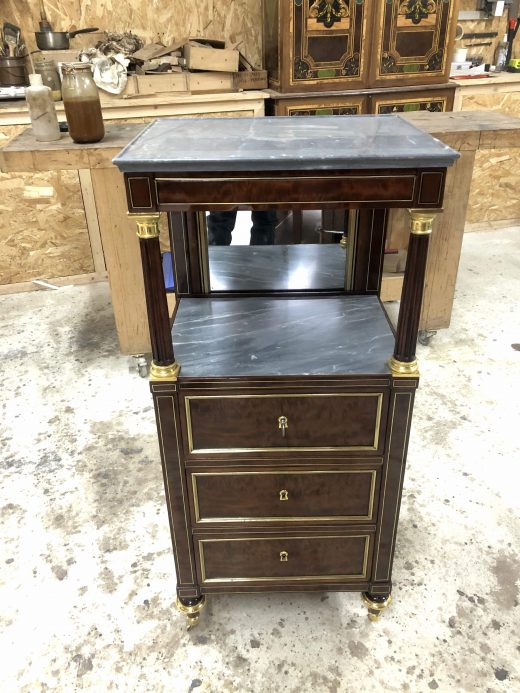
This elegant mahogany-veneered shaving cabinet from the late 18th century rests on four tapered legs with casters and opens with three drawers in the front. The niche, with its blue Turquin marble top framed by fluted columns, is surmounted by two side drawers and a sliding marble shelf with a recessed panel that reveals a sliding mirror on a rack and pinion mechanism, pivoting and framed with ebony and brass stringing. Appearing during the reign of Louis XVI, this style of shaving cabinet is a toilet unit designed to hold a porcelain pitcher and basin […]
Empire Pedestal

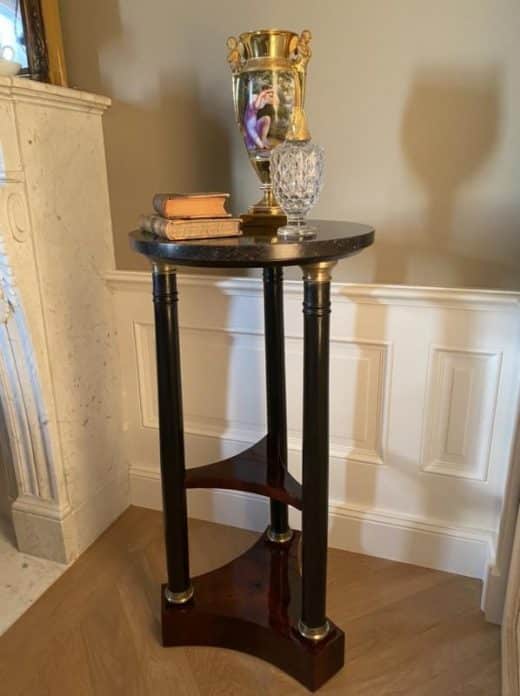
Restoration of a walnut (for the legs and frame) and flame mahogany veneer pedestal table. It rests on three column-shaped uprights, surmounted by a circular black veined marble top adorned with bronze rings. The restoration involved tightening the cracked base, re-gluing the edge veneers, and adding some veneer grafts. The columns, which were heavily infested with wood-boring insects, were stripped and then treated with static anoxia. Static anoxia is an insecticidal treatment that works by depriving the body of oxygen, having […]

Louis XV commode

Ebénisterie Mathieu VATH

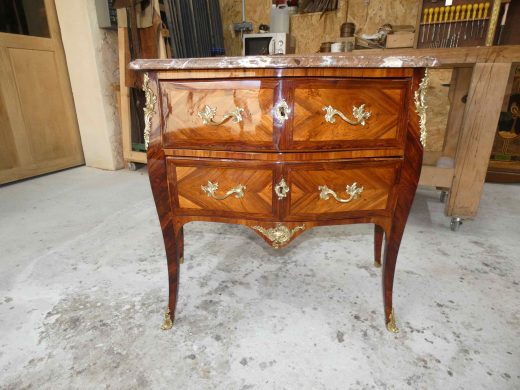
The commode with a jumping habit seems to have been invented during the Regency period, between 1705 and 1730, by the cabinetmaker Charles Cressent, and subsequently became widespread in the Louis XV style. It consists of only two drawers or two rows of drawers. The body must be raised on cabriole legs of about half height, with the body occupying half the height of the piece and the other half the legs. The observer thus has the impression that the piece has legs allowing it to jump like a frog. The width offers straight, curved, or […]

Empire Chest of Drawers with Quivers

Ebénisterie Mathieu VATH

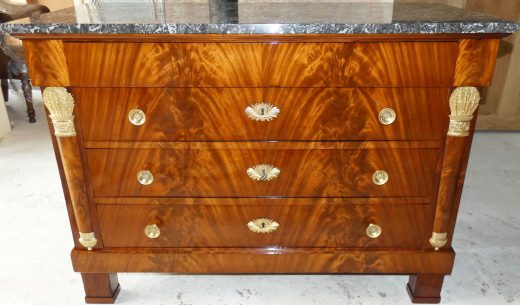
This week, here are some photos of the restoration of this Empire-style chest of drawers veneered in mahogany burl. This chest is truly unique due to the quality and originality of its bronze mounts. Indeed, they form quivers along with the side columns. The keyhole escutcheons are composed of two crossed laurel branches held together by a ribbon. Originally, they were mercury-gilded, as can be seen from the gilding stains on the back. Unfortunately, only a few partial traces remain on the front […]