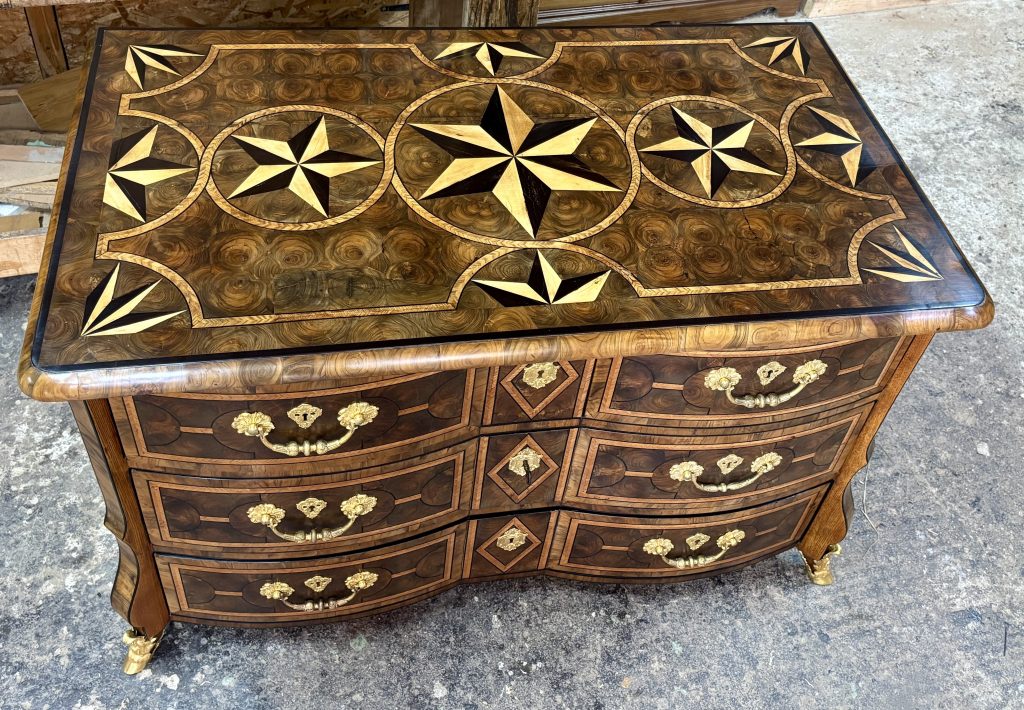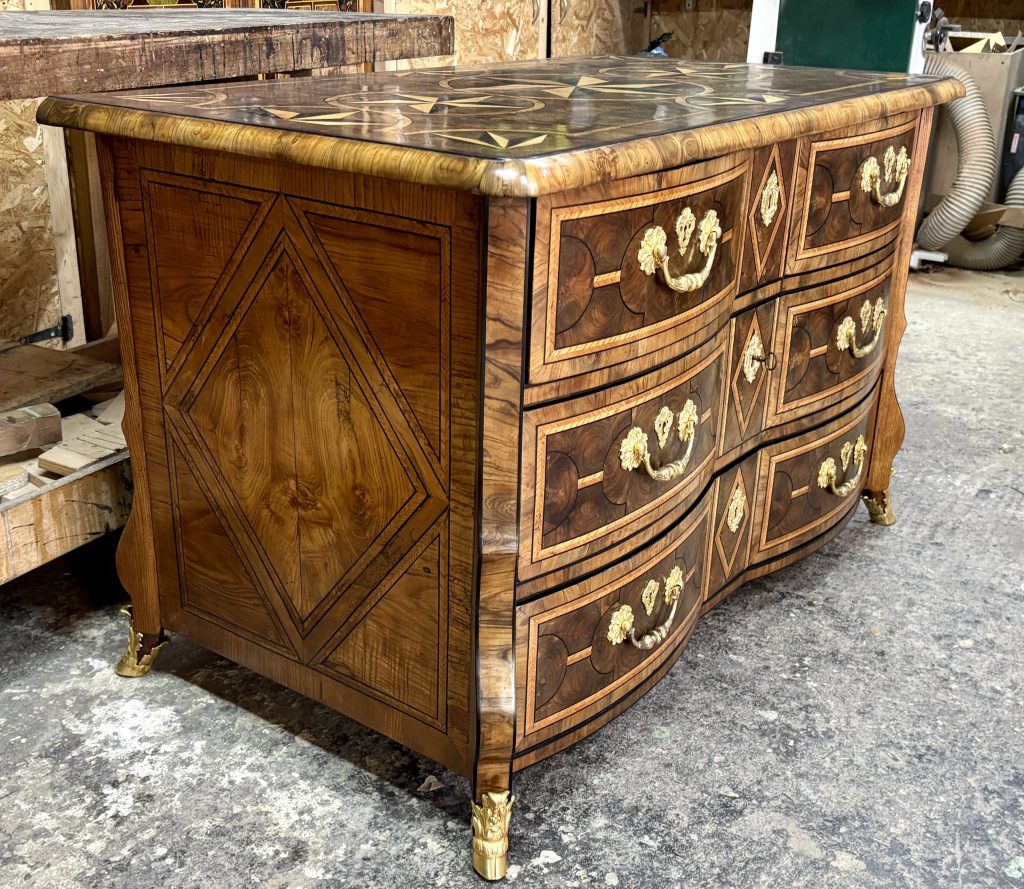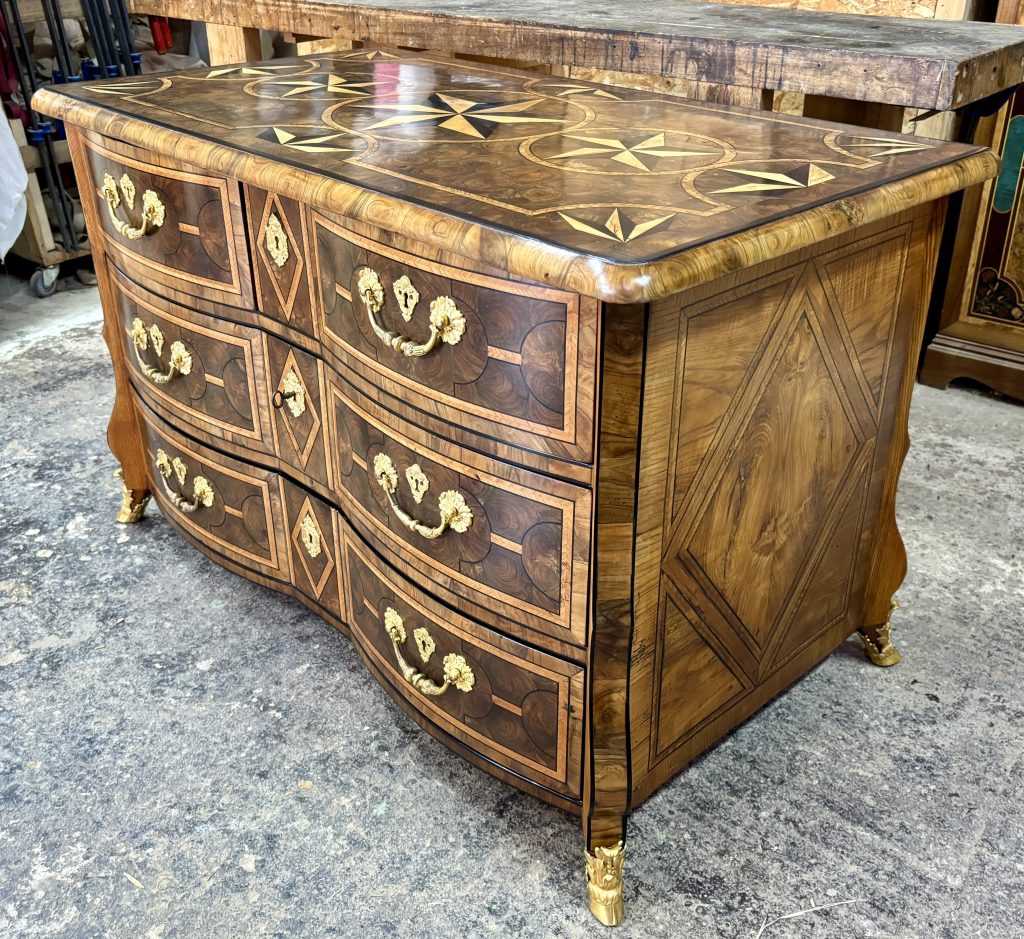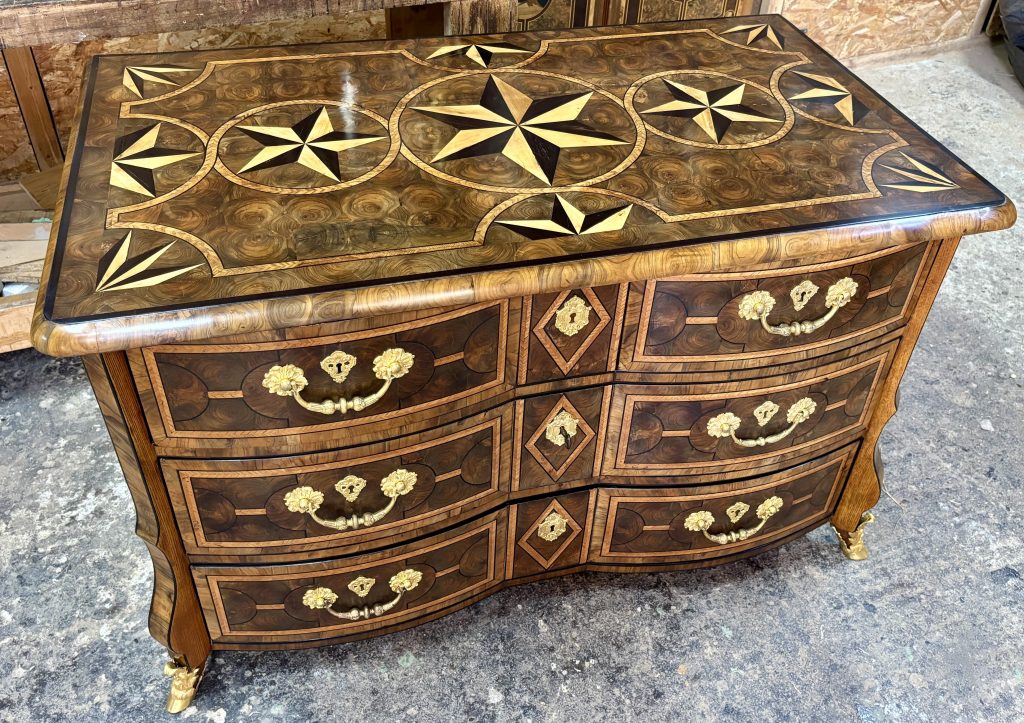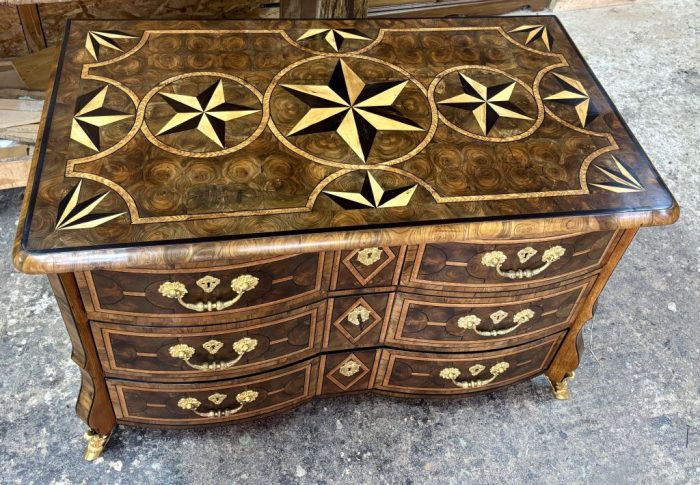
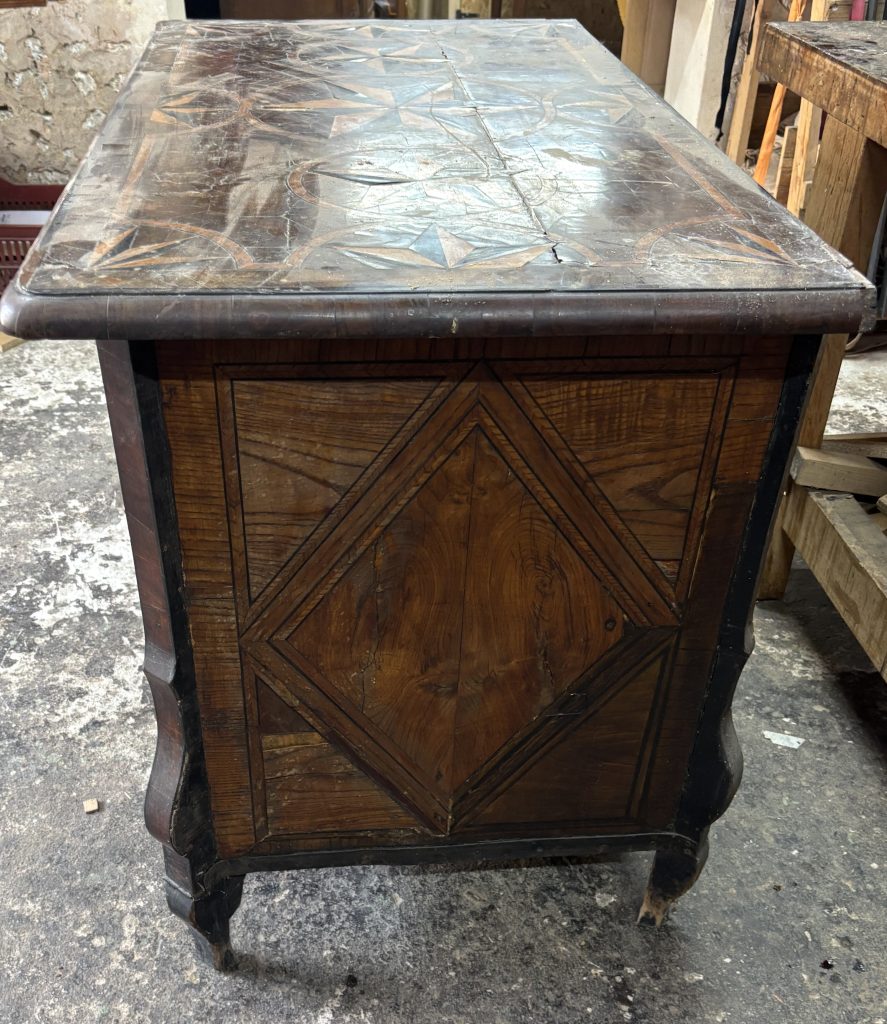
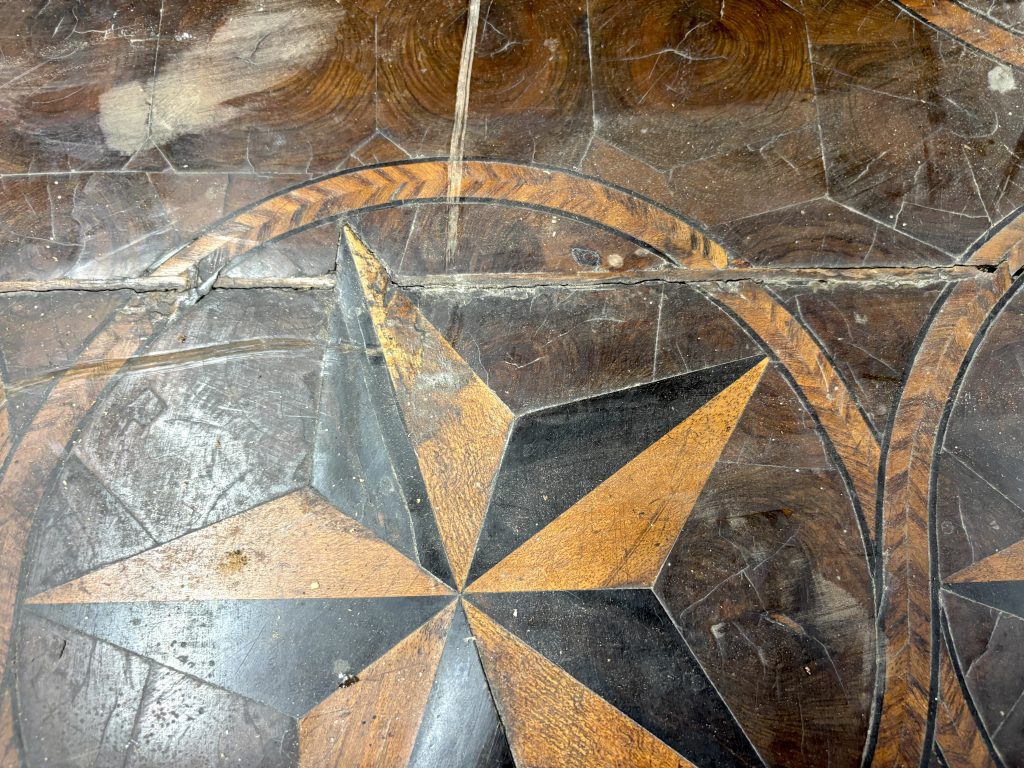
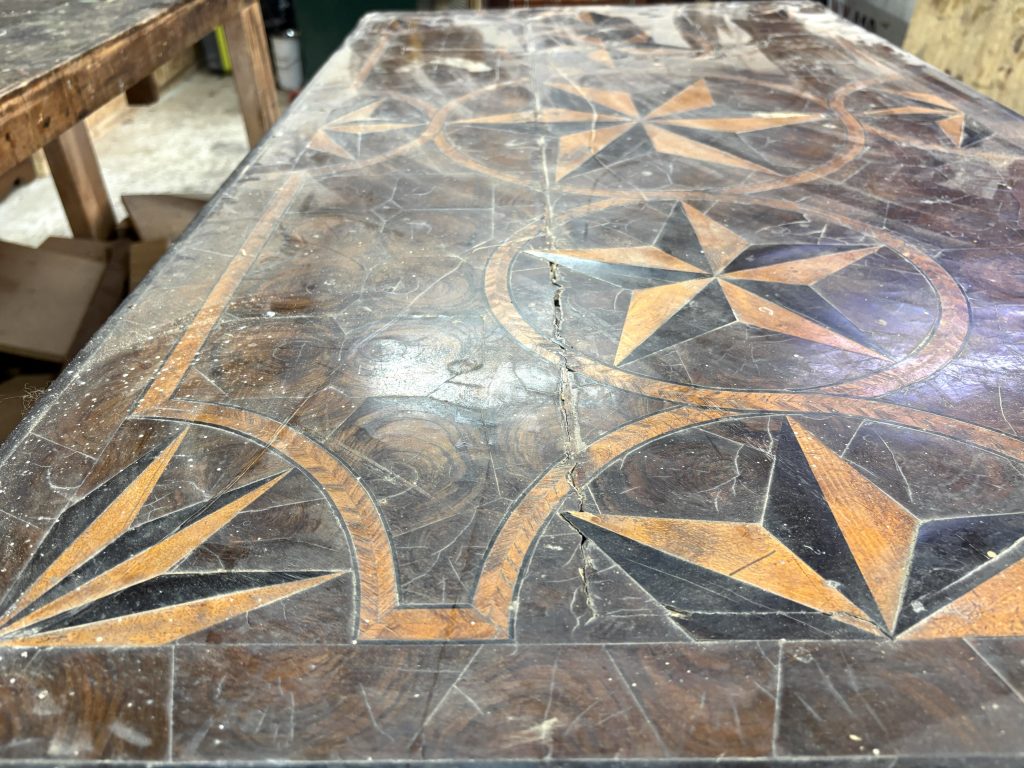
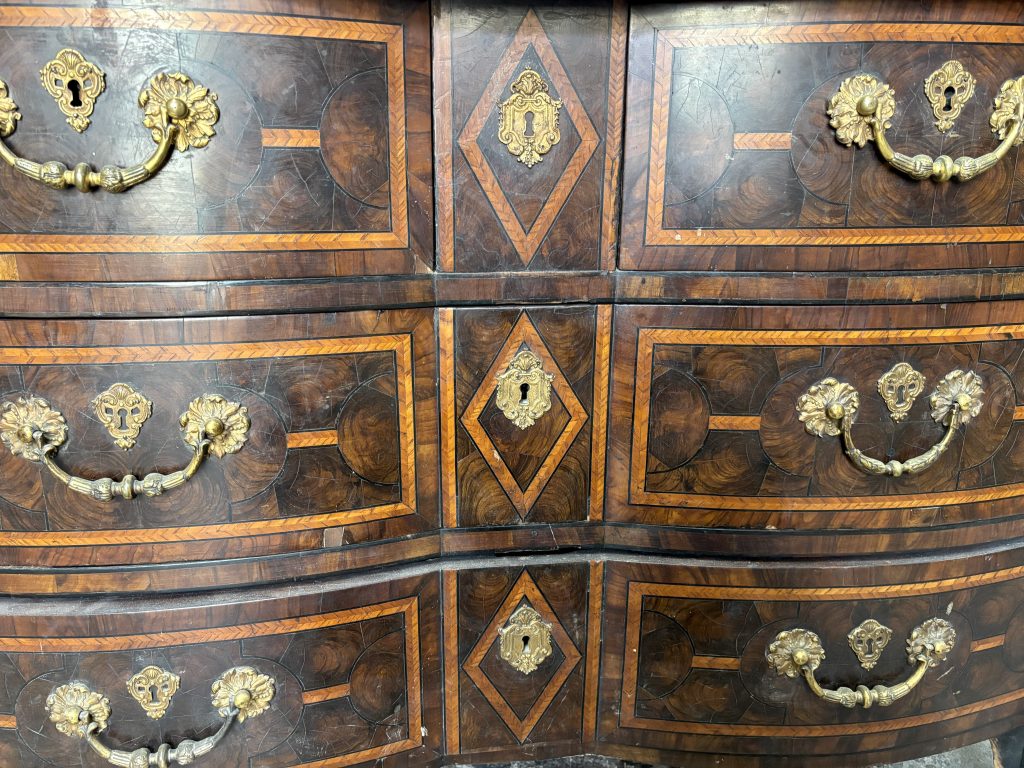
Restoration of a chest of drawers with attached brackets, from the Regency period. It is commonly, but incorrectly, called a "Mazarine commode". Its veneer combines end-grain olive wood, maple, ebony and ash, with chevron stringing of elm and ebony.
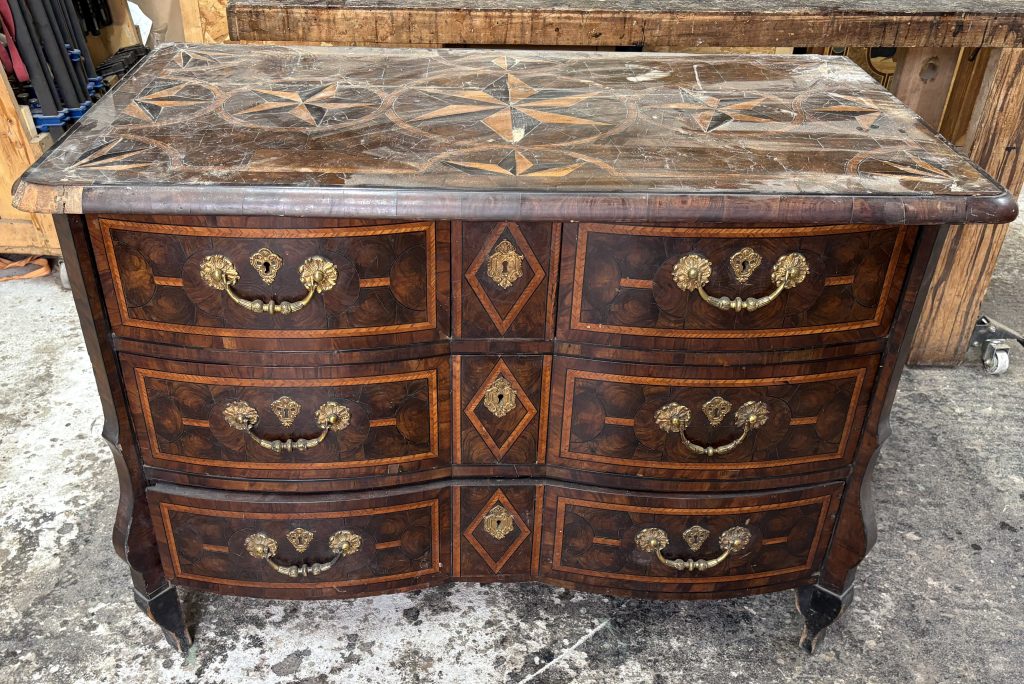
A chest of drawers with added brackets, mistakenly called a "Mazarine" chest of drawers«
This type of chest of drawers is among the very first to have become popular, in the first quarter of the 18th century. The word "commode" itself took some time to become established: this piece of furniture actually derives from eight-legged desks, to which drawers were added across the entire width of the front. They were thus adapted to their new function of storage. The first chests of drawers appeared around 1690 under the names "bureaux" or "bureaux en commode" (desks in the form of a chest of drawers). The term "commode" only later came to designate the rectangular, four-legged form that we know today.
Between 1708 and 1709, André-Charles Boulle produced the oldest known and datable Parisian commodes: a pair made for the bedroom of the new apartment that Louis XIV had furnished at the Grand Trianon starting in 1703. The Marquis d'Antin, recently appointed Superintendent of the King's Buildings, already mentions this piece of furniture in a letter dated July 3, 1708. The royal accounts then record its payment—no less than 3,000 livres—on September 3, 1708, and April 18, 1709. Revealingly, these contemporary documents themselves refer to this piece of furniture as a "desk." This demonstrates the uncertainty surrounding the terminology of this emerging type of furniture at the time.
The Trianon chests of drawers
Shaped like a sarcophagus, the Trianon chests of drawers They open with two superimposed drawers and rest on four arched feet terminating in a gilt-bronze volute. Each corner is accentuated by a console whose volute ends in a winged sphinx head, the foot terminating in a lion's paw foot. Gilt-bronze moldings, rosettes, and acanthus leaves adorn the entire structure, perfectly complementing the marquetry design.
Olive veneer
The olive veneer of the commode restored here illustrates another facet of this same period: during the great winter of 1709, thousands of olive trees perished, and the craftsmen of the Dauphiné recovered them to make furniture (The Century of Louis XIV, p. 249).
Besides its decorative qualities, the olive tree owes its success primarily to its symbolism. For the Huguenot elite, it embodies peace, reconciliation, and hope.
The origin of the name "Mazarine"«
The term "Mazarine commode," commonly used for this type of furniture, is actually a misnomer in the art market. It derives from the history of this very pair of commodes delivered by Boulle for the Trianon. Remaining in the royal collections, they were sent to the Crown Keep on June 13, 1790, in the midst of the French Revolution. Around 1795, they joined the Bibliothèque Mazarine (Mazarine Library) before being deposited at the Palace of Versailles. It is this time in the Bibliothèque Mazarine that gave rise to the name that has remained in common usage.
However, the art market today mistakenly applies this same name to more recent commodes. These latter pieces have an orthogonal body and a generally flat front, with profiled and sometimes openwork uprights. They are more accurately called "commodes with added brackets." They retain the structure of other Regency commodes. They are distinguished by their curved uprights, attached along the diagonals of the top. The commode presented here belongs to this family, and not to that of the true Trianon commodes known as "Mazarine" commodes.
Bibliography
- Voltaire: The Century of Louis XIV. Paris: Garnier Frères, 1919.
- Provincial cabinetmaking in 18th-century France and Abraham Nicolas Couleru – Bernard Deloche and Jean-Yves Mornand
- André Charles Boulle, Monelle Hayot, June 28, 2024
State of affairs report
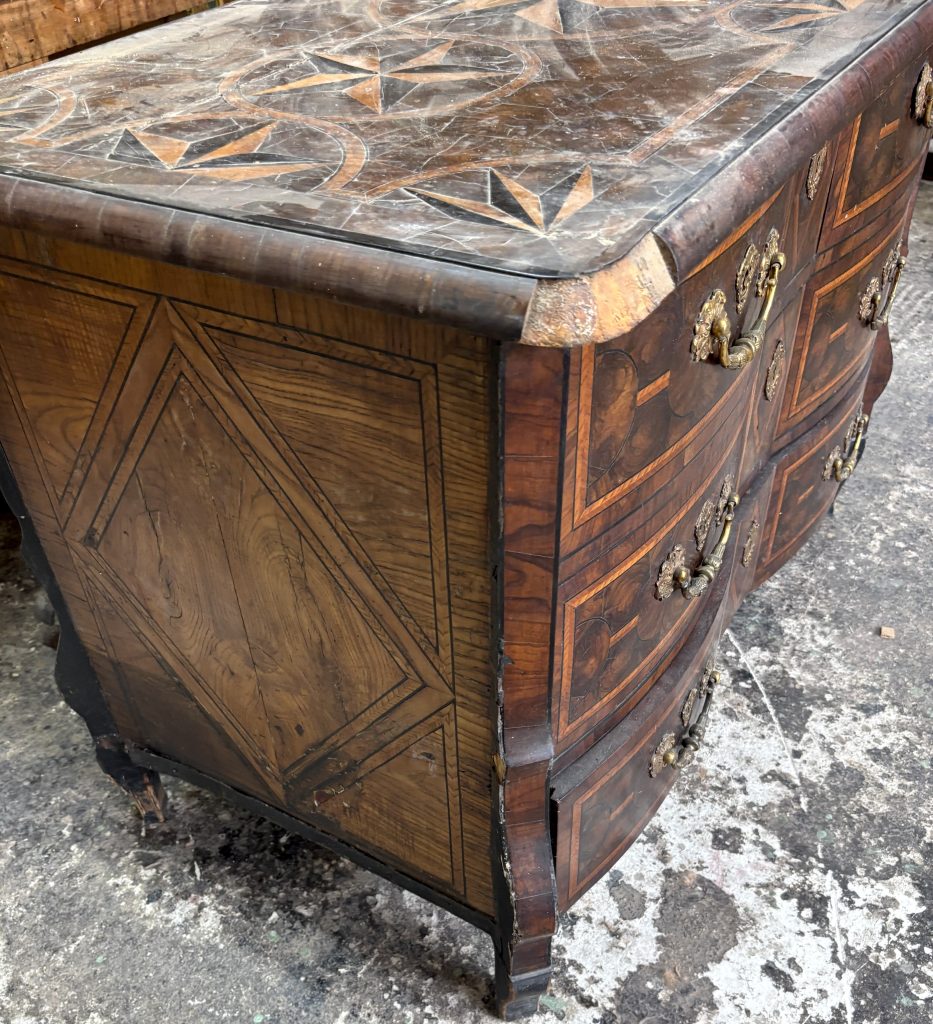
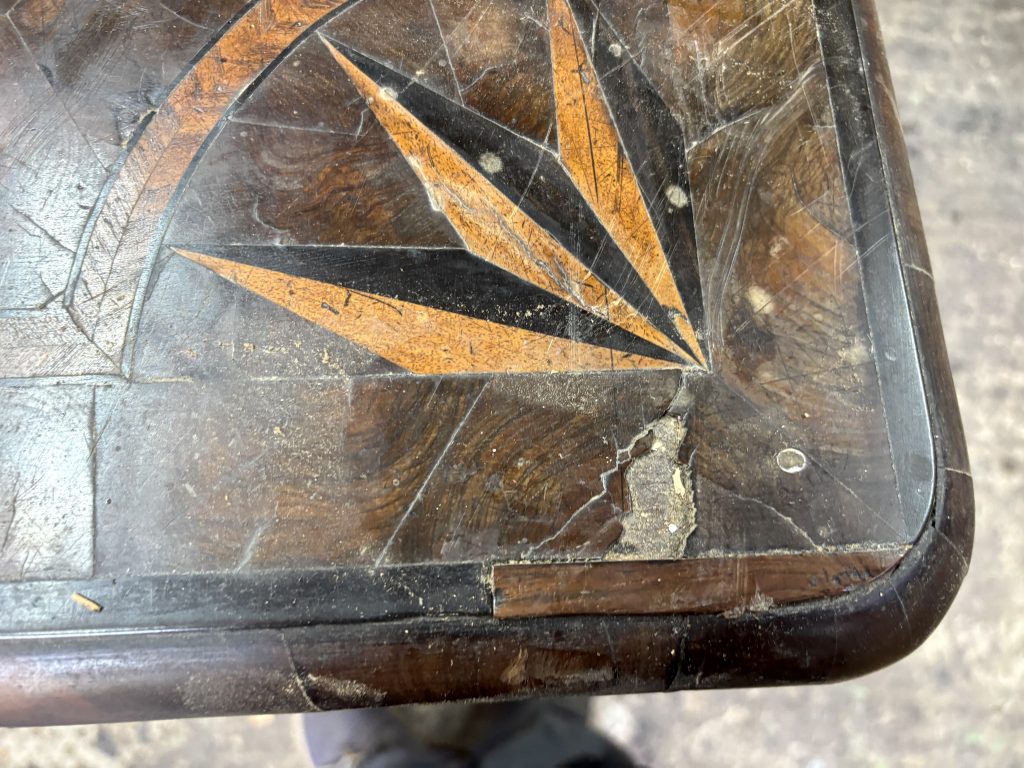
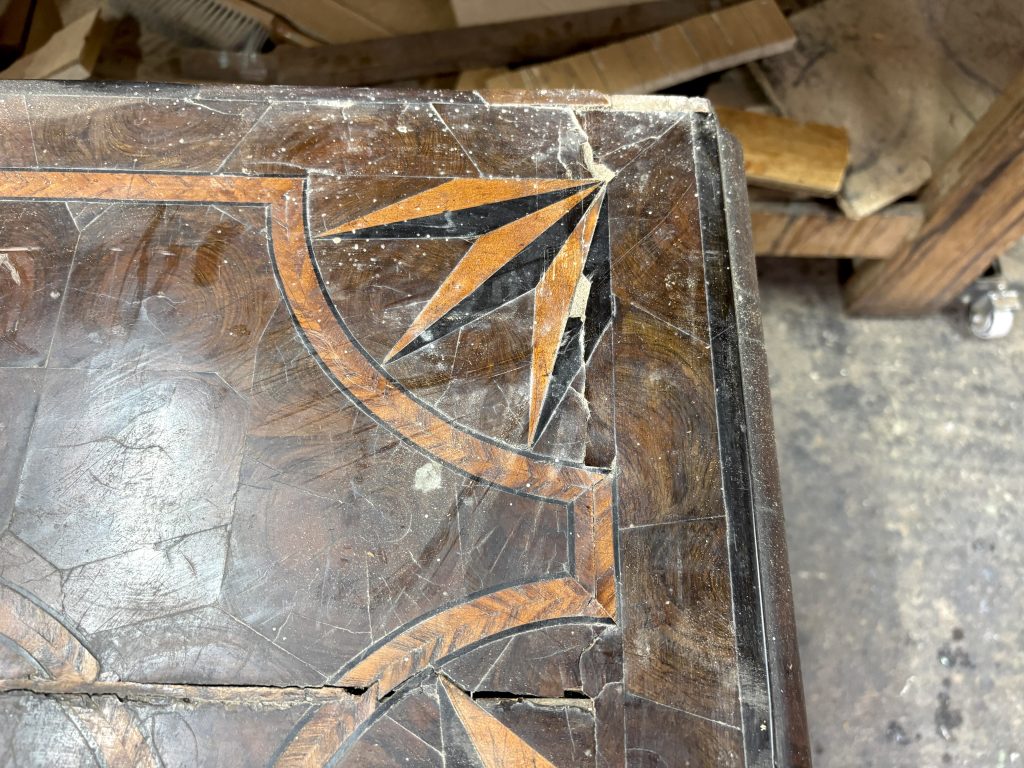
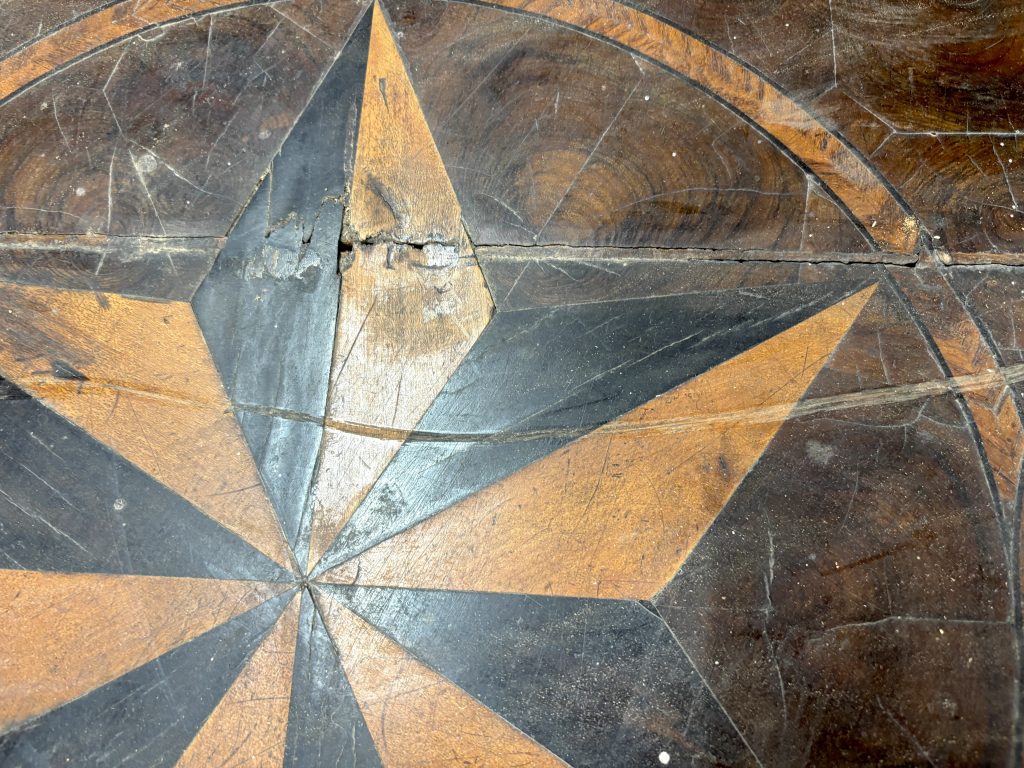
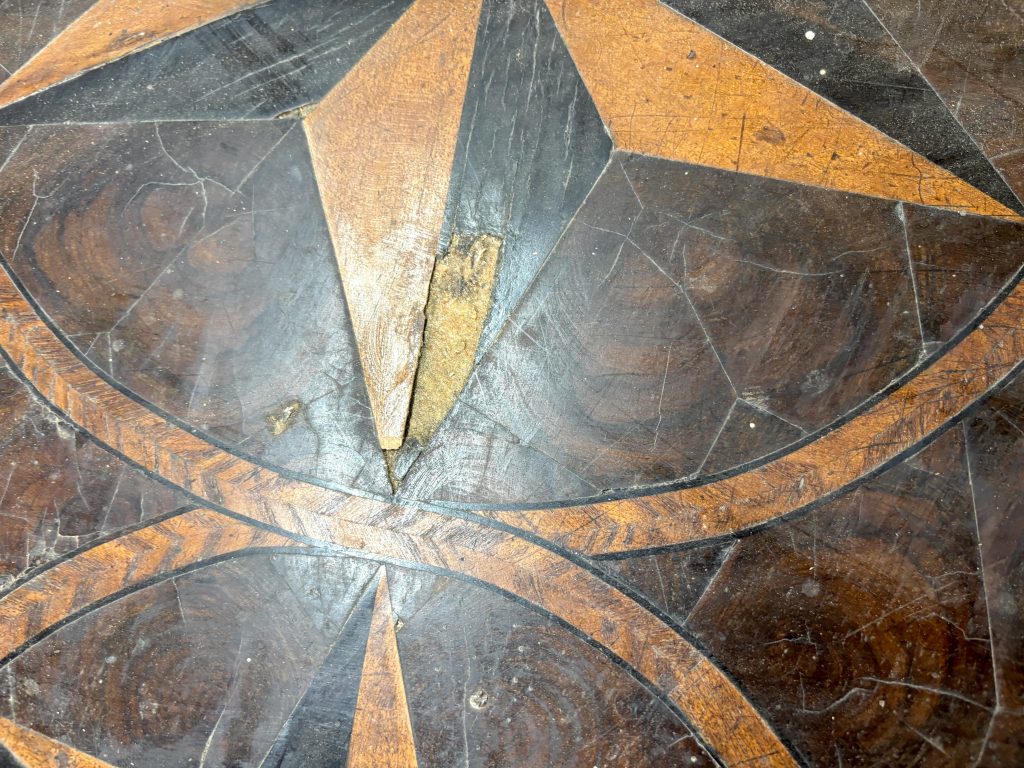
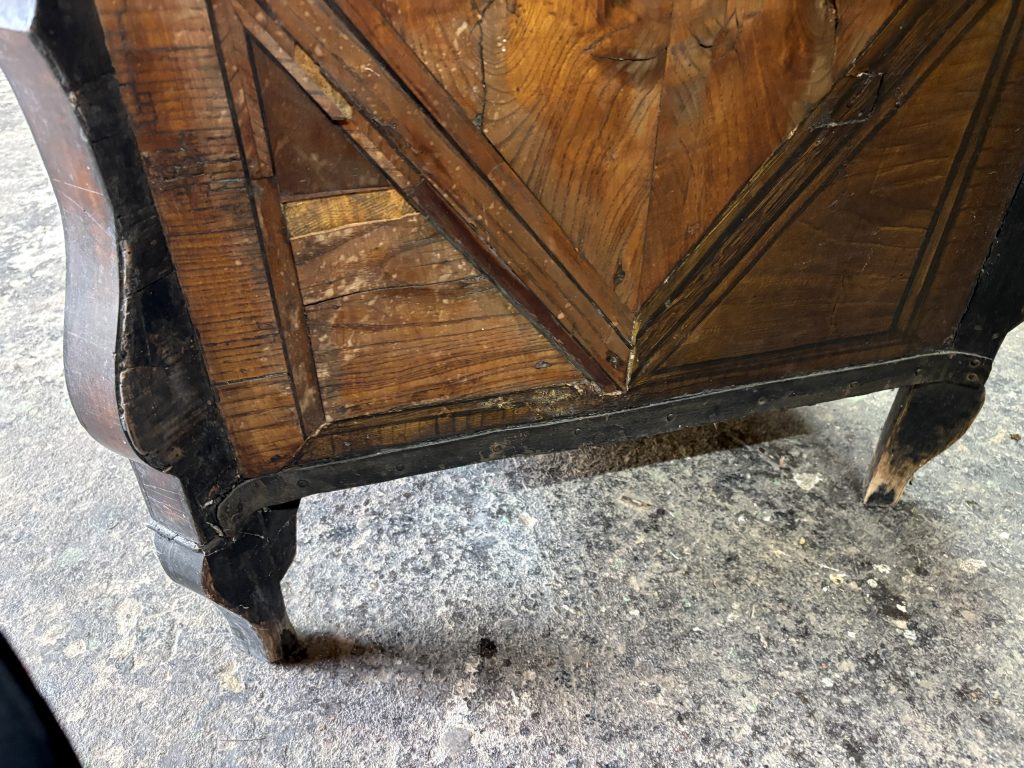
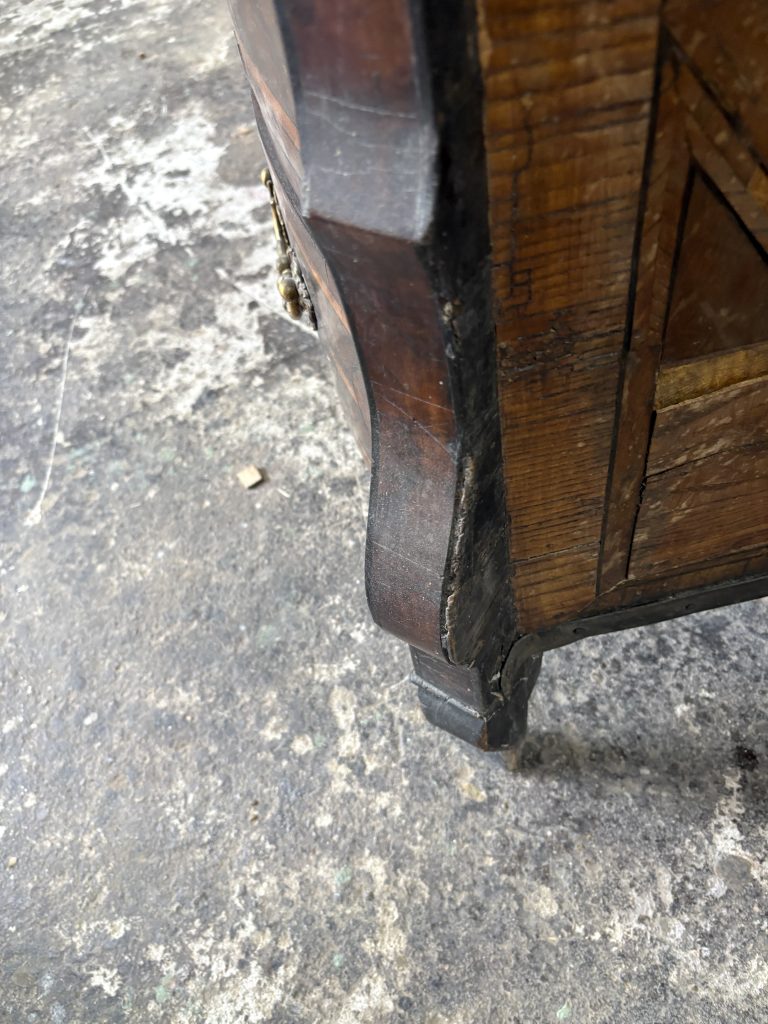
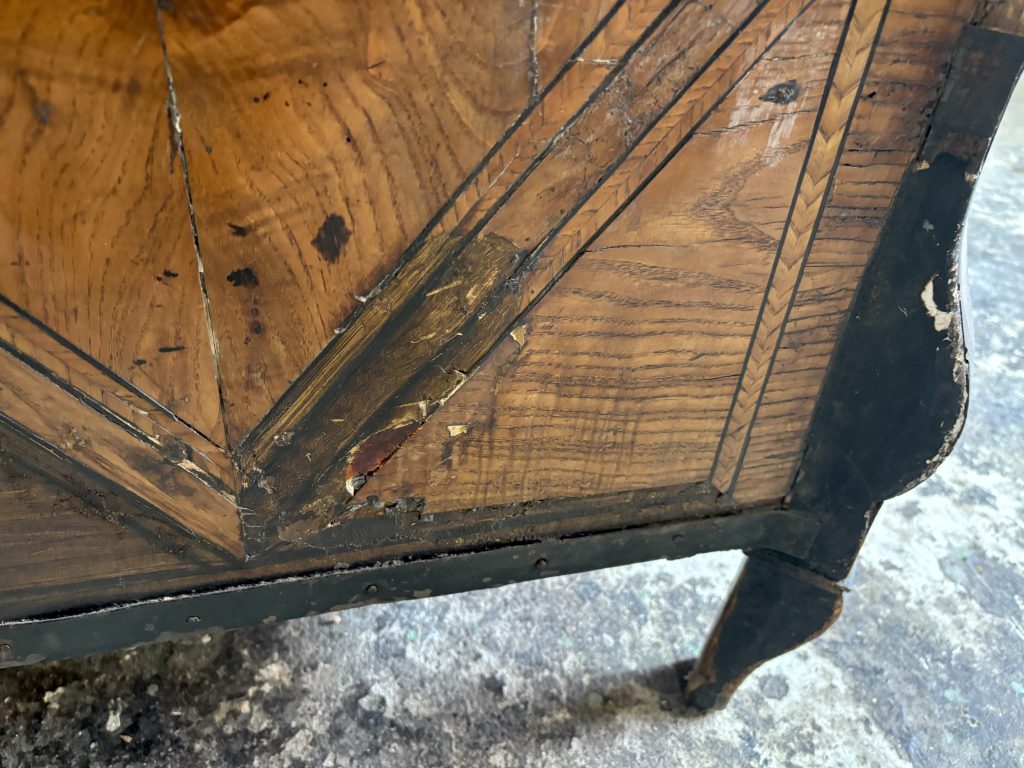
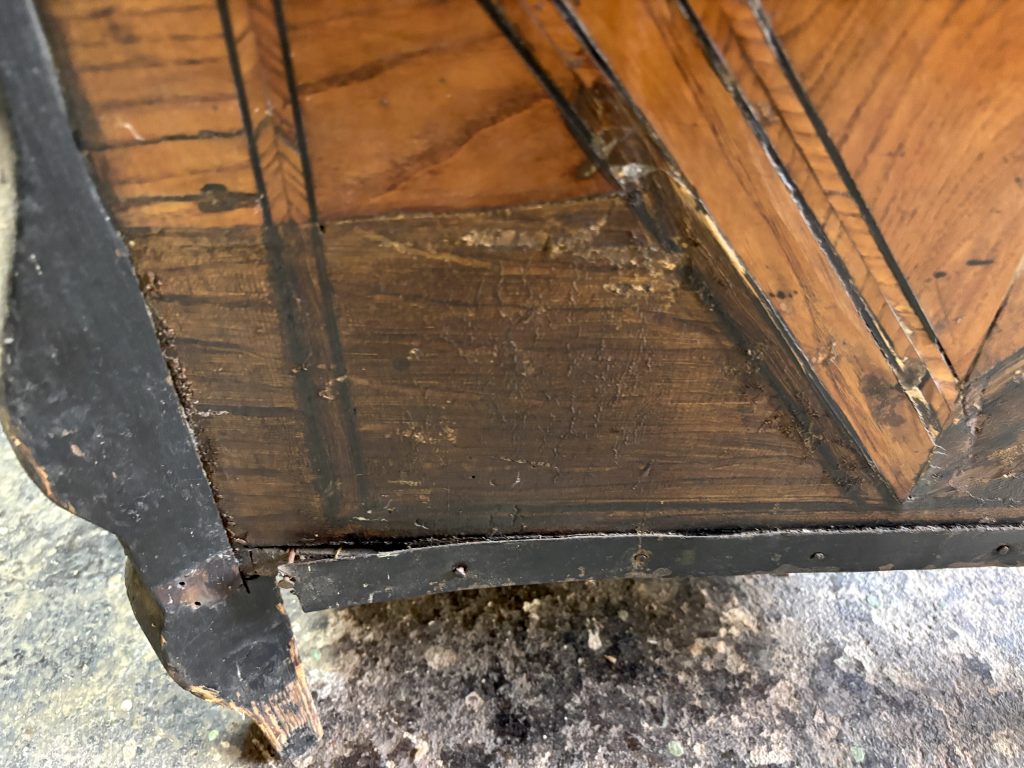
This chest of drawers with added brackets was in very poor condition when it arrived at the workshop. A large portion of the veneer was missing from the sides. A previous restorer had even chosen to paint over these missing sections rather than replace them. The top had a crack running its entire length. Veneer was also missing throughout the piece. Furthermore, a previous restoration had replaced the rear legs, and none of the legs were original.

The Restoration
As is customary with this type of furniture, the workshop restored all the missing veneer using end-grain olive, ash, and elm. Each graft follows the contours of the damaged areas to preserve as much of the original wood as possible. The workshop then recreated the rear legs to match the original design. Finally, the front legs were repositioned to accommodate sabots, replacing the later, non-original feet.
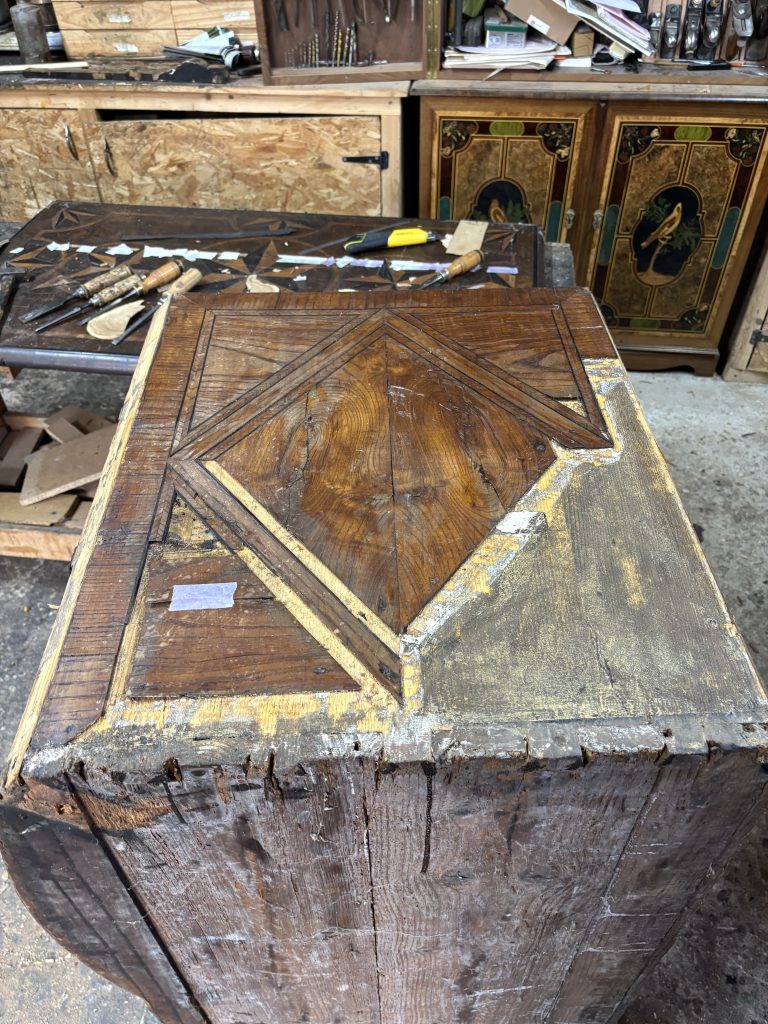
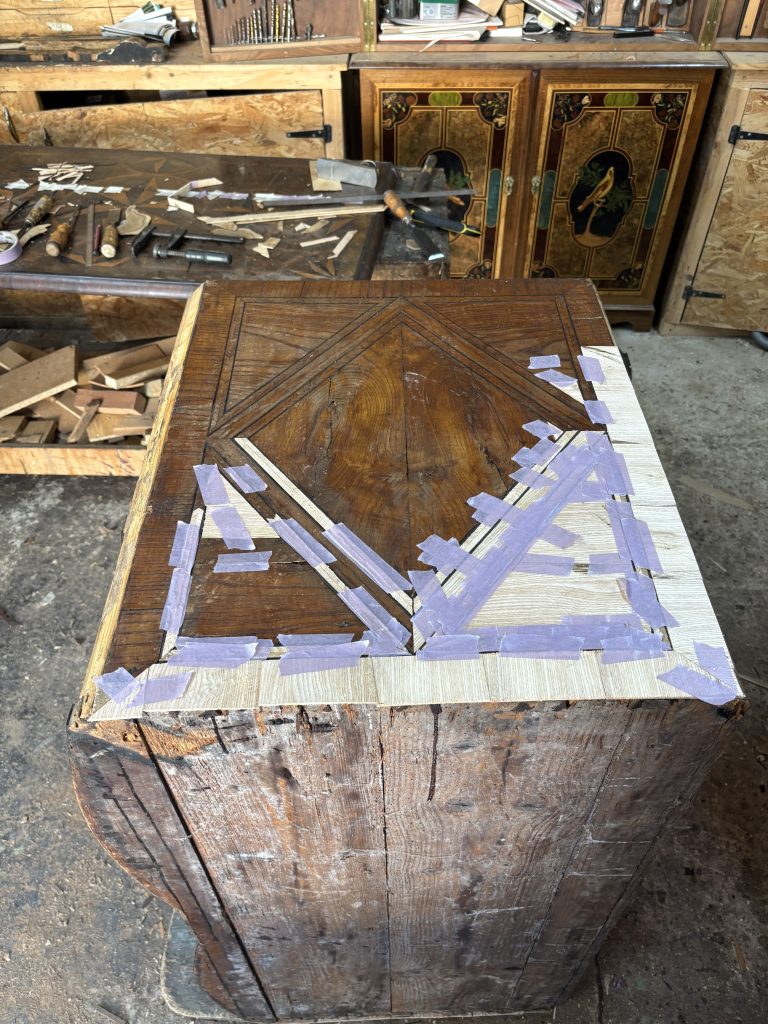
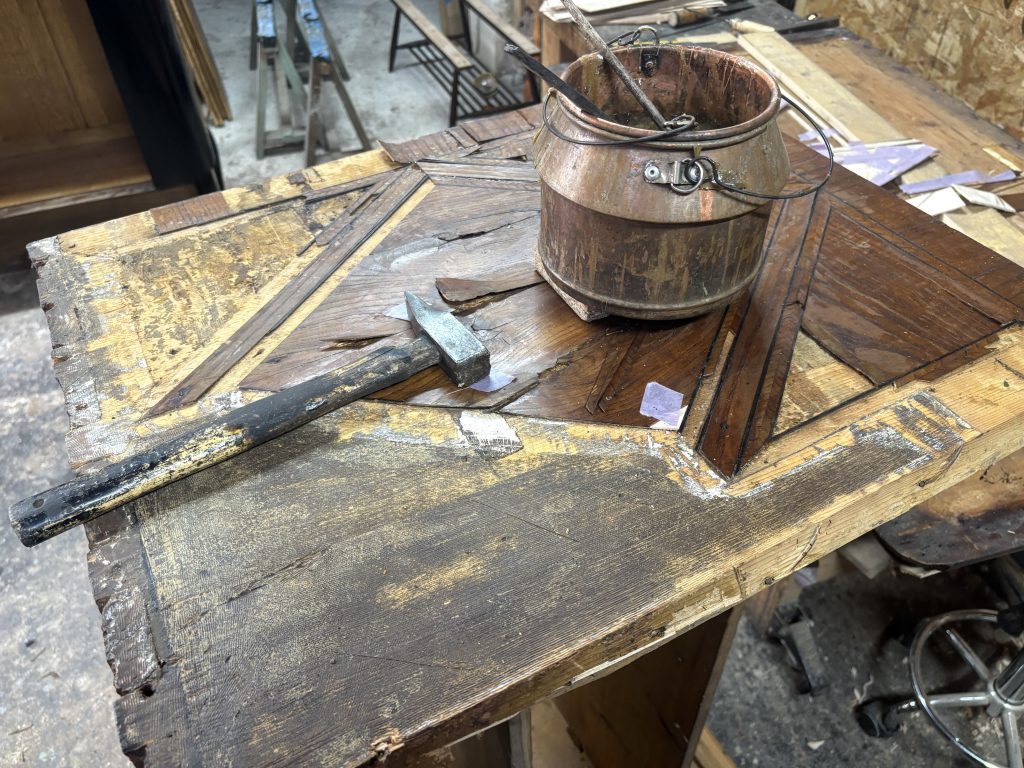
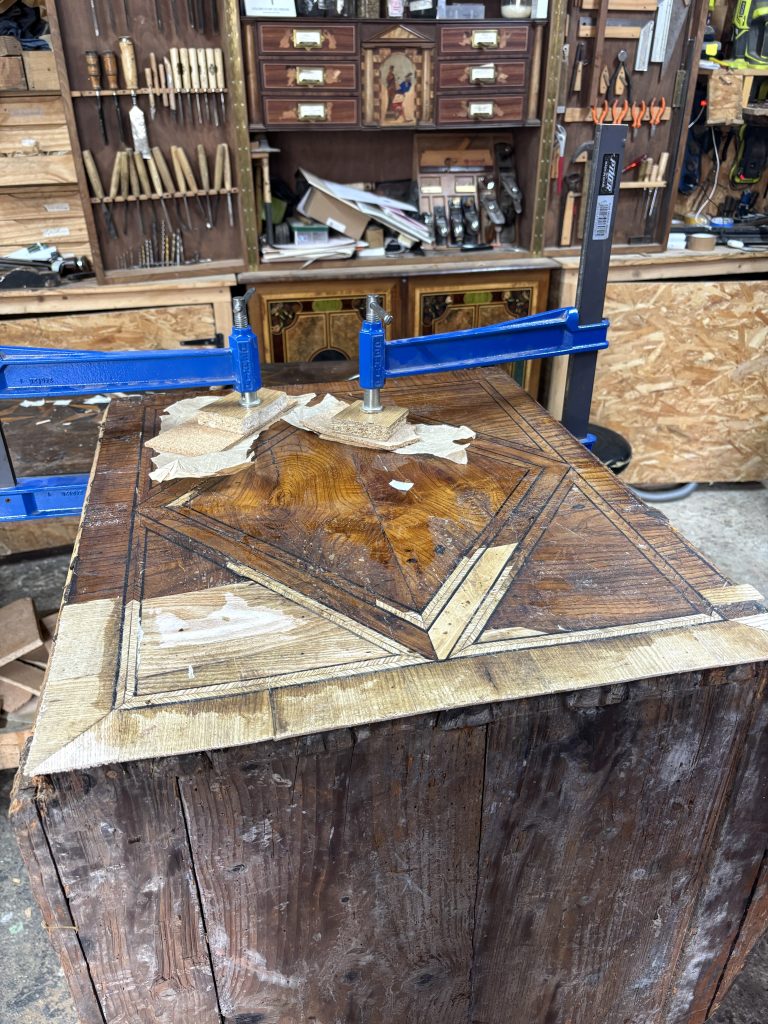
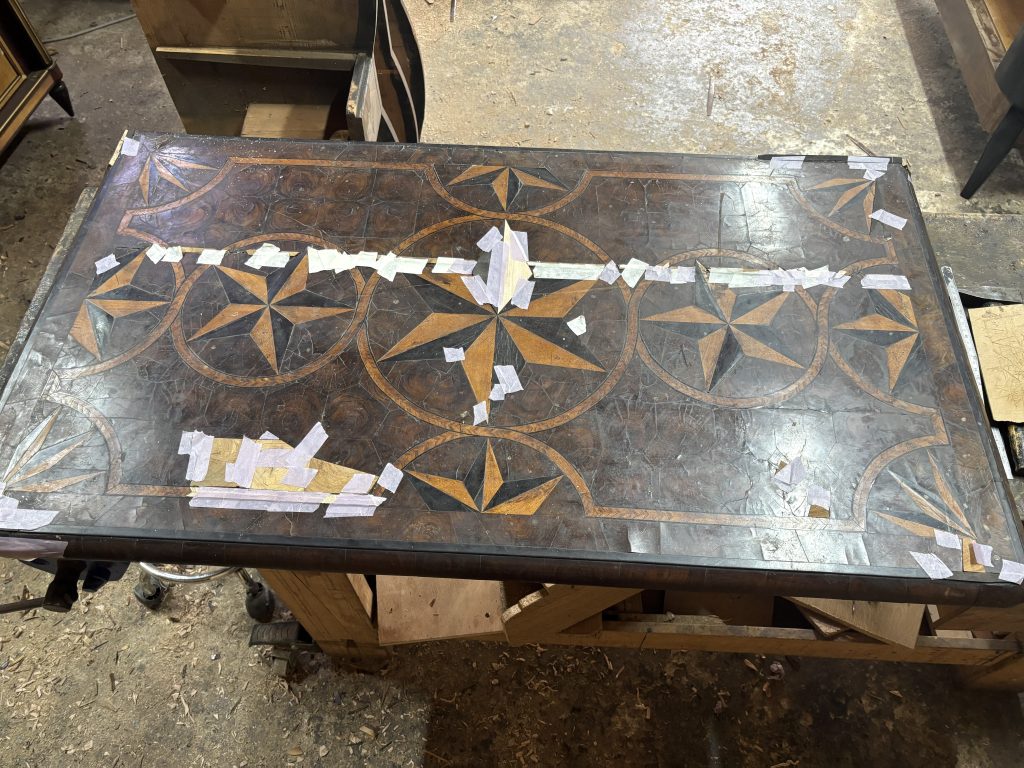
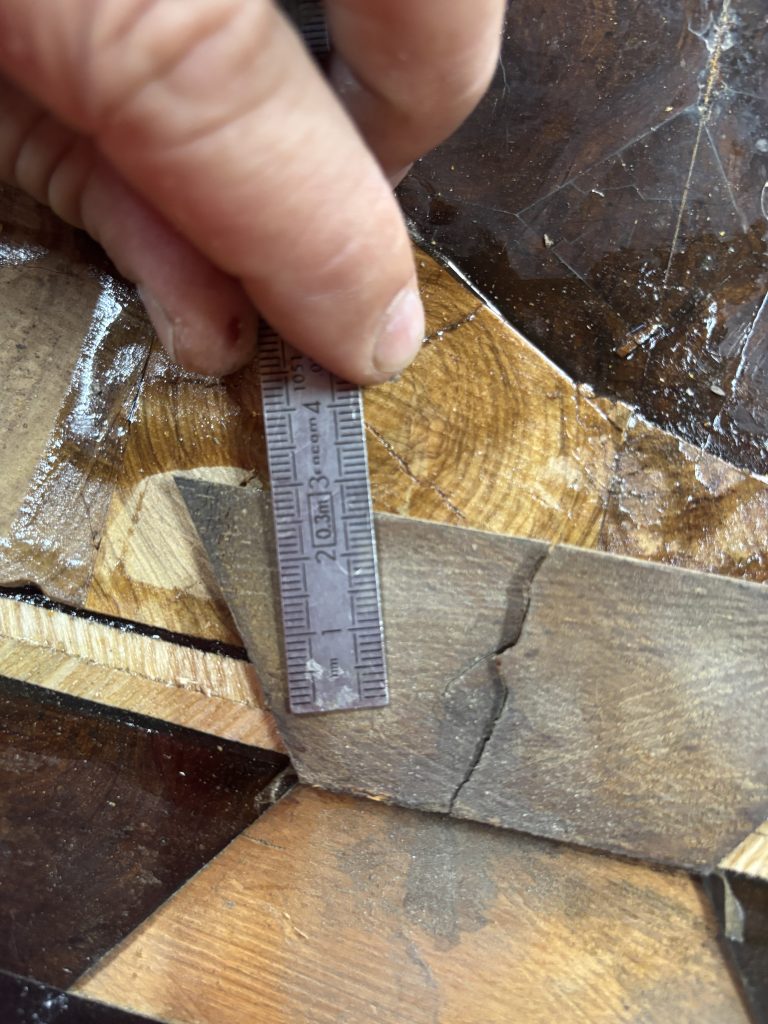
After thorough cleaning, the removal of oxidation from the veneer grafts, and a waxed polish finish, the chest of drawers has regained a coherent display of its original marquetry. It is now free of the overpainting that concealed its imperfections.