Regency commode by François LIEUTAUD

Ebénisterie Mathieu Vath

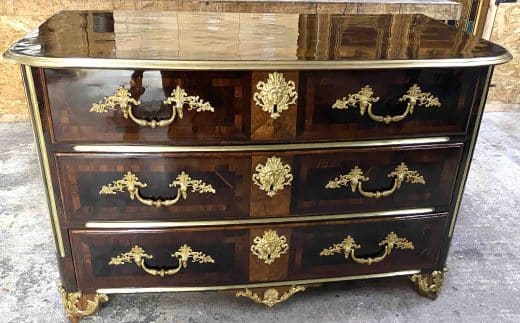
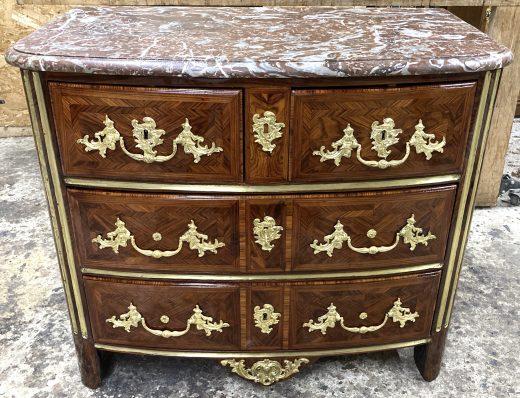
Restoration of a Regency period commode in alternating rosewood and walnut, inlaid with friezes and fillets. Its slightly curved front opens with three wide drawers. A brass molding encircles the top, which features a geometric design of circles around a central polylobed motif adorned with figures. Polished brass fluting embellishes the uprights and rails. The sides are veneered with walnut in a diamond pattern. Finally, the tapered feet terminate in claw feet. The commode also features large, chased and gilded bronze mounts.
Regency chest of drawers stamped ID

Ebénisterie Mathieu Vath

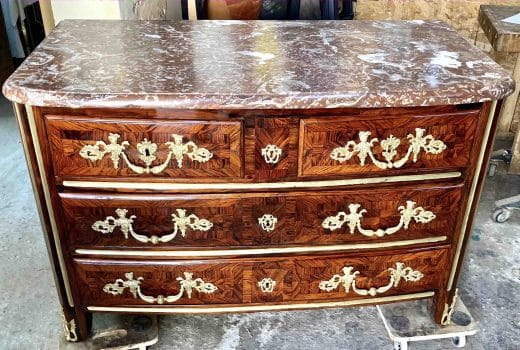
Restoration of a Regency commode, veneered in rosewood on a conifer frame. It was only after three weeks of work that I noticed a strange mark. It had been right in front of me from the start, and I hadn't seen it. It is indeed quite rare to see a stamped Regency commode. But yes, the mark was definitely there. And it's not a modest one: this ID stamp is attributed to Jacques Denizot. Jacques Denizot (1684–1760) was a Parisian cabinetmaker who remains relatively unknown. […]

Regency chest of drawers

Ebénisterie Mathieu Vath

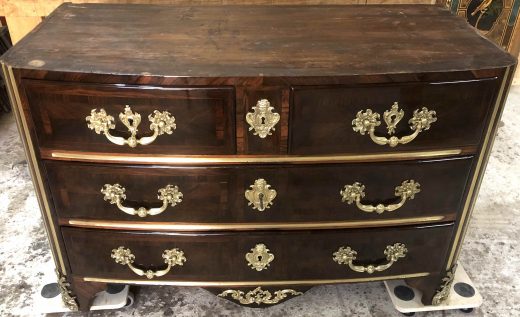
To start the year, here are some photos of the restoration of this Regency commode. Made entirely of softwood, it is veneered with kingwood. Its uprights and rails are adorned with brass fluting. The bronze handles, influenced by Asia and the East India Company trade, are commonly referred to as "Chinese." The keyhole escutcheons, meanwhile, herald the arrival of the Louis XV style in the first half of the 18th century. Upon its arrival, in addition to some missing and peeling veneer, the commode presented a problem […]

Regency chest of drawers

Ebénisterie Mathieu Vath

Originating in the late 17th century but only acquiring its name in the early 18th century, this is the first classic model of a commode. Although typically Louis XIV in style, it may not have existed before the Regency period. With rounded corner pilasters with slightly convex faces, deep copper fluting, veneer, and geometric bronze mounts, it features three rows of drawers. It perpetuates the spirit of Louis XIV furniture throughout much of the 18th century. Bibliography: Furniture […]