The varnished bronzes of the 18th centurye century: study of materials and finishing processes in the context of furniture restoration
When varnish imitates gold: a finish long overlooked
The bronzes that adorn the 18th-century furnituree In the 19th century, gilts, sabots, keyhole escutcheons, and frames were almost always referred to by a single term: "gilt bronze." This term, however, encompasses different material realities. Besides true gilding, achieved by applying an amalgam of gold and mercury, there exists another, more discreet and less frequently identified finish: varnished bronze, whose golden color comes not from gold, but from a tinted varnish applied to polished metal.
Understanding this finish, its materials and its implementation processes is a concrete challenge for the restoration of furniture: the diagnosis made on a bronze — gilded or varnished — directly conditions the choice and reversibility of the intervention.
Mercury gilding, a hallmark of the great age of bronze
The gilding known as "mercury gilding" or "ground gold" constituted, in the 18th centurye In the 18th century, gilding became the standard technique for high-quality bronzes. It involved applying an amalgam of gold and mercury to the bronze, then heating the piece to evaporate the mercury and fix the gold to the surface, before burnishing to reveal its brilliance. A costly process, dangerous for the artisans who practiced it, and demanding in terms of raw materials, it remained reserved for the most exquisite pieces: it is this expertise, cultivated by the greatest Parisian bronze workers, that Pierre Verlet documented in his seminal work on 18th-century French gilt bronzes.e century.
This technical requirement and its cost explain why part of the production, on more common pieces of furniture or on certain less visible parts of a piece of furniture, has turned to a less expensive alternative: gold varnish.
Varnish, a finish in its own right
On ancient bronzes, varnish can be applied in two very distinct ways, which should not be confused.
The first is a protective function: applied over real gilding, a colorless varnish protects the gold leaf from handling, humidity and oxidation, while slightly modulating its shine.
The second function is imitation: applied directly onto polished bronze, without any underlying gilding, a colored transparent varnish—"gold varnish"—gives the metal a hue close to that of gold, at a lower cost. This practice, long considered a phenomenon primarily linked to the industrial rise of furniture bronze in the 19th century,e century, was already used under the Ancien Régime, including on some quality furniture. Recent academic work devoted to gold varnish — notably Julie Schröter's thesis defended at the University of Paris 1 Panthéon-Sorbonne — underlines how this finish has remained absent from museum labels and the historiography of bronze furniture, even though it constitutes an integral part of the production of the period.
Recognizing varnished bronze: the challenge of diagnosis
For the restorer, distinguishing a gilded bronze from a simply varnished bronze is an essential preliminary step: it determines the very nature of the intervention.
A stripping process designed to clean genuine gilding can, if mistakenly applied to varnished bronze, irreversibly destroy a fragile organic layer—and with it, material information about the piece's manufacture and period. Conversely, an altered, yellowed, or cracked varnish can give the illusion of damaged gilding when it is actually a completely different material, requiring different treatment methods.
This observation echoes the one already made regarding wood finishes: a surface coating is never a simple aesthetic detail, it is an integral part of the object and its history.
Composition and application of varnishes
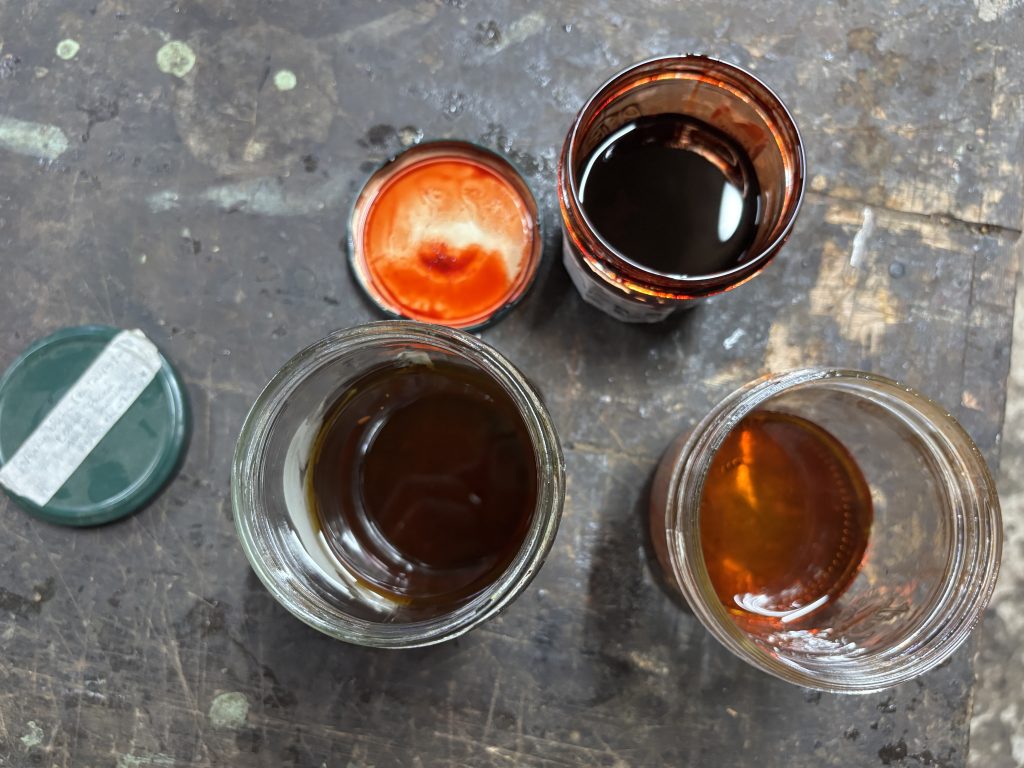
The varnishes used on bronzes, like those used on wood, are based on a natural resin — copal, sandarac, shellac or mastic depending on the recipes and the eras — dissolved in an alcoholic solvent, sometimes combined with an oil or a dye intended to bring the color of the polished metal closer to that of gold.
The application was done with a brush for flat or hard-to-reach surfaces, or with a cotton pad to obtain a more even coat on chiseled reliefs—a technique similar in principle to French polishing on wood. The quality of the result depended closely on the prior stripping of the metal, the color of the alloy itself, and the number of coats applied.
Examination and analysis methods
The identification of a varnished bronze follows the same cross-referencing approach as that applied to wood finishes: direct observation, examination under raking or ultraviolet light, stratigraphic sections when sampling is possible.
Scientific analyses allow us to go further: X-ray fluorescence reveals the composition of the alloy and the presence—or absence—of gold particles on the surface, while techniques such as gas chromatography coupled with mass spectrometry characterize the nature of the organic resin constituting the varnish. It is this combination of physical examination and chemical analysis that makes it possible to definitively distinguish between genuine gilding and imitation.
Implications for restoration
For the cabinetmaker-restorer, who works closely with bronze workers on the furniture entrusted to him, this distinction is not a simple technical curiosity: it relates directly to the ethics of conservation-restoration — reversibility, respect for the original material, refusal of restitutions based solely on appearance.
An old varnished bronze, even if altered, is not necessarily a gilding to be restored: it may be an original finish to be preserved and stabilized as such, evidence of an economic or aesthetic choice made by the workshop that produced the piece of furniture.
Within our workshop
Within our workshop, we have undertaken the work of rediscovering these 18th-century varnish recipes.e century, drawing on the works of Jean-Félix Watin and André-Jacob Roubo. This approach follows the same logic as that described above regarding wood finishes: understanding the original materials and techniques before deciding on an intervention, rather than systematically resorting to modern products.
As with wood varnishes, studying a varnished bronze means rejecting the obviousness of the first glance in order to read, beneath the color of gold, the real material of the object.
Sources
- Pierre Verlet, French gilded bronzes of the 18th centurye century, Paris, Picard, 1987.
- Julie Schröter, thesis on gold varnish on bronze furniture, University of Paris 1 Panthéon-Sorbonne.
- A.-J. Roubo, The Art of the Carpenter, Paris, Printing house of LF Delatour, 1769-1774.
- J.-F. Watin, The Art of the Painter, Gilder, Varnisher, Paris, Grangé, 1st ed. 1772.