Wax polish
Materials, techniques and uses in 18th-century veneer cabinetmakinge century
Study based on the treatise by André-Jacob Roubo, The Art of the Cabinetmaker (Third Section of the Third Part, 1774), and research work in conservation-restoration having carried out an experimental reconstruction of this finish.
The most common finish in veneered cabinetmaking
Contrary to popular belief, varnish was not the most common finish for furniture in the 18th century.e century. Roubo himself states this unequivocally, in introducing his chapter on the different polis:
«"The most common polish is that which is made with wax, [...] as it is the one most frequently used for veneered cabinetmaking."»
And he specifies, a little further on, the technical reason for this predominance: this polish is the one «"which is most commonly used in veneer cabinetmaking, because it is done completely dry, which is necessary to prevent the pieces from detaching"». On veneered furniture, glued with animal glue—which is sensitive to humidity—any finish requiring an aqueous solvent posed a risk to the adhesion of the veneered wood. Wax, applied entirely dry, eliminated this danger.
Preparation before polishing: scraping, smoothing, smoothing
Even before discussing wax, Roubo details a whole chain of preparatory operations, essential for any kind of beautiful polish:
- THE scraper, a tool with a steel blade without a bevel, which is sharpened squarely and handled obliquely along the grain of the wood to remove the last traces of the toothed plane;
- There dogfish skin, which is then used to erase the threads that the scraper could not remove;
- There horsetail (or "horsetail", horse), a rush with a naturally rough surface, which further softens the surface.
It is only once the wood is "pre-finished" - therefore perfectly flat, but with a dull appearance - that the actual polishing takes place, the only process capable of bringing back, and even brightening, the color of the wood.
The technique: the polisher and the wax
Roubo precisely describes the tool and the gesture:
«"To achieve a beautiful polish, one must use the best quality wax possible and rub it over the entire surface of the piece [...]; then it is smoothed with the polisher."»
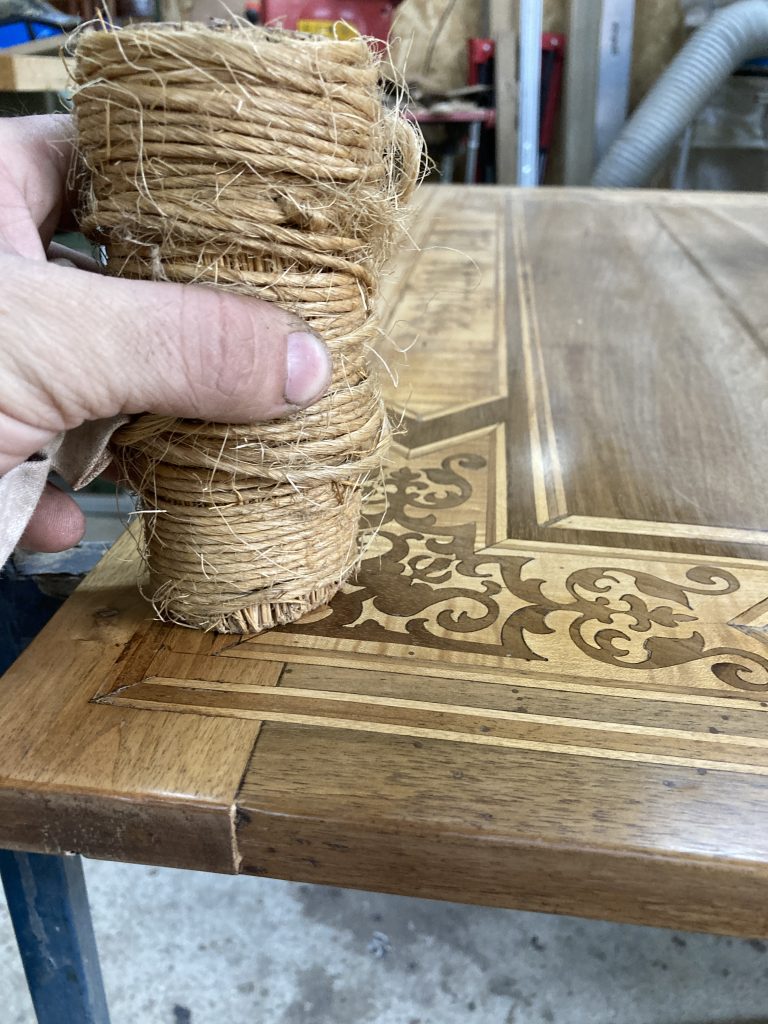
THE polisher East «"an ordinary bundle of rushes"», The wood, tightly bound along its length, is first soaked in melted wax before being rubbed on a piece of planed wood to join them. It is the friction of this polisher that heats the wax and makes it penetrate the pores of the wood.
Once the wax has been spread, it is removed with a specific tool — the wax scraper, whose edges are deliberately blunt (unlike an ordinary scraper) — then the work is finished with a scrubber Serge's contribution provides the brilliant finale. Roubo insists: well done, the work must become «"As smooth and shiny as ice cream"».
Regarding the quality of the wax itself, Roubo distinguishes between different uses: for everyday items (cabinets, chests of drawers in beech or walnut), yellow wax is mixed with a third of tallow; for fine pieces, however, «"We must use beautiful white wax."» — a distinction of quality that is rarely found in modern descriptions of this finish.
The special case of porous woods: shellac powder
For porous or strongly colored woods — rosewood, amaranth — Roubo describes an additional refinement:
«"When polishing porous or reddish woods, such as rosewood, amaranth, and others, after applying wax to these same woods, powdered shellac is sprinkled on them. When spread with a polisher, this fills the wood's cavities without staining them, while simultaneously enhancing its color."»
In other words: a layer of wax is first spread, then a resin powder (shellac, or rosin for dark woods) is sprinkled on top; the passage of the polisher — under the effect of the heat of friction — melts this powder locally, which fills the pores without leaving marks, while intensifying the color of the wood.
Roubo, however, is not without reservations about this mixed method. He notes that, if this method is «"Certainly good in many respects"», She «"It often serves to mask the flaws in the work, especially in the eyes of those who do not have a perfect understanding of it."» — a warning that clearly distinguishes the legitimate technical use of wax (protection, highlighting of veining).
Other polities
Roubo points out that wax polishing is not the only method: he also describes the common polite (wax mixed with a third tallow, applied with a hot iron, for ordinary furniture), the polished with water (with pumice stone, reserved for solid wood as moisture damages the veneer), and the polished in Tripoli, with oil or charcoal, for a more intense finish depending on the type of wood. He even recommends, for the most carefully crafted pieces, following the polish with a white varnish made from spirits of wine (sandaraque, mastic, elemi gum, spike oil), in order to permanently fix the color of the wood — a practice that directly follows the approach described in our study on antique finishes.
Wax polishing was therefore not a secondary or rudimentary finish, but rather the standard method for veneering cabinetmaking in the 18th century.e century, chosen for very concrete reasons: speed of implementation, completely dry application compatible with the fragility of glued veneers, and ability — via the addition of powdered shellac — to seal the pores of difficult woods while brightening their color.
Sources
- A.-J. Roubo, The Art of the Cabinetmaker, Third Section of the Third Part of The Art of the Carpenter, Paris, 1774 (chapter "On the manner of finishing veneered cabinetmaking, & the different kinds of polish").
- Research work in conservation-restoration which carried out the experimental reconstruction and comparative analysis of wax polishing according to Roubo.